
Jammu and Kashmir Forgeries, Reprints, Remainders and Defaced Dies
The Brighton forgeries, the engraver’s specimen book, characters beside the rivets, the defacement of 1898 and later impressions, and how to build a collection on observable evidence.
Updated June 25, 2026
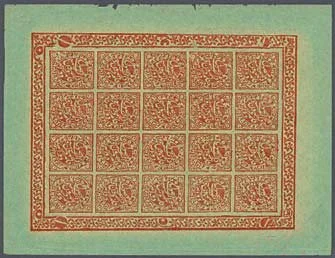
In this article
Postal closure, remainders, reprints and museum impressions all have different dates.
After the post closed
The dies and plates were defaced in February 1898. Singhee describes a few black impressions taken after the defacement and separates them from later museum impressions. A scored die impression belongs in a study collection under its real circumstances, not in a space for an issued stamp.[7]
The Brighton forgeries
The two-anna Brighton reproductions are narrower in both dimensions than the originals: measure against a reliable original, since screen scaling hides the difference. For the four- and eight-anna panes, the genuine pane has seven imitation perforation dots in the margin and the Brighton panes leave some out; that is a pane-margin test, not a rule that a single must show seven dots.
Cancellations, colours and water
Boggs records SRINAGAR SE. 4 91 on remainders and reprints of the circular and Old Rectangular issues, so that date alone proves no journey. Dawson and Smythies warn that the watercolour inks run in water; they look different on the paper from oil colour, but soaking is not a test.[K4][K6]
An engraver’s specimen book is not an issue register
Rahat Ju kept impressions from his dies and plates in a specimen book, later obtained by Masson. Séfi and Mortimer warn that Masson treated too many of them as the earliest printings, some being demonstrably later; provenance from the book proves neither a contemporary proof nor an issued stamp. The small characters beside the upper rivets of the one-anna and two-anna New Rectangular plates are, the handbook says, not to be read as Rahat Ju’s initials.[K16][K17]
Identify the handbook before using its tables
The principal handbook is by A. J. Séfi and C. H. Mortimer, The Stamps of Jammu-Kashmir, 1937. The title and publisher follow a specialist transcription, as the title leaf is missing from the scan; the year and Mortimer’s initials are confirmed in the introduction to Dawson and Smythies’s separate book of 1937, whose Lahore imprint belongs to that book, not to the stamps.[K18][K19][K16]
A practical record
Record shape, value inscription, paper, ink, plate or die features, separation and cancellation separately. Keep strips, blocks and whole cards; for covers, keep both sides and the contents, and copy indigenous calendar dates before converting them. The checklist covers issue families and values, not every plate state, shade, proof, error or forgery.[2]
What is still to be found
Rahat Ju’s rectangular engraving rests on a specialist attribution, questioned for Jammu. The engraver of the circular dies, the second New Rectangular engraver and any separate designers are unnamed, and no commission, signed design or workshop record has been seen. The 1877 iron-mine seal provisional remains contested, and a reliable catalogue crosswalk needs paper, pigment, plate and use evidence. For further reading: Séfi and Mortimer’s full handbook, and Tim Eames’s study of the papers in India Post, vol. 28 (1994), pp. 49–52.
Sources
- [2] L. E. Dawson and E. A. Smythies, The Postage Stamps of Jammu & Kashmir Simplified (1937), contents and general outline.
- [7] A. R. Singhee, “Jammu and Kashmir State Post Cards”, Postal Stationery, May–June 1989, pp.87–94; reprinted from INDIA-89, Bulletin no.2.
- [K4] Winthrop S. Boggs, Jammu and Kashmir: Notes on Their Stamps, The Stamp Specialist Blue Book, 1941, pp.46–58; online transcription with editorial corrections.
- [K6] L. E. Dawson and E. A. Smythies, The Postage Stamps of Jammu & Kashmir Simplified, 1937, pp.35–37 and appendix; online transcription.
- [K11] Christoph Gärtner, 17th auction, Indian States, 7 March 2011.
- [K16] A. J. Séfi and C. H. Mortimer, The Stamps of Jammu-Kashmir (1937), chapter IV, printed pp.19–21; introductory note, pp.3–4.
- [K17] A. J. Séfi and C. H. Mortimer, The Stamps of Jammu-Kashmir (1937), chapter VI pp.71–73 and chapter VIII pp.111–118.
- [K18] L. E. Dawson and E. A. Smythies, The Postage Stamps of Jammu and Kashmir Simplified (1937), original title page and first Introduction page.
- [K19] Collecting Kashmir, online edition of Séfi and Mortimer: contents, title and imprint.
- Collecting Kashmir, “Brighton Forgeries”: dimensions and pane-margin dots.
Notes 0
Add what you know: a cover or stamp in your collection, a date or source, a correction or a question.
No notes yet.
Sign in to add a note.
Notes show straight away. Keep them kind and about the article; anyone can report one that isn't. House rules
