
Jammu and Kashmir’s State Post, the Resident’s Dak and the 1894 Takeover
Visitors’ mail before stamps, the Resident’s Dak rules of March 1867, the half-English-postage charges, mountain routes, overseas covers and the amalgamation with the Imperial post in 1894.
Updated August 21, 2026
In this article
The state’s stamps belong to a post that existed before them and worked beside British Indian arrangements.
Before the first stamps
Bard describes a special channel for European visitors before 1866: their letters went to the state agent’s office, where the address could be transliterated for onward handling. That was different from the receipt handstamps used on residents’ mail, so a cover without a state stamp may still show state carriage. Follow the ordinary state post, the visitors’ arrangements and the Indian offices as separate institutions; a British Indian stamp on a letter from Srinagar does not prove the Indian post carried it all the way.[K1]
Three kinds of messenger
Prassoli distinguishes state messengers, messengers kept privately by senior officials, and carriers employed by merchants. State relays could change men or horses, while a private carrier might go with a letter over a much longer stretch, so an early privately carried letter need not bear the marks of the state post. His early chronology rests on diaries and later reports and has its uncertainties.[K8]
The Resident’s Dak rules
W. Wakefield reproduced seven “Kashmir Postal Rules” in Appendix VI of The Happy Valley (1879), pp. 293–294. They sent letters for Srinagar and the Valley through Marri (Murree), where a sealed bag passed to an official of the Maharaja for carriage to the civil officer at Srinagar, whose establishment sorted the mail. Letters for visitors and their followers went through that establishment; other letters went to the Maharaja’s diwan. It was a particular channel with shared handling, not the end of the State post.[K13][K2]
The notice is signed by T. H. Thornton as Secretary to Government, Punjab: he issued the notice, not the stamps. The Maharaja’s official, the civil officer and the diwan are roles in the rules, not a roster of State postal staff. Bard links the arrangement with seasonal visitors and official communication with Ladakh, keeping the documented arrangements apart from his views of their political purpose.[K13][K2]
The accounts disagree on the date of notice No. 673: Wakefield’s heading of 1879 gives 16 March 1867, Bard’s article 23 March 1867. Until the original Punjab Gazette is seen, March 1867 is the safe label.[K13][K2]
Visitors, residents and the price of a journey
Wakefield’s rules separate the two directions. Rule 5 added a charge equal to half the English postage on letters delivered at Srinagar under the arrangement. Rule 7 required outgoing covers to British territory by the Resident’s Dak to carry, besides the English postage, a Kashmir stamp worth half the English postage, the endorsement “per resident’s dâk” and the sender’s signature at the lower left. Covers that did not comply went to the diwan, to be returned to a known sender or dealt with under State rules. These rules explain mixed frankings on that class of mail; they are not a tariff for every State letter. Bard notes some concessions were already working in 1866, before the notice.[K13][K2]
Bard quotes Major Cracroft’s explanation of 1886 that visitors could pay the state delivery charge in cash to the British postmaster, and records an exceptional onward letter to Leh with a state stamp for delivery. A missing state stamp need not mean free carriage, and a state stamp does not by itself reveal the full charge. The incoming levy is described as a fee, while the outgoing rule demands a Kashmir stamp: read the direction and class of service.[K2][K13]
An actual visitor-rate cover, 1877
Christie’s records an envelope of 28 October 1877 to Amritsar bearing a vertically bisected Kashmir half anna ultramarine, paying the quarter-anna visitor’s rate, with a British Indian half anna. Both share a KASHMIR/5/L-6 duplex, and the back has an Amritsar arrival of 3 November. The rate belongs to that visitor concession, not to every letter, and the bisect is not a licence to read every bisect as postal.
For every cover, record each administration’s stamps, their total, any cash or postage-due notes, registration and the dated marks in order. An address and an arrival mark can fix the end of a journey without proving every stage between.
Routes in the mountains
The Provincial Gazetteer of 1909 describes a mountainous country where most roads were fair-weather tracks unfit for wheels. It names the cart road from Srinagar through Baramula and the Jhelum valley towards Abbottabad and Murree, and the main routes over the Banihal, Pir Panjal and Zoji La passes. That is a road description, not a postal schedule.[K14]
Later covers abroad and registered at home
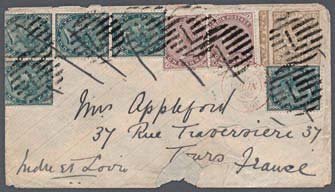
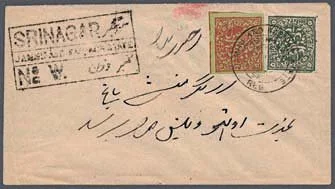
Two overseas covers carry state and British Indian stamps together, and a registered inland cover has the Srinagar registration mark and three-ring strikes. Each needs its own address, marks and dated tariff; one cover’s franking cannot supply another’s missing weight.[K11]
1894 was a postal change, not the end of the state
Singhee dates the Imperial takeover to 1 November 1894. It ended the state’s own postal system decades before the political events of 1947. Two official retrospective accounts confirm amalgamation in 1894: the Provincial Gazetteer records the transfer to the Indian postal system, and Aitchison says the arrangement was made for twenty-five years. Neither gives a day or month, so 1 November rests on Singhee. Aitchison’s mention of a draft renewal shows negotiations, not a renewal signed.[7][K14][K15]
The network after amalgamation
The Gazetteer of 1909 places the state in the postal circle of the Postmaster-General of the Punjab and North-West Frontier Province. Its table gives these figures for the years shown; its earlier entries of two post offices in 1880–81 and 1890–91 count British offices only, not the separate State service.[K14]
| Year | Post offices | Letter boxes | Miles of postal communication |
|---|---|---|---|
| 1900–01 | 81 | 199 | 1,588 |
| 1904–05 | 78 | 207 | 1,678 |
Sources
- [7] A. R. Singhee, “Jammu and Kashmir State Post Cards”, Postal Stationery, May–June 1989, pp.87–94; reprinted from INDIA-89, Bulletin no.2.
- [K1] Anthony S. Bard, “The Postal History of Jammu and Kashmir State: Visitors’ Letters 1860–1866”, Stamp Monthly, March 1982, pp. 51–53.
- [K2] Anthony S. Bard, “The Postal History of Jammu and Kashmir State: The Resident’s Dak 1867–1870”, Part One, Stamp Monthly, November 1982, pp. 85–88.
- [K8] Armando Prassoli, “Kashmir: pre-philatelic postal service”, bilingual.
- [K11] Christoph Gärtner, 17th auction, Indian States, 7 March 2011.
- [K13] W. Wakefield, The Happy Valley: Sketches of Kashmir & the Kashmiris (London: Sampson Low, Marston, Searle, & Rivington, 1879), Appendix VI, “Kashmir Postal Rules”, pp.293–294.
- [K14] Imperial Gazetteer of India, Provincial Series: Kashmir and Jammu (Calcutta: Superintendent of Government Printing, 1909), pp.71–72.
- [K15] C. U. Aitchison, A Collection of Treaties, Engagements and Sanads, vol. XII, revised and continued up to 1929 (Calcutta: Government of India, 1931), p.9.
- Christie’s, lot 1998303: visitor-rate bisect cover to Amritsar, 28 October 1877.
Notes 0
Add what you know: a cover or stamp in your collection, a date or source, a correction or a question.
No notes yet.
Sign in to add a note.
Notes show straight away. Keep them kind and about the article; anyone can report one that isn't. House rules
