
The Jammu and Kashmir Quarter-Anna Postal Card and the State’s Postmarks
The quarter-anna card of 1883 printed at the Ranbir Prakash Press: four settings, laid and wove papers, the black official card, essays and museum impressions; then seals, obliterators and the three-ring system.
Updated October 6, 2026
In this article
One basic design produced a specialist field of papers, settings and postal treatment.
A card for internal correspondence
The state’s quarter-anna card was introduced in 1883. Singhee describes a Dogri heading, a central sun and a rectangular stamp at the right with an armorial shield and supporting soldiers. The cards were larger than the British Indian card of the time, so outward cards could be treated as letters by the Imperial post: his illustrated card from Jammu to Amritsar carries a one-anna postage-due mark. The internal quarter anna did not pay the outward charge.[7]
Four settings from three parts
Singhee reconstructs the printing forme from a left text block, a right text block and the stamp die. Movement between them gave four settings: the first aligned; the next two with the left text turned and dropped; in the fourth, alignment largely restored and a circular rivet flaw below left of the sun. Compare the whole card, since cutting down to the stamp loses the setting. The dates for the changes around 1890 are his reconstruction.[7]
Papers, printer and varieties
He separates horizontal laid, vertical laid and toned white wove card. Horizontal laid cards can show part of a large Charles & Thomas sheet watermark; others show none, since a card covers only part of the sheet. All laid cards in his study are Setting I; the later misaligned and repaired settings are on wove. The cross-line spacing is about 29–31 mm on the horizontal laid and about 25–27 mm on the later vertical laid, measurements to take on the card itself. Singhee names the printer as the Ranbir Prakash Press at Jammu, and records double impressions and printing on both sides.[7]
A black card, an essay and later impressions
Black Setting IV cards on wove paper were apparently prepared for official use but not issued; Singhee knew no used example in 1989. He also discusses a hand-painted essay dated May 1892, defacement proofs of 1898 and impressions taken from museum dies in 1981, none of which is an issued card. An authentic die does not make a much later impression a postal issue.[7]
Seals, obliterators and the three-ring system
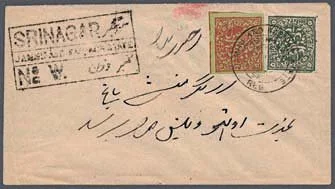
Dawson and Smythies group the markings into early seals, state-office obliterators, British Indian devices, the unified three-ring system of 1890–94 and several later special forms. Exchange-office marks such as Sialkot may help explain mail entering British India, but support a route only with the address and the rest of the cover. Their measurements describe a study, not a modern census.[K6]
| Family | What to look for |
|---|---|
| Early state seals | Separate from the later dated circles; read the whole inscription |
| State-office devices | Dogri office and calendar details may go with barred obliterators |
| British Indian marks | Read with the franking and the exchange-office evidence |
| Three concentric circles (1890–94) | State and office wording, in English and Dogri; special REG and PAR forms recorded |
Sources
- [7] A. R. Singhee, “Jammu and Kashmir State Post Cards”, Postal Stationery, May–June 1989, pp.87–94; reprinted from INDIA-89, Bulletin no.2.
- [K6] L. E. Dawson and E. A. Smythies, The Postage Stamps of Jammu & Kashmir Simplified, 1937, pp.35–37 and appendix; online transcription.
- [K11] Christoph Gärtner, 17th auction, Indian States, 7 March 2011.
Notes 0
Add what you know: a cover or stamp in your collection, a date or source, a correction or a question.
No notes yet.
Sign in to add a note.
Notes show straight away. Keep them kind and about the article; anyone can report one that isn't. House rules
