
The Common New Rectangulars of Jammu and Kashmir, 1878–1894
From circulars to the joint New Rectangulars: Rahat Ju’s plates, the Jammu and Srinagar printings, papers and sheet watermarks, printed dots and real perforations, and the black official printings.
Updated August 31, 2026
In this article
Shape, the position of the inscription and the area of use are a safer first classification than colour.
A sequence for the album
The circular dies appeared in 1866. The provincial Old Rectangulars followed, and the New Rectangulars later served the combined state. On the Old Rectangulars the value sits above the centre of the oval; on the New, below it. The values of the circulars caused a long dispute, so an old catalogue number needs its edition. The circulars include Dogri for “Post of Jammu”, and their year 1923 corresponds to 1866.[K4]
Why the Kashmir rectangles came in mixed-value plates
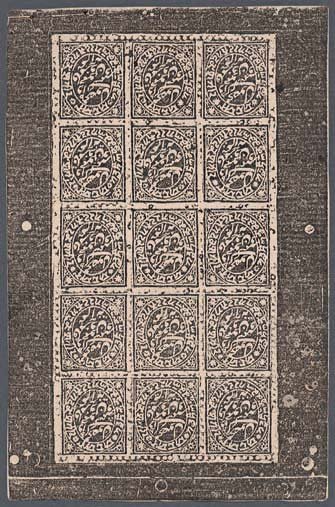
Bard describes the early Kashmir half anna and one anna as coming from one plate: twenty half-anna subjects above a row of five one-anna subjects. For the coloured printings the upper part was printed blue and the bottom row brown-orange, so a mixed-value plate does not mean a sheet in one colour. The quarter anna and two annas came from another plate with five of each; the four and eight annas from single dies.[K2]
Where the New Rectangulars were printed
The New Rectangulars were one design programme, but not one undivided printing. Séfi and Mortimer reconstruct a first period at Jammu in 1878–80, then production at Srinagar from the plates in later states, while admitting that no administrative record proves the move. Their argument rests on papers, plate states, perforation and dated use. A stamp used in one province was not necessarily printed there.[5]
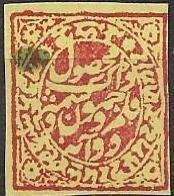
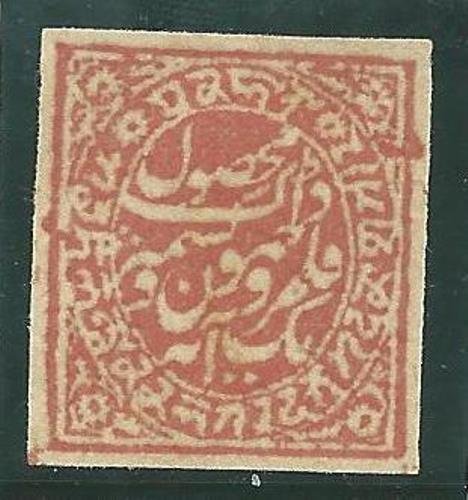
Red and orange New Rectangulars stayed in use after the later distinctive colours came in, and the authors argue some were earlier stock returned to circulation, by paper, impression and plate state. A half anna from an early plate state on a later cover needs comparing, not a new issue date. Repeated identical cancellation dates do not by themselves prove favour cancelling: registration and parcel charges could need blocks or sheets, since the highest value was eight annas. Equally, an old stamp could be cancelled later for collectors.[5]
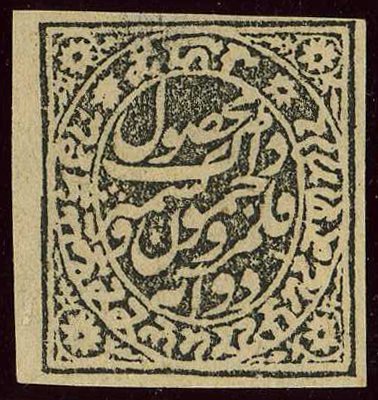
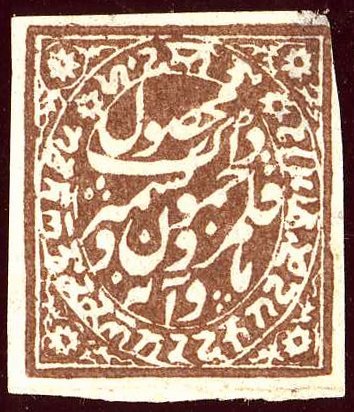
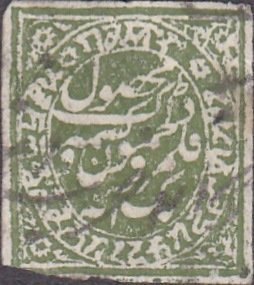
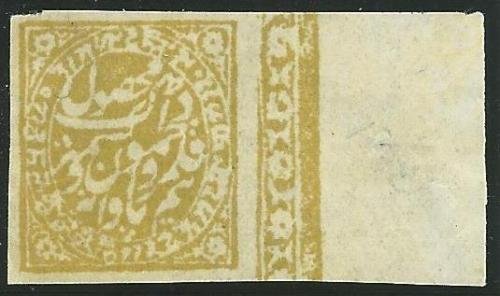
The same original stamps illustrate both these and the provincial articles where the issue and value correspond, such as the half-anna circular, the Kashmir Old Rectangulars and the early Jammu laid-paper New Rectangulars. That cannot be done for the red New Rectangulars: some Jammu and Srinagar printings need plate-state or cancellation evidence to tell apart.[K12]
Rahat Ju and the limits of a maker’s name
Rahat Ju, a seal-cutter of Srinagar, is the main named craftsman behind the rectangular stamps. Séfi and Mortimer name him on p. 19 and attribute the small Jammu composite plate to him on p. 72. They leave the engraver of the three circular dies unnamed, and assign the high-value four-anna/eight-anna composite and the unissued quarter-anna plate to another unnamed hand, on grounds of workmanship and design. The modern Collecting Kashmir study questions whether Rahat Ju made the Jammu implements, so the Jammu plate is “attributed to him by Séfi and Mortimer”.[K16][K17][K22]
Masson’s account of 1900 brings us closer: he describes Rahat Joo living near Bahuri Kadal in Srinagar, an old man who had lately cut seals for him. That is testimony near the maker, though it does not say who chose each design.[K20]
How the design was rearranged
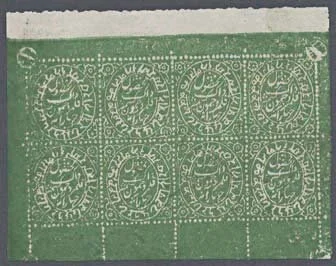
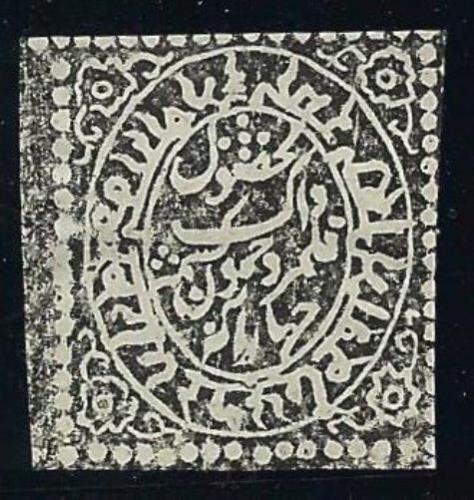
The New Rectangulars kept the double oval but rearranged the lettering and ornament. The sun emblem moved from the top of the old outer oval to small ornaments in the four corners; Dogri filled the outer oval and Persian stayed inside; the value moved to the bottom line of the inner oval. The eighth anna was written as half of a quarter anna. Each subject was engraved by hand: the handbook counts seven New Rectangular plates and 113 engraved subjects, including the twelve-subject quarter-anna plate that was never issued and the later eighth anna, so this is not seven plates in use together in 1878.[K16][K17]
Paper first, then the shade
Native paper has irregular striations; European laid paper has more regular lines. The thickness of a native sheet varies, so thickness does not date a stamp. Later two-anna New Rectangulars occur on yellow or green tinted wove. Record the colour of the paper separately from the ink, and look through the paper before naming a watermark.[K5]
Séfi and Mortimer describe large sheet watermarks, armorial designs and capital lettering, of which only fragments fall on some stamps. They concentrate on the laid papers of 1877–80 but note rare traces on wove. A stamp with no fragment visible does not prove unwatermarked paper.[K17]
Perforation
Most issues are imperforate. The early New Rectangular experiments include perforated half annas; other experiments and proofs need separate treatment. Do not soak a stamp you suspect is watercolour: the soluble ink is part of the evidence. Keep unusual margins intact.[K7][K6]
Masson credits Rahat Joo with two perforating machines, for sheets of fifteen and twenty. He describes the surviving fifteen-hole machine as a brass bed with short, unsharpened brass needles and a damaged hinged lid, which explains rough separation better than “poor workmanship”.[K21]
Printed dots are not holes
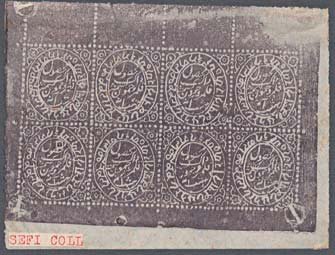
The half-anna and high-value composite plates carried rows of imitation perforation dots, part of the engraved design. On the four-anna/eight-anna plate the spaces between stamps were not cut away, so they printed as solid bands broken by dots, and a blank central row separated the two groups of eight. Sixteen stamps and four blanks matched a twenty-position perforator, and Séfi and Mortimer infer that the layout was adapted to the machine and that the dots may have been guides: their reconstruction. Record holes, printed dots and gutters separately.[K17]
Margins keep the history of the plate
The half-anna New Rectangular plate changed as it was secured and repaired. Marginal rivet impressions, controls and broken edges mark its states. Séfi and Mortimer describe a cover of January 1883 with small and enlarged rivets together, an intermediate state, and their earliest marginal evidence for the final state is dated February 1884: a first recorded example, not an official date.[5]
The printer was not one documented office
“State Printer” suggests one permanent establishment. Séfi and Mortimer print Stuart Godfrey’s recollection that printing was first done in the offices of the provincial governors of Jammu and Kashmir, his inability to prove separate establishments, and his statement that the “State Printer” had no official existence. The Ranbir Prakash Press, named for the later postal cards, should not be extended to the early stamps.[K17]
The black official printings
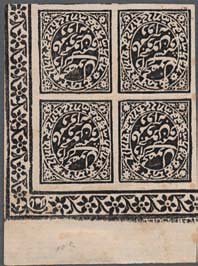
The black New Rectangular officials were printed from the regular plates; they are not coloured stamps with a SERVICE overprint. Several earlier ordinary stamps were also black, so colour alone does not make an official. Séfi and Mortimer’s first, Jammu, group has no four or eight anna from the high-value plate in its first state, and the later range of six values should not be pushed back to 1878.[6]
For the later Srinagar period their list covers the quarter, half, one, two, four and eight annas, on the papers of the respective printings. There was no issued eighth-anna official; a black trial of that value is a proof or unissued item. The rare perforated official is the half anna on laid paper, known from two covers in the Masson collection, one dated 3 September 1878 and the other 25 October without a clear year. The authors read both as black officials in a contemporary argument over very dark slate-blue ordinary stamps, an argument no colour-balanced scan can settle.[6]
Two Masson covers that seemed to carry one-anna black officials turned out to have postmarks underneath the stamps: the stamps had been added later. Loose used officials are easier to find than convincing covers, and Séfi and Mortimer infer that some black stamps served other official communications such as telegrams.[6]
Later values and colours
Sources
- [5] A. J. Séfi and C. H. Mortimer, The Stamps of Jammu-Kashmir (1937).
- [6] A. J. Séfi and C. H. Mortimer, The Stamps of Jammu-Kashmir (1937), chapter XI, “The Black Official Stamps of the New Rectangulars”, pp. 188–194.
- [K2] Anthony S. Bard, “The Postal History of Jammu and Kashmir State: The Resident’s Dak 1867–1870”, Part One, Stamp Monthly, November 1982, pp. 85–88.
- [K4] Winthrop S. Boggs, Jammu and Kashmir: Notes on Their Stamps, The Stamp Specialist Blue Book, 1941, pp.46–58; online transcription with editorial corrections.
- [K5] Collecting Kashmir, Papers: illustrated paper study, with references to Tim Eames and Séfi and Mortimer.
- [K6] L. E. Dawson and E. A. Smythies, The Postage Stamps of Jammu & Kashmir Simplified, 1937, pp.35–37 and appendix; online transcription.
- [K7] Collecting Kashmir, Perforation: illustrated experiments, proofs and recorded postal uses.
- [K11] Christoph Gärtner, 17th auction, Indian States, 7 March 2011.
- [K12] A. J. Séfi and C. H. Mortimer, The Stamps of Jammu-Kashmir (1937), chapter XVIII, pp. 300–302: the Jammu and Srinagar New Rectangular printings.
- [K16] A. J. Séfi and C. H. Mortimer, The Stamps of Jammu-Kashmir (1937), chapter IV, printed pp.19–21; introductory note, pp.3–4.
- [K17] A. J. Séfi and C. H. Mortimer, The Stamps of Jammu-Kashmir (1937), chapter VI pp.71–73 and chapter VIII pp.111–118.
- [K20] D. P. Masson, The Stamps of Jammu and Kashmir, Part I (1900), §5, pp. 16–21, in a modern transcription.
- [K21] D. P. Masson, The Stamps of Jammu and Kashmir, Part II (1901), §2, pp. 7–9, in a modern transcription.
- [K22] Carol A. von der Lin, Collecting Kashmir, “The Printing Implements”: the early period.
Notes 0
Add what you know: a cover or stamp in your collection, a date or source, a correction or a question.
No notes yet.
Sign in to add a note.
Notes show straight away. Keep them kind and about the article; anyone can report one that isn't. House rules
