
JHIND, JEEND and JEIND: Jind’s Queen Victoria Convention Overprints, 1885–1900
How British Indian stamps were overprinted in Calcutta for Jind, the curved JHIND STATE, the JEEND spelling and the reply from Calcutta, settings, inversions, trial settings and reprints.
Updated July 20, 2026
In this article
From 1 July 1885 Jind used British Indian stamps overprinted with the state’s name. The spelling changed more than once, and the printing records explain why.
Made in England, overprinted in Calcutta
Stewart-Wilson describes the chain. British Indian stamps supplied by contractors in England were sent to the Government of India Central Printing Press in Calcutta for the state-name setting. The Superintendent of Stamps and Stationery issued the stock and received the same quantity back after overprinting. A later proof procedure added a final check in the Director-General’s office. H. E. M. James signed the notice of 1885 that announced the convention; no source links him to a printing order.[117][114]
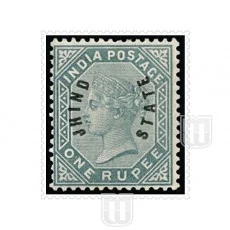
Curved JHIND STATE, then JEEND
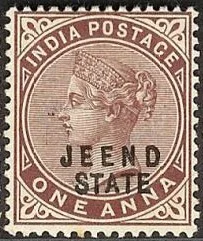
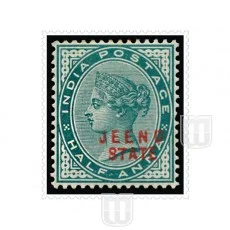
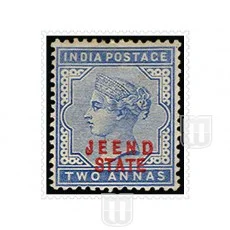
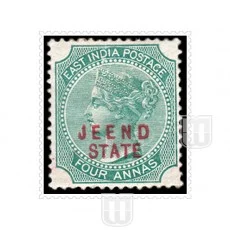
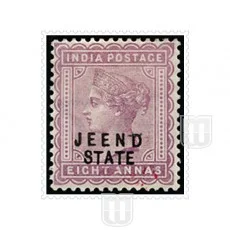
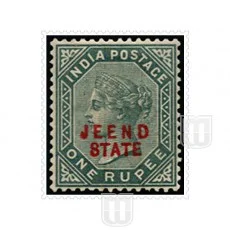
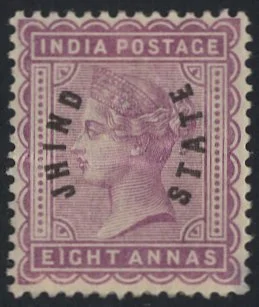
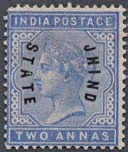
The first overprint was a curved vertical JHIND STATE, in ordinary and official versions. The curved stamps were printed before July 1885: preparation, despatch and the start of the convention are separate dates. The curved group and the horizontal JEEND STATE group that followed in the first period both ran to half, one, two, four and eight annas and one rupee for ordinary postage; the first official supplies were half, one and two annas. JEEND is a documented spelling, not a counterfeiter’s mistake.[1]
Stewart-Wilson traced the reason to an exchange of July 1885 about the spelling on postal notes: the press had been told JEEND, while other instructions said JHIND. The reply specified JHIND. Horizontal JHIND STATE printings followed, in red or black according to the issue, and the later lists add more values.[1]
The settings of type
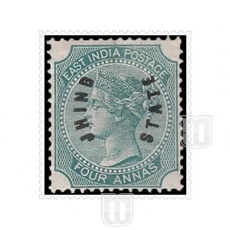
Stewart-Wilson thought the sixth, seventh and eighth Jhind printings shared one setting of type. On each sheet he found one JHIND measuring 10½ mm and another measuring 9¾ mm. In most sheets of the eleventh printing, listed as October 1897, one SERVICE measured 11½ mm, which he cautiously put down to a loose forme. He records ISERVICE once a sheet in the eighth printing and JHINDI once a sheet in the ninth. His list places the ninth printing, July 1897, before the tenth, January 1897; the dates are given here as printed. The number expected in a printing is not the number that survives.[1]
How many curved overprints were inverted?
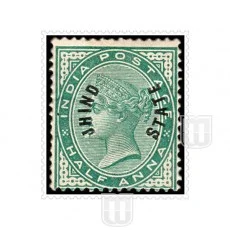
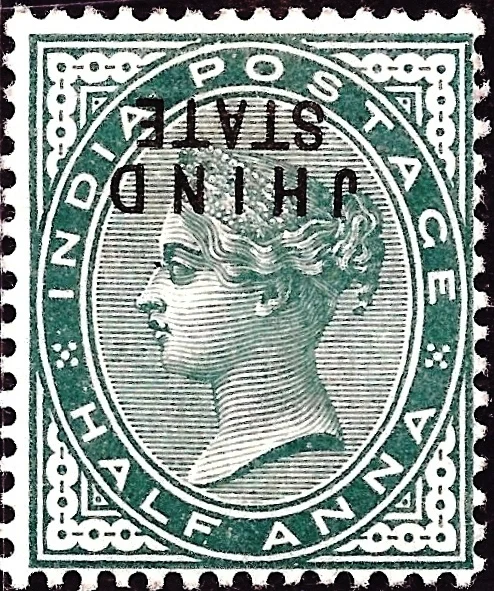
The handbook’s main text puts one reversed curved overprint in each pane of the star-watermarked stamps, two to a sheet. Its addenda add an exception: at least one ordinary half-anna sheet went through the press upside down, giving 119 reversed overprints and only one correct one in each pane. The main-text figure for the half anna is therefore not a complete count.[1]
Inversions and errors in the catalogues
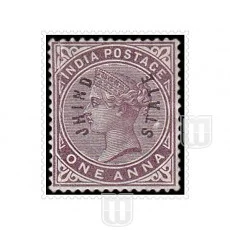
Gärtner lists the inverted curved two annas as SG 3a and the later inverted horizontal half anna as SG 17a, each with a B.P.A. certificate reported. The half anna illustrated below, from Brigadier A. P. Singh’s collection, is another copy. Spink lot 261 is a brown-purple one-anna trial printing with inverted overprint, SG 2a, with a B.P.A. certificate of 1990; Burda item 248070 is an inverted eight annas, SG 5a, with an RPSL certificate.[67][69][91][92]
The JEIND error occurs on separate values. Grosvenor lot 2866 identifies it on the red-overprinted one rupee slate as SG 16a. Feldman lot 51299 and Baldwin’s lot 138 both identify the eight annas dull mauve as SG 28a, with different certificates; Baldwin’s describes its copy as having one inked and two uninked impressions, a feature of that stamp.[72][71][70]
A trial setting is not an inversion
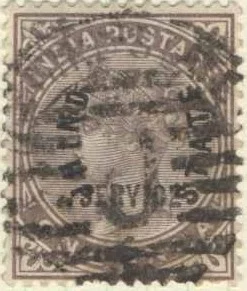
A one-anna brown-purple stamp, star watermark, perforated 14, offered as Köhler lot 10844, came with B.P.A. certificate 33,311 of 23 July 1990. The certificate calls it genuine and identifies its downward-reading overprint as coming from a trial setting. That is more precise than an auction’s “inverted overprint”, but it gives no date, press record or quantity for the trial. Since the descriptions do not show that Spink’s SG 2a and Köhler’s trial are the same stamp, they are kept apart. A downward reading alone does not make a normal inversion.[68][91]
Reprints
For the curved reprints, Stewart-Wilson describes cramped letters that make the overprint 1 to 1½ mm shorter, and says the reversed-overprint error was not reproduced. It is a useful historical test, not a complete one.[1]
Late Queen Victoria additions and the officials
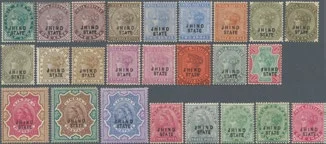
Rupee values were added to the range, and later the three pies, half anna and one anna came on new British Indian bases; the half anna of the official family changed colour in 1902. Official stamps had SERVICE added to the curved and JEEND groups and then to the JHIND STATE stamps. Keep the two state-name forms and the official overprint apart.[1]
Sources
- [1] C. Stewart-Wilson, British Indian Adhesive Stamps Surcharged for Native States, Part II: Jhind, Nabha, Patiala, Calcutta: Philatelic Society of India, 1898, Jhind chapter and addenda.
- [67] Christoph Gärtner, auction 17, Indian States, lots 1154–1155 and 1158.
- [68] Heinrich Köhler, auction 377, Indian States, lot 10844, one-anna trial overprint, with B.P.A. certificate 33,311 of 23 July 1990.
- [69] Brig A. P. Singh collection, Queen Victoria half-anna inverted JHIND STATE, SG 17a, original scan via Wikimedia Commons.
- [70] Baldwin’s, sale S24007, lot 138, Jind eight-annas JEIND, SG 28a, with B.P.A. certificate reported.
- [71] David Feldman, 2021 autumn sale, lot 51299, Jind eight-annas JEIND, SG 28a, ex Sturton.
- [72] Grosvenor, sale 126, lot 2866, Jind red-overprinted one-rupee JEIND, SG 16a.
- [91] Spink, Mulberry collection, sale 26013, lot 261, 1885 one-anna trial inversion, SG 2a.
- [92] Burda Auction 72, item 248070, 1885 eight-annas inverted overprint, SG 5a.
- [114] Postal Notice signed by H. E. M. James, Simla, 22 June 1885, reproduced in C. Stewart-Wilson, British Indian Adhesive Stamps Surcharged for Native States, Part II, Calcutta, 1898, appendix, document I, p. 123.
- [117] C. Stewart-Wilson, British Indian Adhesive Stamps Surcharged for Native States, Part I, chapter 1, 1897.
Notes 0
Add what you know: a cover or stamp in your collection, a date or source, a correction or a question.
No notes yet.
Sign in to add a note.
Notes show straight away. Keep them kind and about the article; anyone can report one that isn't. House rules
