
Jind: the Raj Press Lithographs, JHIND and JEEND, and the Convention Post
Jind printed its own stamps at Sangrur from 1874–75, then used British Indian stamps overprinted JHIND, JEEND and JIND from 1 July 1885 until 1950: the state, its rulers and its stamps.
Updated October 15, 2026
In this article
The state behind the stamp
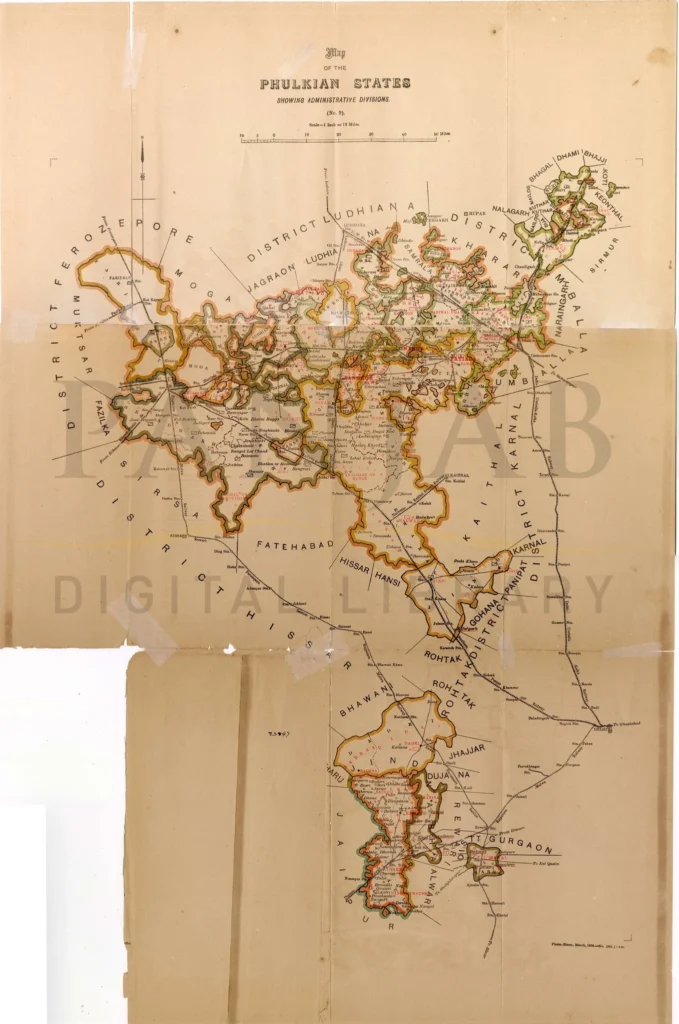
Jind was one of the Phulkian states, ruled by a Sikh family, and its territory was a set of separated tracts in the Punjab. Sangrur replaced Jind town as the capital in 1827, so a state name on a stamp is not necessarily the town where it was posted.[3]
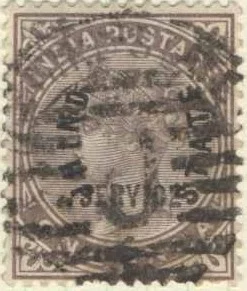
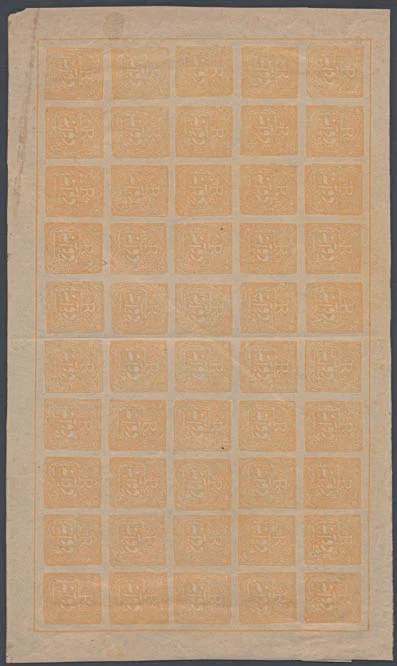
Its local stamps belong to the years before 1885, when they were lithographed at the Raj Press in Sangrur and also served fiscal purposes. From 1 July 1885 Jind was a convention state: it used British Indian stamps overprinted with its name, first JHIND and JEEND, later JIND, until its post was taken over in 1949 and its stamps ceased to be valid at the end of 1950.[2][1][45]
The rulers
A ruler’s reign and the dates a stamp was issued or valid are different kinds of evidence. The change of postal system in 1885 came under Raghubir Singh; his grandson Ranbir Singh succeeded as a minor in 1887 and received full powers in 1899.[13][3][55]
| Reign | Ruler | Note |
|---|---|---|
| 1760s–1786 or 1789 | Gajpat Singh | Took Jind and Safidon in the 1760s; recognised as Raja in 1772. Douie and the Census handbook give his death as 1789, the district history 1786; the Phulkian States Gazetteer gives 1789 in its pedigree and 1786 in its narrative |
| 1786 or 1789–1819 | Bhag Singh | Rani Sobrahi was appointed regent in 1814; Prince Pratap Singh revolted and briefly seized Jind fort; Prince Fateh Singh later ran the state in his father’s lifetime |
| 1819–1822 | Fateh Singh | Had governed for his father before succeeding |
| 1822–1834 | Sangat Singh | Succeeded as a minor; died without a son |
| 1834–1837 | Disputed succession | Settled in 1837 in favour of Sarup Singh |
| 1837–1864 | Sarup Singh | Of the Bazidpur branch; Dadri was added in his reign |
| 1864–7 March 1887 | Raghubir Singh | Ruler during the native stamps and the convention of 1885; title Raja-i-Rajagan in 1881 |
| 7 March 1887–1948 | Ranbir Singh | Succeeded his grandfather as a minor; Council of Regency until his investiture on 10 November 1899; British political adviser until 1901; Maharaja by sanad of 12 December 1911; died 31 March 1948, by a secondary account |
| 1948 | Rajbir Singh | Signed the PEPSU covenant; the Raj Pramukh took over Jind’s administration on 20 August 1948 |
Chronology
| Date | Event |
|---|---|
| 1874–1885 | Native stamps lithographed at Sangrur (Gessler); the first notices date from 1875 (Evans) |
| November 1883 | Issue statement for the first native quarter-anna postcard |
| April 1885 | Philatelic Record reports an earlier start, on the word of G. J. Hynes; not confirmed |
| 3 June 1885 | Postal convention ratified (Aitchison) |
| 22 June 1885 | Postal Notice at Simla announces the convention from 1 July |
| 1 July 1885 | First overprinted stamps; end of native postal use; the gazetteers give 15 July |
| July 1885 | JEEND or JHIND? Calcutta is told to use JHIND |
| 1893 | Jind Branch Telegraph, Maler Kotla to Sangrur |
| by 1893 | Old native stamps sold for revenue use |
| 30 January 1897 | Perforated orange quarter anna on laid paper received by the Monthly Journal |
| October 1897 | Eleventh printing, with the wide SERVICE |
| 6 September 1899 | Railway agreement providing for mail carriage |
| 10 April 1900 | Revised postal convention signed |
| 1902–1906 | Edward VII stamps typographed in London, overprinted in Calcutta |
| 1926 | Indian stamp printing moves to Nasik |
| 16 February 1927 | Jind postcards listed among Nasik products |
| late 1927 | Last recorded fiscal use of the native stamps (Warren) |
| 1 April 1929 | New British Indian inland schedule; the Jind booklet SG SB1 |
| 1932 | Dadri office list, from the statistical tables of 1933 |
| June and July 1933 | Covers to Auxerre and, by air, to Bombay |
| 20 August 1947 | JAI HIND slogan at Sangrur |
| 20 August 1948 | The Raj Pramukh takes over Jind’s administration (PEPSU) |
| 16 September 1949 | Postal takeover of Jind, Nabha and Patiala |
| 31 December 1950 | Last day of validity of Jind stamps; exchange until 31 March 1951 |
| 23 July 1990 | B.P.A. certificate 33,311 identifies a trial setting |
A closer look at the stamps
The stamps
The issues and their values, from the research checklist. Official stamps, and the shades, papers, settings and inversions of each issue, are not listed. The collector’s checklist for Jind is a separate page in this section.
| Period | Issue | Values |
|---|---|---|
| 1874 traditionally; documented 1875 | First local lithographed series | ½ anna, 1 anna, 2 annas, 4 annas, 8 annas |
| 1876 | Local series on azure laid paper | ½ anna, 1 anna, 2 annas, 4 annas, 8 annas |
| 1882–1884 | Later local designs and added quarter anna | ¼ anna, ½ anna, 1 anna, 2 annas, 4 annas, 8 annas |
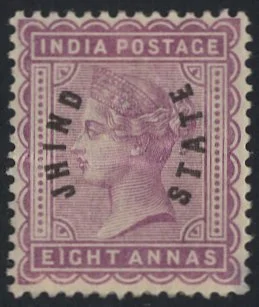
| 1885 | Curved JHIND STATE on Queen Victoria | ½ anna, 1 anna, 2 annas, 4 annas, 8 annas, 1 rupee |
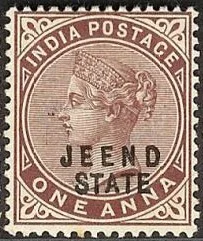
| 1885–1886 | Horizontal JEEND STATE | ½ anna, 1 anna, 2 annas, 4 annas, 8 annas, 1 rupee |
| 1886 onwards | Horizontal JHIND STATE | ½ anna, 1 anna, 1½ annas, 2 annas, 3 annas, 4 annas, 6 annas, 8 annas, 12 annas, 1 rupee |
| 1897–1904 | Late Queen Victoria additions | 3 pies, ½ anna, 1 anna, 2 rupees, 3 rupees, 5 rupees |
| 1903–1909 | Edward VII ordinary | 3 pies, ½ anna, 1 anna, 2 annas, 2½ annas, 3 annas, 4 annas, 6 annas, 8 annas, 12 annas, 1 rupee |
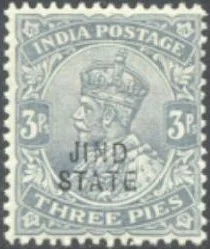
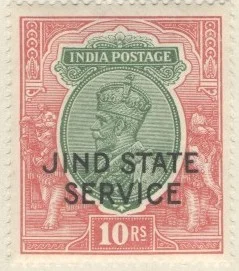
| 1913 | George V, early 1913 state-name setting | 3 pies, ½ anna, 1 anna, 2 annas, 3 annas, 6 annas |
| 1913–1927 | George V, succeeding state-name setting and additions | 3 pies, ½ anna, 1 anna, 2 annas, 3 annas, 4 annas, 6 annas, 8 annas, 12 annas, 1 rupee, 1½ annas, 2½ annas, 2 rupees, 5 rupees |
| 1922 Jind catalogue listing | George V denomination surcharge | 9 pies on 1 anna |
| 1927–1932 | George V, multiple-star watermark | 3 pies, 9 pies, ½ anna, 1 anna, 1¼ annas, 1½ annas, 2 annas, 2½ annas, 3 annas, 4 annas, 8 annas, 12 annas, 1 rupee, 2 rupees, 5 rupees, 10 rupees, 15 rupees, 25 rupees |
| 1934–1937 | George V changed types and colours | ½ anna, 1 anna, 2 annas, 3 annas, 3½ annas, 4 annas, 6 annas |
| 1937–1938 | George VI initial ordinary family | 3 pies, 9 pies, ½ anna, 1 anna, 2 annas, 2½ annas, 3 annas, 3½ annas, 4 annas, 6 annas, 8 annas, 12 annas, 1 rupee, 2 rupees, 5 rupees, 10 rupees, 15 rupees, 25 rupees |
| 1942–1943 | George VI changed overprints on 1937 stamps | 3 pies, 9 pies, ½ anna, 1 anna, 1 rupee, 2 rupees, 5 rupees, 10 rupees, 15 rupees, 25 rupees |
| 1942–1943 | George VI later low-value designs | 3 pies, 9 pies, ½ anna, 1 anna, 1¼ annas, 1½ annas, 2 annas, 3 annas, 3½ annas, 4 annas, 6 annas, 8 annas, 12 annas |
| Early 1920s base | George V Indian-produced half-anna postcard, more sharply drawn Royal Arms (postal stationery) | ½ anna · single card, ½ anna · message half of reply card |
| Early 1920s base | George V Indian-produced half-anna postcard, single counterpart to Jind CP18 (postal stationery) | ½ anna · single card |
| Early 1920s base | George V De La Rue half-anna postcards with Jind overprint (postal stationery) | ½ anna · single card, ½ anna · reply card |
| 1939 India base | George VI nine-pies solid-background postcard, JIND STATE (postal stationery) | 9 pies · single card, 9 pies · reply card |
| 1939 India base | George VI nine-pies solid-background postcard, JIND (postal stationery) | 9 pies · single card, 9 pies · reply card |
| 1941 India base | George VI nine-pies white-background postcard, JIND (postal stationery) | 9 pies · single card, 9 pies · reply card |
| 1946 provisional | George VI HALF ANNA on white-background nine-pies Jind reply postcard (postal stationery) | ½ anna on 9 pies · reply card |
| 1946 India base | George VI half-anna mauve definitive postcards with Jind overprint (postal stationery) | ½ anna · single card, ½ anna · reply card |
| Used in 1902 | Queen Victoria quarter-anna brown postcard with Jind state overprint (postal stationery) | ¼ anna · single card |
| Reported by May 1887 | Queen Victoria half-anna envelope with black two-line JHIND STATE (postal stationery) | ½ anna · envelope |
| Reported by May 1887 | Queen Victoria one-anna envelope with black two-line JHIND STATE (postal stationery) | 1 anna · envelope |
| Reported in 1885 | Quarter-anna Convention card with curved blue JHIND STATE (postal stationery) | ¼ anna · single card |
| Reported in 1885 | Quarter-plus-quarter-anna Convention reply card with curved blue JHIND STATE (postal stationery) | ¼ + ¼ anna · reply card |
| Reported in 1885 | Green half-anna envelope with curved red JHIND STATE (postal stationery) | ½ anna · envelope |
| Reported in 1885 | Brown one-anna envelope with curved silver and brown markings (postal stationery) | 1 anna · envelope |
| Reported in 1885 | Green half-anna envelope with red two-line JHIND STATE and green arms (postal stationery) | ½ anna · envelope |
Sources
- [1] C. Stewart-Wilson, British Indian Adhesive Stamps Surcharged for Native States, Part II: Jhind, Nabha, Patiala, Calcutta: Philatelic Society of India, 1898, Jhind chapter and addenda.
- [2] Henry Gessler, “Jind Cover with Dagger Cancellation”, The London Philatelist, vol.114, November 2005, pp.341–342.
- [3] Encyclopædia Britannica, 11th edition, 1911, “Jind”: separated territory, Sangrur and Ranbir Singh.
- [13] Sir James Douie, The Panjab, North-West Frontier Province, and Kashmir (1916), chapter XXVI, Jind, printed pp.276–277.
- [19] Government of Haryana, Jind district history, regency and PEPSU inauguration.
- [22] Supreme Court of India, State of Haryana v. Amar Nath Bansal, 15 January 1997, (1997) 1 SCR 262, Jind handover and PEPSU Administration Ordinance.
- [29] Punjab Government, Phulkian States (Patiala, Jind and Nabha), 1904 gazetteer, printed 1909, pp. 274–277 and 296, Jind succession, post offices and postal convention.
- [45] Ashok Kumar Bayanwala, Merger of Postal System, Jind postal takeover, reported DGPO Circular 49 and overprint validity.
- [55] C. U. Aitchison, A Collection of Treaties, Engagements and Sanads, vol. I, pp. 127–130, Jind succession and communications.
- Census of India 2011, District Census Handbook, Jind, Part XII-B, District Highlights, succession and state administration.
- Haryana District Gazetteers, Jind, pp. 26–27 and 130, regency and post offices.
Notes 0
Add what you know: a cover or stamp in your collection, a date or source, a correction or a question.
No notes yet.
Sign in to add a note.
Notes show straight away. Keep them kind and about the article; anyone can report one that isn't. House rules
