
Who made Jind’s stamps: presses, printers, postal officials and the researchers
The Raj Press at Sangrur, the Central Printing Press in Calcutta, De La Rue and Nasik, the fiscal workshop in Sangrur jail, the officials who ran the post, and Evans and Dawson.
Updated November 24, 2026
In this article
Many hands touched a Jind stamp, but almost none of them is known by name. The sources name institutions and offices, and each one did a particular job. Keeping those roles apart avoids crediting a ruler, an administrator or the printer of an Indian stamp with work they did not do.[24][126][1][127][128][129][130][131]
The native stamps: the Raj Press at Sangrur
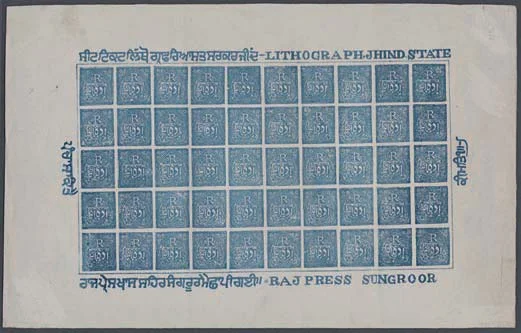
The native stamps carry the name of the Raj Press, Sungroor, in their sheet margins, and a French account of 1916 calls it the Raja’s Press at Sangrur and reads the central R of the design as Raghubir Singh’s initial. Gärtner’s sale describes a half-anna sheet with the press name in its margin and a complete lion essay sheet with a press imprint. That is evidence for the workshop. The artist, the people who prepared the transfers and whoever ordered the lion essay are not known, and Evans could only suggest wood or metal dies, or drawing straight on the stone.[115][14][24]
The convention stamps: England, Calcutta and Nasik
Convention manufacture followed a different chain. Stewart-Wilson describes British Indian stock supplied by contractors in England and sent to the Government of India Central Printing Press in Calcutta for the state-name setting; the Superintendent of Stamps and Stationery issued the stock and took back the same quantity after overprinting, and a later proof procedure added a check in the Director-General’s office. Armstrong credits De La Rue in London with typographing the Indian Queen Victoria stamps of 1900 and the Edward VII stamps of 1902, and the Central Printing Office in Calcutta with the Jhind overprints. The George V portrait came from a model by Bertram Mackennal, and from 1926 the Indian stamps were printed at the Security Printing Press, Nasik. None of these sources names a compositor or foreman for a Jind overprint, or gives the day Jind’s overprinting moved to Nasik.[117][127][128][129]
Fiscal stamping and the post
The fiscal sheets were made under treasury control: the sadr treasury sealed the paper with the lion and kept the stone seal and type, the Mohtamim watched the work, and the sadr jail at Sangrur did the lithography. The post was run first by a Munsarim attached to the Deodhi Mualla and, after 1885, by a State Postmaster-General, with the Imperial Government supplying the overprinted stamps and stationery at cost. Stewart-Wilson names one Head of Post Office, Sirdar Shamsher Singh, without dates. H. E. M. James signed the notice that brought the convention into force.[130][1][114]
The researchers
E. B. Evans studied both the native adhesives and the native cards, and changed his mind about the later stones as he saw more sheets. L. E. Dawson’s articles in the Philatelic Journal of India and The Philatelist (1965) reconstruct the stones and the quarter-anna sheets, but much of his text reproduces Evans and is not a separate witness. Stewart-Wilson, writing in 1898 from official records, gives the convention printing lists.[24][131][132][15][126][1]
| Person, institution or office | Role | What it does not show |
|---|---|---|
| Raj Press, Sungroor | Named in the native stamps’ margins | No designer, die material or engraver |
| E. B. Evans | Studied the native stamps and cards; proposed how they were made | Not a maker |
| L. E. Dawson | Later investigator; partly reproduces Evans | Not independent evidence of production |
| Sirdar Shamsher Singh | Head of Post Office in 1898 | No tenure dates; no part in making stamps |
| De La Rue, London | Typographed the Indian stamps of 1900 and 1902; supplied the 1911 George V low values | Not the printer or designer of the Jind overprints |
| Central Printing Office, Calcutta | Applied the Jhind overprints | No compositor or engraver named |
| Bertram Mackennal | Modelled the George V portrait on the Indian one anna | Not a designer of the Jind overprint or frames |
| Security Printing Press, Nasik | Printed the Indian stamps from 1926; made Jind postcards by 1927 | No exact date for the move of Jind overprinting |
| Mohtamim | In charge of fiscal stamping | No personal name; no postage work |
| Sadr treasury | Sealed and counted fiscal paper; kept seal and type | No postage work |
| Sadr jail, Sangrur | Lithographed fiscal sheets; printing among its industries | Not shown to have printed postage stamps |
| Munsarim, Deodhi Mualla | Ran the state post offices before 1885 | No personal name |
| State Postmaster-General | Ran the state offices after 1885 | No personal name |
| Imperial Government | Supplied overprinted stamps and stationery at cost | Not a named maker |
Sources
- [1] C. Stewart-Wilson, British Indian Adhesive Stamps Surcharged for Native States, Part II: Jhind, Nabha, Patiala, Calcutta: Philatelic Society of India, 1898, Jhind chapter, printing lists and addenda.
- [14] Christoph Gärtner, 17th auction, 7 March 2011, India and Indian States.
- [15] L. E. Dawson, “Indian Feudatory States—IV: Jind”, The Philatelist, July 1965, pp.222–225.
- [24] E. B. Evans, “The Stamps of Some of the Native States of India—Jhind”, Stanley Gibbons Monthly Journal, December 1903, January and March 1904, pp. 116–119, 146–149 and 192–195.
- [114] Postal Notice signed by H. E. M. James, Simla, 22 June 1885, reproduced in C. Stewart-Wilson, British Indian Adhesive Stamps Surcharged for Native States, Part II, Calcutta, 1898, appendix, document I, p. 123.
- [115] Le Collectionneur de timbres-poste, 1916, Jhind entry, printed p. 6.
- [117] C. Stewart-Wilson, British Indian Adhesive Stamps Surcharged for Native States, Part I, chapter 1, 1897.
- [126] L. E. Dawson, “The Stamps of Jind”, Philatelic Journal of India, articles reproducing E. B. Evans.
- [127] D. B. Armstrong, Twentieth Century Colonials, Jhind, Gibbons Stamp Weekly.
- [128] The Postage Stamp, 30 December 1911, p. 166, India chronicle.
- [129] Indian Postage Stamp Centenary 1854–1954, Souvenir Album, explanatory p. 2.
- [130] Punjab States Gazetteers, Volume XVII.A, Phulkian States: Patiala, Jind and Nabha, 1904.
- [131] E. B. Evans, “The Post Cards of Jhind”, Stanley Gibbons Monthly Journal, 29 April 1893, p. 194.
- [132] E. B. Evans, “The Post Cards of Jhind, Native Issues”, Stanley Gibbons Monthly Journal, 31 July 1893, vol. IV, pp. 29–31.
Notes 0
Add what you know: a cover or stamp in your collection, a date or source, a correction or a question.
No notes yet.
Sign in to add a note.
Notes show straight away. Keep them kind and about the article; anyone can report one that isn't. House rules
