
Jind’s Stamps on Petitions and Receipts: the Fiscal Boundary and the Lion Design
Why a used Jind native stamp may record a petition or a treasury receipt rather than a letter, how fiscal sheets were made in Sangrur jail, and the walking-lion essay.
Updated September 12, 2026
In this article
Stewart-Wilson noted that some of the older Jind designs later served for court fees and receipts. A genuine state impression of an original design does not by itself prove postal use.[2]
A stamp could pay a petition
Dawson’s study of 1965, drawing on Stewart-Wilson’s account of 1898, describes petitions that needed eight annas in stamped paper or adhesive stamps. A petition sent through the state post also paid for its carriage: half an anna for the letter and four annas for registration. The petition duty and the postage were separate payments.[15]
The same stamps were used on receipts for money paid out of the state treasury. A used high value may therefore record a fiscal transaction, not a heavy letter, and even a postal-looking cancellation cannot tell us what the missing document was. Dawson read one eight-anna multiple as a receipt; that is his explanation of one object, not a rule. A complete petition, receipt or cover keeps the evidence that a loose stamp has lost.[15]
The end of native postal use
Evans dates the end of native postal use to 1 July 1885, when the convention stamps came in. Collectors had once assumed the native designs carried on for internal letters, and so mixed later fiscal material into postal lists. A later state product can be a genuine fiscal without being a genuine postal issue.[8]
No perforated native stamp had been reported before the end of the postal period. Perforated copies reached the journals only afterwards, some of them old stock put through a machine. Evans doubted that they were ever valid for postage, and a cancellation cannot settle it, since it may be fiscal or applied as a favour. He also recorded fraudulent envelopes and a wrapper reported in 1878–79, quite separate from the genuine postcards.[8]
In his continuation of March 1904 Evans reports that the state postmaster had confirmed the sale of old stamps for revenue use by 1893. He quotes Stewart-Wilson’s observation that the post office cancelled stamps on petitions, even when no postage was represented. A whole cover, with its markings and the instructions of its time, is far stronger evidence of postal carriage than a loose cancelled stamp.[24]
John Warren’s exhibit synopsis of 2025 traces fiscal use of the stamps to late 1927. An original withdrawal order or securely dated late revenue documents would confirm that end date.[121]
A wrapper that was not issued
Pemberton’s handbook of 1878 lists a wrapper of uncertain value under Rampour, the name early philatelic reports used for the Jhind designs. Evans later identified a wrapper announced in 1878 as a fictitious issue. No native wrapper should be listed as issued stationery without an authenticated surviving example.[53][24]
How fiscal sheets were made in Sangrur jail
The Phulkian States gazetteer, compiled in 1904 and printed in 1909, describes a controlled process for Jind’s fiscal stamped sheets. The paper was first marked on the back with a lion seal in the sadr treasury, counted, and handed to the Mohtamim in charge of stamping. The sheets were soaked in water and the coat of arms lithographed on their face in Sangrur’s sadr jail, in his presence. The stone seal and type were kept in the treasury when not in use.[130]
Fiscal stamps with red arms served criminal cases; blue arms served civil suits and non-judicial uses. The gazetteer lists one stamp vendor each at Safidon, Balanwali and Kularan and two each at Sangrur, Jind and Dadri, nine vendors in six towns; these were fiscal vendors, not post offices. Its list of jail industries mentions printing, without naming any stamp. The account describes fiscal sheets and points elsewhere for postage stamps; it does not make the jail, or the Punjab Government Press that printed the gazetteer, the maker of the native postage stamps, and it does not date a change in 1909.[130]
The walking lion
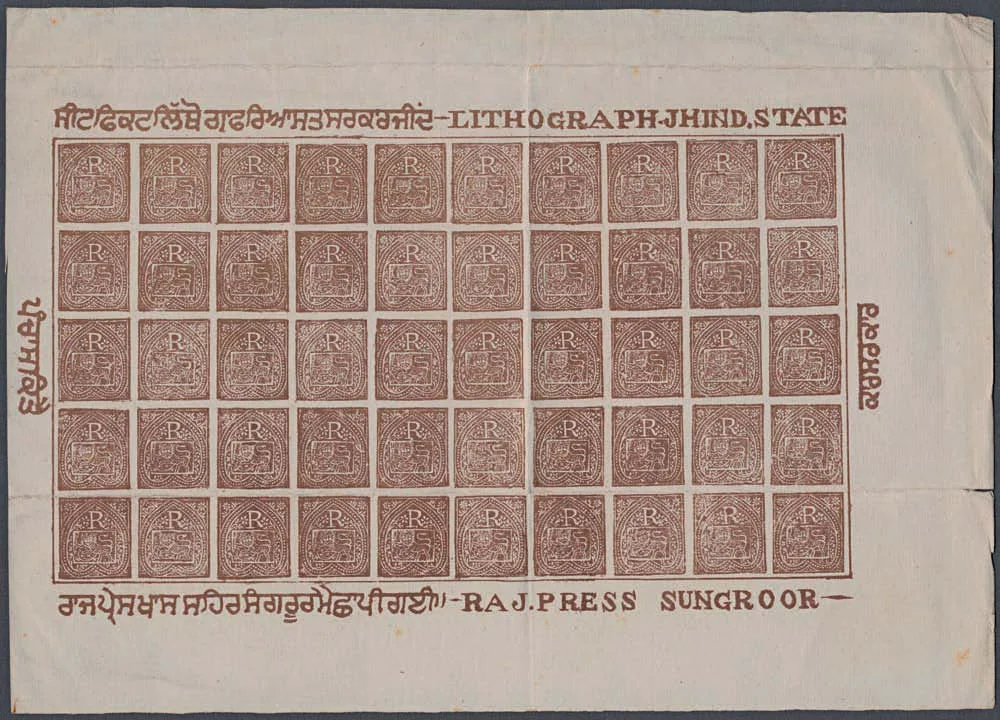
Dawson records brown impressions on azure laid paper with a walking lion in the value space, and wording he took to mean official correspondence. He knew no used copy. This is prepared or proposed material, not an issued native official set. Gärtner’s sale describes a complete lion sheet with a press imprint as an essay of 1876.[15][14]
The convention officials of later years are quite different: British Indian stamps overprinted with the state name and SERVICE. The lion design, a native stamp in fiscal use and a convention official should never share one heading for official stamps.[15]
Sources
- [2] Henry Gessler, “Jind Cover with Dagger Cancellation”, The London Philatelist, vol.114, November 2005, pp.341–342.
- [8] E. B. Evans, “The Stamps of Some of the Native States of India—Jhind”, Stanley Gibbons Monthly Journal, 31 December 1903, p.117.
- [14] Christoph Gärtner, 17th auction, 7 March 2011, India and Indian States.
- [15] L. E. Dawson, “Indian Feudatory States—IV: Jind”, The Philatelist, July 1965, pp.222–225.
- [24] E. B. Evans, “The Stamps of Some of the Native States of India—Jhind”, Stanley Gibbons Monthly Journal, January and March 1904, pp. 146–149 and 192–195.
- [53] Edward L. Pemberton, The Stamp Collector’s Handbook, 1878, pp. 177–178, contemporary wrapper listing under Rampour.
- [121] John Warren, The Indian Feudatory State of Jind, NAPEX 2025 exhibit synopsis.
- [130] Punjab States Gazetteers, Volume XVII.A, Phulkian States: Patiala, Jind and Nabha, 1904.
Notes 0
Add what you know: a cover or stamp in your collection, a date or source, a correction or a question.
No notes yet.
Sign in to add a note.
Notes show straight away. Keep them kind and about the article; anyone can report one that isn't. House rules
