
Jind: the State Post, Its Offices and the Postal Convention of 1885
Jind’s own post before 1885, the convention with the Imperial post that began on 1 July 1885, the revised convention of 1900, and the offices of the state from Sangrur to Dadri.
Updated October 3, 2026
In this article
Jind was a Phulkian state of separated tracts in the Punjab, with Sangrur as its capital from 1827. Its post moved from a purely local service to a convention with the Imperial post in 1885, and the offices that served the state kept changing until the post was taken over in 1949.[3]
The state post before the convention
The Phulkian States Gazetteer records eight Jind State post offices before 1885, among them Sangrur, Jind, Safidon, Dadri and Badhara. British post offices also worked at Jind and Dadri. The gazetteer records that Jind stamps and postcards were used within the state.[29]
The same gazetteer describes how the post was managed. Before 1885 the state offices came under a Munsarim attached to the Deodhi Mualla; later they were run by a State Postmaster-General, and the Imperial Government supplied the overprinted stamps, postcards and envelopes at cost price. These are administrative titles and a supply arrangement. The passage does not name a postmaster or a local maker of the convention stamps.[130]
Stewart-Wilson’s Jhind chapter of 1898 names Sirdar Shamsher Singh as Head of Post Office. He was a postal official, not a designer, engraver or printer, and the handbook gives no dates for his tenure.[1]
The convention: ratified in June, in force from 1 July 1885
Aitchison’s treaty compilation records the Viceroy’s ratification of Jind’s postal convention, No. XI, on 3 June 1885, although Aitchison’s own narrative of Jind gives 1884. A Postal Notice dated 22 June 1885 at Simla, signed by H. E. M. James and reprinted in Stewart-Wilson’s appendix of 1898, announces that the Nabha and Jhind conventions come into force on 1 July 1885. Stewart-Wilson, Evans and StampWorld all date the first Jind overprinted stamps to that day.[56][114][1][103]
Two other dates must be kept apart. The Phulkian States and Bhiwani gazetteers give 15 July 1885 for the convention, and the reason for their later date has not been found. And the Philatelic Record of April 1885 reported, on the word of Assistant Director-General G. J. Hynes, that overprinted Indian stamps had come into use on the first of that month; its May issue spoke of the Jind and Nabha supplies in the future tense. The April report is a contemporary statement that conflicts with the official notice; it does not show that the stamps were used in April.[29][30][100]
In his account of the common convention terms, the postal official Geoffrey Clarke separates inland mail, which could be paid with the state-overprinted stamps, from foreign mail, which needed ordinary Imperial postage without the overprint. The terms covered registered mail, insured articles, parcels and money orders.[26][27][28]
Exchange offices: Ambala and Sangrur
After the convention, both the Phulkian States Gazetteer and the Bhiwani district gazetteer name the Imperial post office at Ambala and the State post office at Sangrur as the exchange offices for items that needed accounts. The Bhiwani gazetteer also records the overprinted stamps and stationery supplied to Jind at cost, and identifies Charkhi Dadri as a head office and Badhara as a branch office in an account whose date has not been fixed.[29][30]
The revised convention of 1900
Jind signed a revised postal convention on 10 April 1900. The Government of India’s compilation prints the Patiala counterpart in full and calls Jind’s agreement similar. In the Patiala text the Indian Postal Guide governed exchanges, selected exchange offices handled insured and value-payable articles and money orders, and Article 5 capped the state’s charges at Imperial rates. Jind’s own instrument would show any local differences, including its exchange offices.[56]
The revision did not lift the rule on outgoing foreign mail. In the Patiala form, Article 15 required Imperial stamps without the state name, and Article 4 recognised the overprinted stamps only for inland mail posted within the state. That text, published in the compilation of 1931, is a dated comparison; it does not prove which instructions applied to a cover from Sangrur to Auxerre in June 1933.[56]
The Postal Guide of 1907
The Indian Postal Guide of October 1907 names Jhind among the states with separate postal offices under convention. Its Section VII applies Indian inland rates and rules to mail exchanged in either direction between Imperial and convention-state offices, registered, insured and value-payable articles included. Overprinted stamps, cards and embossed envelopes could pay for mail posted in the state for British India, but not for items posted at an Imperial office or letter box.[79]
The Guide’s directory lists the local Jind offices, among them Jhind, Baund and Kalwa, as offices outside the control of the Imperial post to which mail could still be prepaid with Imperial stamps. It marks with an asterisk places that also had an Imperial office: Dadri and Julana are two such Jhind entries. A town name alone therefore cannot tell which administration handled an item; the office, cancellation, stamps and date must be read together.[79]
Offices in the Jind and Dadri districts
The Jind district gazetteer records a head office at Jind in the early twentieth century, with a sub-office at Safidon and a branch at Julana, and mentions Narwana and its branches in its district-wide account. The former district included territory from more than one princely state.
For the Dadri area the Bhiwani District Gazetteer gives two dated lists. Charkhi Dadri was the head office in both. Some sub-offices and branches opened and others closed between them; the exact dates are not known.[30]
| Year | Head office | Sub-offices | Branch offices |
|---|---|---|---|
| 1913 | Charkhi Dadri | Badhara, Kaliana, Baund Kalan | Jhojhu Kalan, Chhapar, Imlota |
| 1932 | Charkhi Dadri | Mandi Dadri, Kaliana, Baund Kalan, Badhara | Jhojhu Kalan, Manheru |
The 1932 list is taken from table 31 of the Jind State Statistical Tables, 1933. Pakistan’s National Archives holds two copies of volume XLIII (506/36), and the Chughtai Public Library catalogues its Lahore printing of 1934. The full table would extend the list beyond Dadri.[30][98][99]
Telegraph and railway
The Jind Branch Telegraph agreement of 1893 provided for a line from Maler Kotla to Sangrur, built at Jind’s cost and worked by the Government of India’s Telegraph Department. Clause 20 of the agreement for the Ludhiana–Dhuri–Jakhal railway, effective from 6 September 1899, required the North Western Railway to carry mail when called upon. Both describe means of carriage; a cover’s actual journey still has to be read from its dated transit marks.[56]
Roads, sand and ferries
The gazetteer’s page on the post also describes the country: unmetalled roads that were difficult in the rains around Jind and Sangrur, drifting sand in Dadri and Balanwali, and seasonal ferries at Usmanpur and near Nanhera on the Kaithal road. This is the background to the service, not the route of any particular letter.[130]
Maps
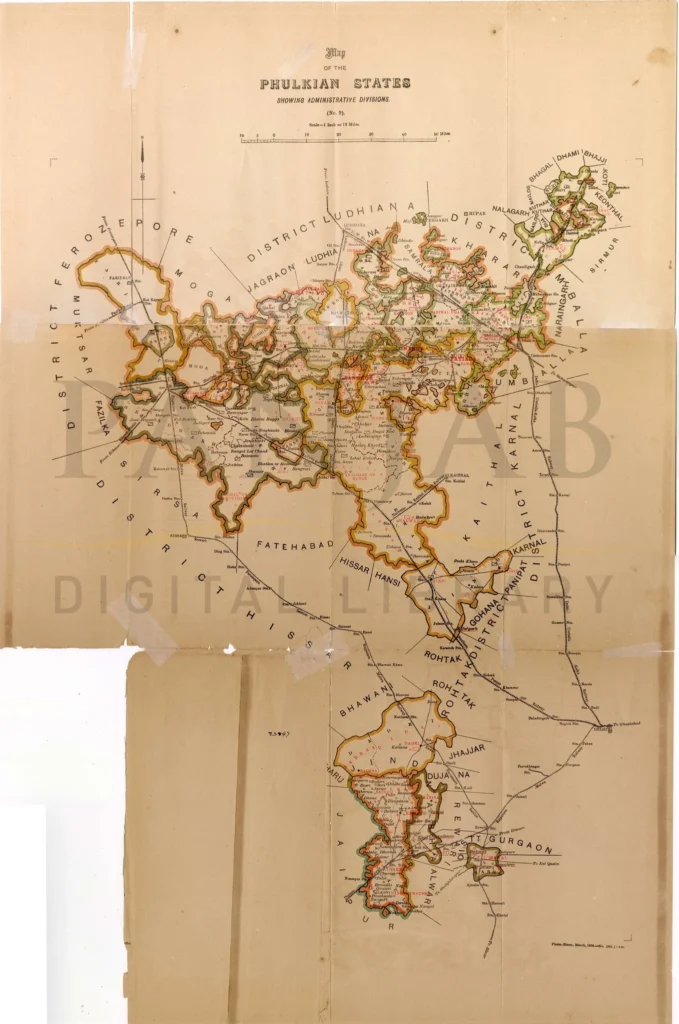
The 1909 map of the Phulkian States shows Jind’s separated territories with their administrative divisions and railways. Several Survey of India sheets give more local detail: sheet 44/N/8 of 1913 (Ludhiana district with parts of Jind, Nabha and Patiala) at Deccan College; the preliminary Ambala sheet 53B of 1910, registered in 1909, with hand-coloured boundaries, at the British Library; sheets 44 P/15 (1918) and 44 N/12 (1920) under Jind State in the Block 44 inventory; and sheet 53 C/S.E. of 1921, Karnal & Rohtak Districts & Jind State, at the American Geographical Society Library. None of them traces a postal route.[77][48][96]
Sources
- [1] C. Stewart-Wilson, British Indian Adhesive Stamps Surcharged for Native States, Part II: Jhind, Nabha, Patiala, Calcutta: Philatelic Society of India, 1898, Jhind chapter and addenda.
- [3] Encyclopædia Britannica, 11th edition, 1911, “Jind”: separated territory, Sangrur and Ranbir Singh.
- [26] C. U. Aitchison, A Collection of Treaties, Engagements and Sanads, vol. IX, p. 91, ratification notice for the Jind postal convention.
- [27] Geoffrey Clarke, The Post Office of India, chapter XII, pp. 114–115, common convention terms.
- [28] Spink, Mulberry Collection, sale 26013, lot 261, first convention one-anna attributed to 1 July 1885.
- [29] Punjab Government, Phulkian States (Patiala, Jind and Nabha), 1904 gazetteer, printed 1909, pp. 274–277 and 296, Jind succession, post offices and postal convention.
- [30] Haryana District Gazetteers, Bhiwani, Communications chapter, post offices and exchanges.
- [48] Survey of India Block 44 scan inventory (Zenodo): 1918 Jind sheet 44 P/15 and 1920 Jind sheet 44 N/12.
- [56] C. U. Aitchison, A Collection of Treaties, Engagements and Sanads, vol. I (1931), nos. XI, XX, XLVIII and XLIX, pp. 176–180, 201–205 and 270–281.
- [77] British Library, Survey of India preliminary Ambala sheet 53B, 1910, IOR/X/9051/53B 1910.
- [79] Indian Postal Guide, Calcutta, October 1907, clauses 256–258, 267, 309 and 334–337, and the directory of offices.
- [96] Survey of India, Karnal & Rohtak Districts & Jind State, Punjab, sheet 53 C/S.E. (1921), American Geographical Society Library catalogue record.
- [98] National Archives of Pakistan, gazetteer holdings, entry 48, Jind State Statistical Tables, vol. XLIII, two copies, reference 506/36.
- [99] Chughtai Public Library, Jind State Statistical Tables, 1933, Punjab State Gazetteers vol. XLIII, printed at Lahore in 1934, catalogue no. 3173.
- [100] The Philatelic Record, vol. VII, April 1885, no. 75, p. 54, Jhind notice attributed to G. J. Hynes. Compare May 1885, p. 74.
- [103] StampWorld, Jind postage 1885–1889, first ordinary group, rows 1–6, dated 1 July 1885.
- [114] Postal Notice signed by H. E. M. James, Simla, 22 June 1885, reproduced in C. Stewart-Wilson, British Indian Adhesive Stamps Surcharged for Native States, Part II, Calcutta, 1898, appendix, document I, p. 123.
- [130] Punjab States Gazetteers, Volume XVII.A, Phulkian States: Patiala, Jind and Nabha, 1904.
- Haryana District Gazetteers, Jind, pp. 26–27 and 130, regency and post offices.
- Survey of India, 1913 sheet 44/N/8, Deccan College Maps & Atlases catalogue.
Notes 0
Add what you know: a cover or stamp in your collection, a date or source, a correction or a question.
No notes yet.
Sign in to add a note.
Notes show straight away. Keep them kind and about the article; anyone can report one that isn't. House rules
