
Jind 1947–1951: PEPSU, the Postal Takeover and the End of the Overprints
The JAI HIND slogan of August 1947, Jind’s merger into PEPSU in 1948, the postal takeover of 16 September 1949 and the validity of Jind stamps to 31 December 1950.
Updated June 20, 2026
In this article
The end of Jind as a state and the end of its post were separate events, more than a year apart.
1947
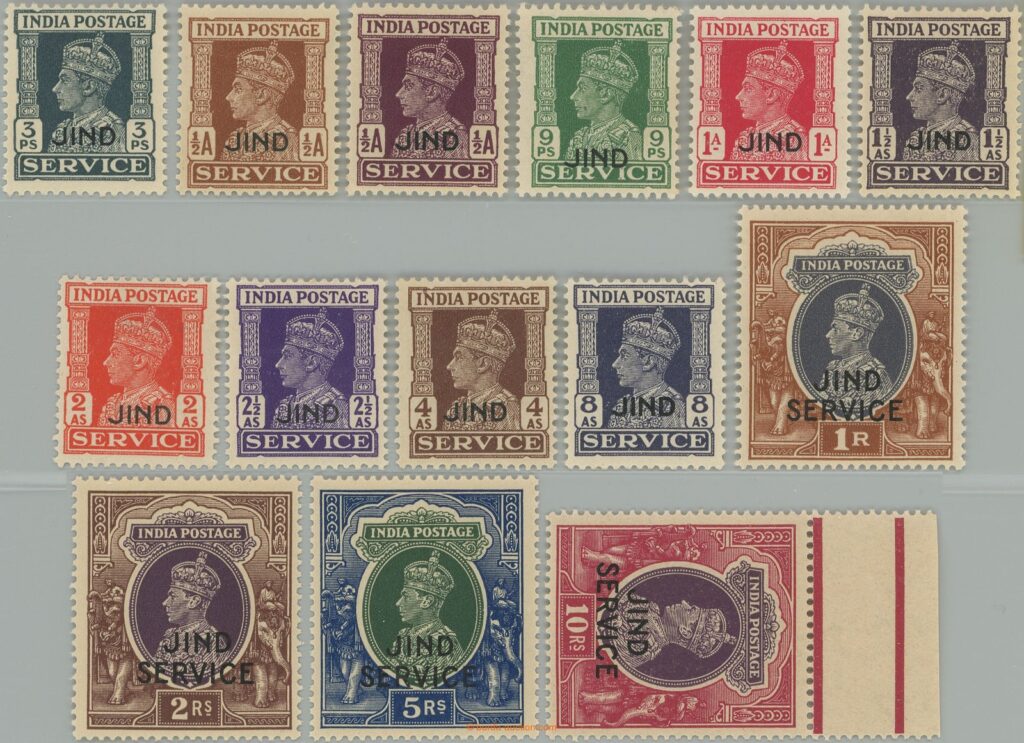
Bayanwala records a JAI HIND slogan, 63 × 14 mm, used at Sangrur on 20 August 1947. A Gärtner lot describes an invitation and service cover of 1947 for a diamond jubilee, sent from Sangrur to Delhi with George VI one anna and 1½ annas overprinted JIND, a jubilee cachet and Delhi delivery marks.[76][67]
PEPSU, 1948
Rajbir Singh signed the covenant of the Patiala and East Punjab States Union as Maharaja of Jind, and the union was inaugurated on 15 July 1948. The Supreme Court records that the Raj Pramukh took over Jind’s administration on 20 August 1948 and promulgated PEPSU Administration Ordinance No. 1 that day.[19][20][21][22]
The postal takeover, 1949
Ashok Kumar Bayanwala dates the postal takeover of Jind, Nabha and Patiala to 16 September 1949, citing Director General of Posts and Telegraphs Circular 49 of 28 November 1949. This is a different event from the civil transfer of August 1948.[45]
How long the stamps stayed valid
Bayanwala gives 30 April 1950 as a first deadline, then cites Postal Notice 20 of 26 June 1950 extending validity to 31 December 1950, with exchange until 31 March 1951; his paragraph follows his account of Gwalior and refers to the overprinted stamps together. Gledhill quotes Stanley Gibbons giving 1 January 1951 as the first day of invalidity for all five convention states, and the National Postal Museum gives the same end. Madhukar and Savita Jhingan include Jind by name among the states whose stamps were valid to 31 December 1950, with exchange to 31 March 1951. The notice itself would show how it treated the stationery, and a legible late cover would show practice.[45][61][44][64]
Sources
- [19] Government of Haryana, Jind district history, regency and PEPSU inauguration.
- [20] Government of India, White Paper on Indian States (1950), printed p. 273, PEPSU covenant signatures.
- [21] Government of India, White Paper on Indian States (1948), PEPSU covenant Article VI.
- [22] Supreme Court of India, State of Haryana v. Amar Nath Bansal, 15 January 1997, (1997) 1 SCR 262, Jind handover and PEPSU Administration Ordinance.
- [44] Smithsonian National Postal Museum, Convention States, Jind entry with narrative credited to Linn’s Stamp News.
- [45] Ashok Kumar Bayanwala, Merger of Postal System, Jind postal takeover, reported DGPO Circular 49 and overprint validity.
- [61] A. C. Gledhill, “Postal Stationery of the Indian Convention States: A Surprising Finale”, The Philatelist, February 1968, p. 146.
- [64] Madhukar and Savita Jhingan, “Demonetization of India’s Stamps”, Stamps of India Collectors Companion, no. 511, February 2012.
- [67] Christoph Gärtner, auction 17, Indian States, lots 1154–1155 and 1158.
- [76] Ashok Kumar Bayanwala, Indian Postal History 1947–1997, part 2, table of JAI HIND slogan markings.
Notes 0
Add what you know: a cover or stamp in your collection, a date or source, a correction or a question.
No notes yet.
Sign in to add a note.
Notes show straight away. Keep them kind and about the article; anyone can report one that isn't. House rules
