
Portuguese India: the Crown Issues and the Surcharges of 1881–1883
A Crown design shared across the colonies became a distinctive Portuguese India field through new values and repeated changes of value.
Updated October 26, 2026
In this article
The Crown arrives
The Crown keytype joined the Portuguese India sequence in 1877. The design belonged to the wider Portuguese colonial system; INDIA PORTUGUEZA identified the territory, and CORREIO and the value tablet carried the postal information around the emblem. Similar designs from another colony are not the same catalogue entries.[1][2]
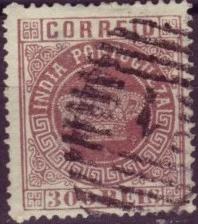
The 300-réis stamp shown here shows how a high value fits the same layout as a low one. Start with the inscription and the printed value, then look at any added value and the cancellation. The shared imperial design is the framework; paper, perforation, colour and local changes make up the detailed study.[1][2]
New units change the reading
The later scale of twelve réis to one tanga and sixteen tangas to one rupia changed the values needed at the counter. An old réis value with a new tanga surcharge is not read by adding the two figures: the new value replaces the old one.[3][2]
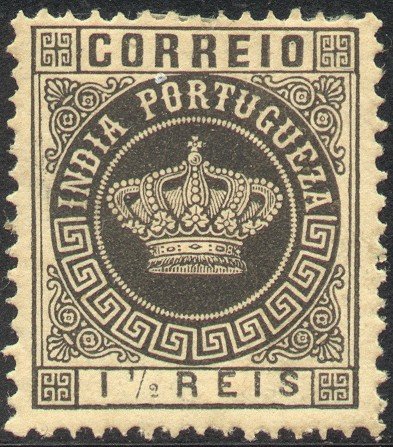
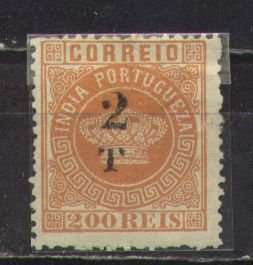
The Crown 1½ réis and the surcharged stamps show why a value must always carry its unit. Shorthand such as “2 on 50” leaves out what is needed to understand the change. Write “2 tangas on 50 réis”, then describe the colour, position and form of the surcharge separately.[3][2]
Two operations, read in order
A Crown stamp can carry the old printed value, a new surcharge and a cancellation, each from a different operation. The printed stamp identifies the stock used; the surcharge changes its value; the cancellation records what happened to the result. Do not treat them as one black mark.[2][1]
Further changes complicate this. A second added value needs both earlier stages described, not just the final figure. One catalogue family can include stamps with different original values, and similar final values on different base stamps can be separate entries.[2][1]
Typography is not instant authentication
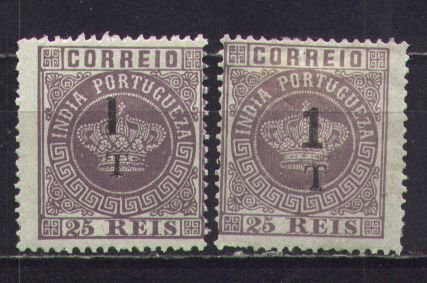
The pair of one-tanga surcharges on 25-réis stamps shown here is useful because it puts two different-looking impressions side by side. The catalogue itself raises the question of how they compare; it gives no rule by which a broad or narrow numeral can be accepted as genuine.[2]
Compare shape, spacing, ink, direction and position on the design. A difference can come from printing conditions or later damage as well as from a different setting, and a small image cannot measure a surcharge accurately. Keep the catalogue’s identification as its own, and have the stamp itself examined before drawing any important conclusion.[2]
A labelled forgery is useful evidence
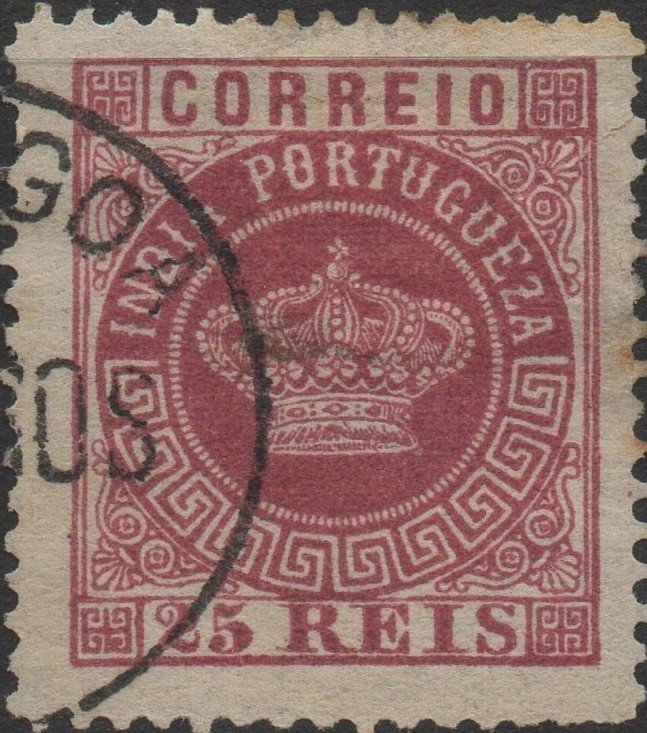
The Crown stamp below is identified in the catalogue as a Fournier forgery. It is here for comparison, not as a stamp that could pay postage, and it shows that an old, convincing colonial design can come from the history of the stamp trade rather than from the post office.[2]
Keep such material out of the issued-stamp sequence and keep its label. The cancellation on an imitation cannot establish a town’s handstamp or a date of use. The study of genuine stamps and of forgeries overlap, but a reference collection only works when the status of every item is clear.[2]
Build the surcharge entry from the base
For each stamp, record the original stamp, the new value and its unit, the colour of the added printing and any further operation. Add paper and perforation only where examination supports them, and link the entry to the catalogue edition or published comparison that identified it.[2][1]
A good checklist leaves room for later correction. It can tell an established family from an unresolved type without turning doubt into an invented rarity. Complete covers and joined multiples deserve their own records: a loose surcharge and the same form repeated in a documented block do not carry the same weight.[2][1]
| Field | Example |
|---|---|
| Base | Crown design; original 50 réis |
| New value | 2 tangas |
| Added printing | Colour, form, direction and position |
| Postal evidence | Cancellation, and the complete item if kept |
Sources
- [1] Bernard Towler, “Forgotten Countries: Portuguese India”, originally The Stamp Lover, reprinted in IND DAK, July–August 2001, pp. 103–104.
- [2] Evert Klaseboer, Catalogue, Portuguese India: Crown issue.
- [3] “Portuguese India”, journal report of 3 April 1959, p. 235, from Dr W. Alexander-Katz of Lisbon.
Notes 0
Add what you know: a cover or stamp in your collection, a date or source, a correction or a question.
No notes yet.
Sign in to add a note.
Notes show straight away. Keep them kind and about the article; anyone can report one that isn't. House rules
