
Portuguese India Before Stamps: Routes and Connections with British India
Royal letters, Mediterranean routes and one cover that crossed three administrations show how the post came before stamps.
Updated July 6, 2026
In this article
Communication came before stamps
Portuguese India’s first stamp appeared in 1871, long after letters had travelled between the territory and Europe. Royal, official, business and private letters do not all belong to the same postal service. An early letter shows that people communicated; it does not by itself show a public post open to all at a uniform rate.[1][2]
A good description starts with the letter’s date, writer, recipient and original endorsements. Separate a charge written by a postal clerk from a later filing number or a dealer’s pencil note. For letters folded into their own address panels, the inside may hold the best evidence of date and origin, so keep the whole letter rather than an attractive front.[1][2]
Road, sea and foreign transit
Goa’s outside connections could involve a coastal journey, British Indian offices and ocean carriage beyond. A route through the Mediterranean is a different matter from a voyage round the Cape, and a modern line from Goa to Lisbon cannot choose between them; endorsements and transit marks must.[2][3]
The contents of the Barreiros book list overland routes, Mediterranean connections, sea carriage via the Cape and British steam-packet agreements as separate subjects. That shows how wide the subject is; it does not mean every cover followed one standard route. A reconstruction should name the stages that are certain and leave unrecorded handling open.[2][3]
What a paid mark shows
A handstruck paid mark belongs to the letter’s accounts. It shows that an office treated the postage as prepaid, without telling us every part of the payment. Colour, frame, wording, size and position are all part of identifying it; record them before giving a fine strike a catalogue type.[1][3]
A letter can carry several money notes because different administrations collected or accounted for different stages. Do not add every manuscript figure as if each were in the same currency; work out the clerk’s unit and the direction of travel first. The difference between a prepaid stage and money collected later still matters after stamps arrive.[1][3]
Goa to Hanamkonda: three postal systems
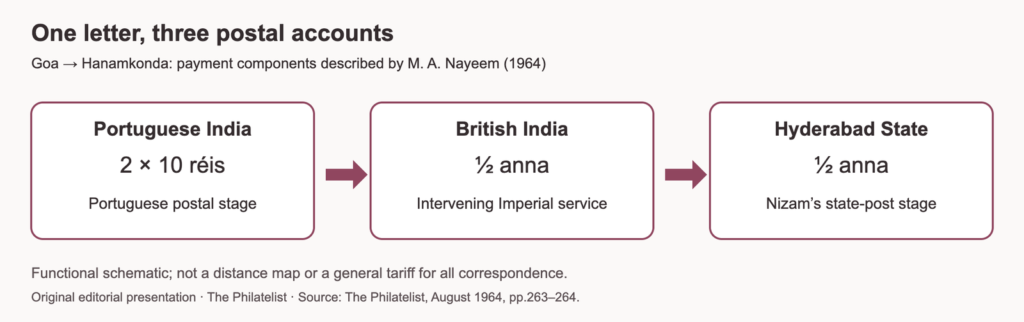
M. A. Nayeem published a cover addressed from Goa to Hanamkonda in Hyderabad State, franked with two Portuguese ten-réis stamps, a British Indian half anna and a Hyderabad half anna. Each administration did a different part of the work; one stamp did not replace the others.[3]
The Portuguese stage linked the sender with an outside route; the British Indian postage paid for the Imperial post in between; the Hyderabad stamp paid for the Nizam’s service at the receiving end. That is the value of the cover: it explains a postal relationship through a real object, rather than leaving a colourful mixed franking as a curiosity.[3]
| Stamps | What they paid for |
|---|---|
| Two Portuguese 10-réis stamps | The Portuguese Indian stage |
| British Indian ½ anna | The Imperial service in between |
| Hyderabad ½ anna | Carriage and delivery by the state post |
Follow the marks in order
Nayeem reads Sawantwari on 21 August and Poona with a Railway Mail Service mark on 24 August, then follows the cover into Hyderabad and on to Hanamkonda. Several strikes overlap and the Goa datestamp is only partly legible. His date of 1877 and his conversion from the Hijri calendar are kept as his readings.[3]
The lack of a fully legible strike matters. The combination of three administrations is certain while a disputed day or calendar conversion stays open. A reconstructed route is strongest when each stage says whether it comes from a visible mark, the writer’s dateline, a receiving endorsement or an earlier researcher’s interpretation.[3]
What to keep with a cross-border letter
Photograph the whole front, the back and the inside dateline before looking at single stamps. Copy office names in their original form and note where each mark falls in relation to a stamp. A cancellation running from stamp to envelope ties the two together; a strike on a separate piece proves less.[3][4]
Keep earlier publications and identifiable sale descriptions with the record of the item, so that later collectors can check whether a description has changed or a stamp has been moved. Old claims of rarity should stay dated to their source: Nayeem called his cover unique in 1964, which is not a census today.[3][4]
Three dates in the reform law
The official annual collection of legislation distinguishes a decree of the Cortes of 16 August 1869, the royal law (carta de lei) given at Belém on 1 September 1869, and its publication in the Diário do Governo no. 202 on 7 September. Leote’s wording of an “August carta de lei” needs this distinction, without denying the parliamentary act of August.[6]
Article 1 authorises reform of the postal and stamp services of the State of India. Article 2 allows spending on staff, materials and manufacturing machinery. Articles 3 and 4 give a fallback for funding if ordinary revenue surpluses fall short: money for equipment from the treasury for redeeming Crown land rents set up under the law of 10 June 1867, to be repaid each year from stamp revenue. Article 5 requires the government to account to the Cortes. Permission to spend is not evidence that the money was drawn, a machine bought or stamps issued.[6]
The closing formula names the minister Luiz Augusto Rebello da Silva and João Izidoro Duarte Pereira, but neither is thereby a designer, engraver or printer of stamps. The Diário issue itself, the Goa notices of 1871 and the actual accounts of spending are still to be found.[6]
Sources
- [1] Joaquim Leote, The Native Stamps of Portuguese India: Some Considerations, 3rd electronic edition, Edições Húmus, January 2006, ISBN 972-99937-0-X, pp. 11–31.
- [2] Royal Philatelic Society London, publisher’s description of Luís and Eduardo Barreiros, Portuguese India: Postal History and the First Issues—From the “natives” to 1900 (2022), ISBN 978-1-913015-18-3.
- [3] M. A. Nayeem, “Portuguese India, British India and Hyderabad Combination Cover”, The Philatelist, August 1964, pp. 263–264.
- [4] “Cancellations of British & Portuguese India”, undated collection mounts nos. 1, 8 and 9.
- [5] Diagram of the three postal accounts on the Goa–Hanamkonda cover, drawn by The Philatelist (2026) from M. A. Nayeem, The Philatelist, August 1964, pp. 263–264.
- [6] Collecção Official da Legislação Portugueza, Anno de 1869 (Lisboa: Imprensa Nacional, 1870), p. 407, Direcção Geral do Ultramar, 2.ª Repartição.
Notes 0
Add what you know: a cover or stamp in your collection, a date or source, a correction or a question.
No notes yet.
Sign in to add a note.
Notes show straight away. Keep them kind and about the article; anyone can report one that isn't. House rules
