
Portuguese India: Stamps, Territories and the Post Across Borders
From Goa’s numerals of 1871 to royal portraits, republican overprints, Ceres, the decimal reform and the move to Indian administration.
Updated September 28, 2026
In this article
A colonial post among separated territories
Portuguese India was an administration of separated territories, not a princely state working under a postal convention with British India. Goa was the largest block; Daman and Diu lay further north; Dadra and Nagar Haveli were inland dependencies attached to Daman. The distances between them, and their different political endings, matter whenever a stamp inscription, an office name or a map is used to place a postal item.[1][19][20]
Goa came under Portuguese control in 1510, but its stamps belong much later, to the reigns of Luís I and Carlos I and then to the Portuguese Republic. A stamp headed INDIA is not necessarily British Indian or of the Republic of India: language, design, currency and date identify the issuer. Royal portraits and republican allegories give the first division of the collection.[1][19][20]
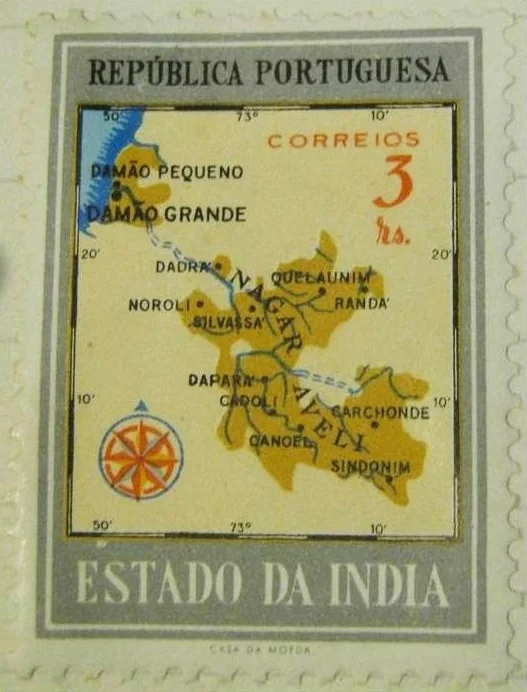
The map stamp of 1957 shown here labels Daman, Dadra and Nagar Haveli together, although Portuguese control of the inland territory had already ended. It records how the issuer presented its territory, not who actually ran each place. Read such a map as a dated claim before using it as a guide.[1][19][20]
The first stamps were a local postal reform
The first stamps went on sale on 1 October 1871. Their plain oval design had a numeral at the centre, with SERVIÇO POSTAL and INDIA PORT around it. This began prepayment by stamp, not communication between Goa and Lisbon; earlier official mail and the later public post were different stages.[6][7]
King Luís authorised local stamp production in 1869. The directives of 1871 name five first values, 10, 20, 40, 100 and 200 réis, in black, red, blue, green and orange, printed at the New Goa press. Leote’s account credits the design to the engineer Assa Castel Branco, the plate to Goindosó and the printing to Silvestre de Sousa. Local manufacture explains the collectors’ name for them: nativos.[6][7]
The same reform required British stamps as well when a letter passed through British India, except for carriage wholly within Portuguese territory. A Portuguese stamp did not prepay every destination, and a later mixed franking shows this distinction on paper.[6][7]
Reading the nativos before naming a rarity
The native design changed through recutting and new production. Some types have a smaller S and R in SERVIÇO; others have letters of even size. Background lines, the size of the numeral, the lettering of REIS and the star above the value separate the groups, and paper and perforation must then be checked on their own. Colour alone cannot establish a design family.[8][1]
The checklist lists values rather than turning every paper, die and surcharge into an unsupported total. The 15-réis addition and the later 1½, 4½ and 6 réis native forms belong to later phases. Surcharges on native stock are another layer: describe both the original value and the new one. An apparent double numeral may be a genuine variety, a later addition or a forged surcharge.[8][1]
Reprints and forgeries circulated early enough to enter old collections and even early illustrations. An old provenance deserves attention but is not a certificate. The useful order of study is design, die, paper, separation, new value and cancellation, and complete multiples keep relationships that a trimmed single has lost.[8][1]
The Crown and the royal face
The colonial Crown keytype arrived in 1877. It was a design shared across the Portuguese empire, but the inscription INDIA PORTUGUEZA identifies this territory. Supply problems and the need for new values brought repeated surcharges on both Crown and locally printed stamps. The Crown group of 1882 is in the newer scale of réis and tangas; keep old- and new-value stocks apart before adding anything up.[1][9][10]
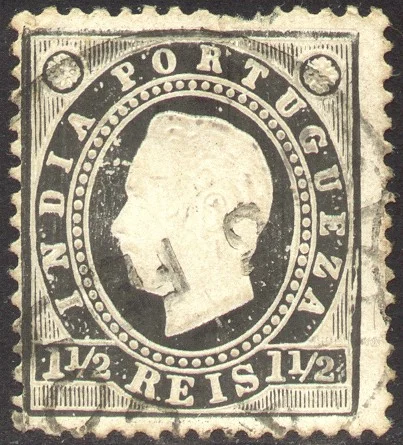
In 1886 the embossed head of Luís I brought a royal portrait to the definitives. Carlos I succeeded him in 1889 and appeared on Portuguese Indian stamps in 1895; the large corner numerals of the 1895 design set it apart from the later Carlos design. Manoel II came to the throne after the assassinations of 1908, but no Portuguese India stamp with his portrait is known.[1][9][10]
Beneath the royal portrait, perforation, printing and paper still matter. Luís stamps are recorded perforated 12½ and 13½, and the Carlos values and later surcharges add more combinations. Do not borrow a catalogue number from a similar Portuguese colony, or from the other Carlos design, because the face is the same.[1][9][10]
One letter, three postal systems
A cover from Goa to Hanamkonda shows the border between three administrations. Its franking is two Portuguese 10-réis stamps, a British Indian half anna and a Hyderabad half anna. The Portuguese stamps paid the Portuguese stage, the British stamp the Imperial service in between, and the Hyderabad stamp delivery through the Nizam’s post.[3]
The route can be followed on the cover: Goa, Sawantwadi, Poona, the Railway Mail Service and Hyderabad, then Hanamkonda. The account records Sawantwadi on 21 August and Poona with a railway mark on 24 August; the Hyderabad and destination marks use the Hijri calendar. The Goa date is only partly legible and should not be presented as fully read.[3]
The published study dates the journey to 1877 and converts the Hyderabad mark to a Gregorian date. The marks overlap, and that conversion is the author’s. What is certain is the combination of three administrations and the route; this is not a new earliest use or a full tariff for Goa–Hyderabad mail.[3]
That is why a cover says more than three loose used stamps. A receiving stamp, a dispatch datestamp, a barred obliterator and a travelling-office mark may each record a different stage, and lifting a stamp from the back would destroy part of the evidence.[3]
Vasco da Gama’s voyage in pictures
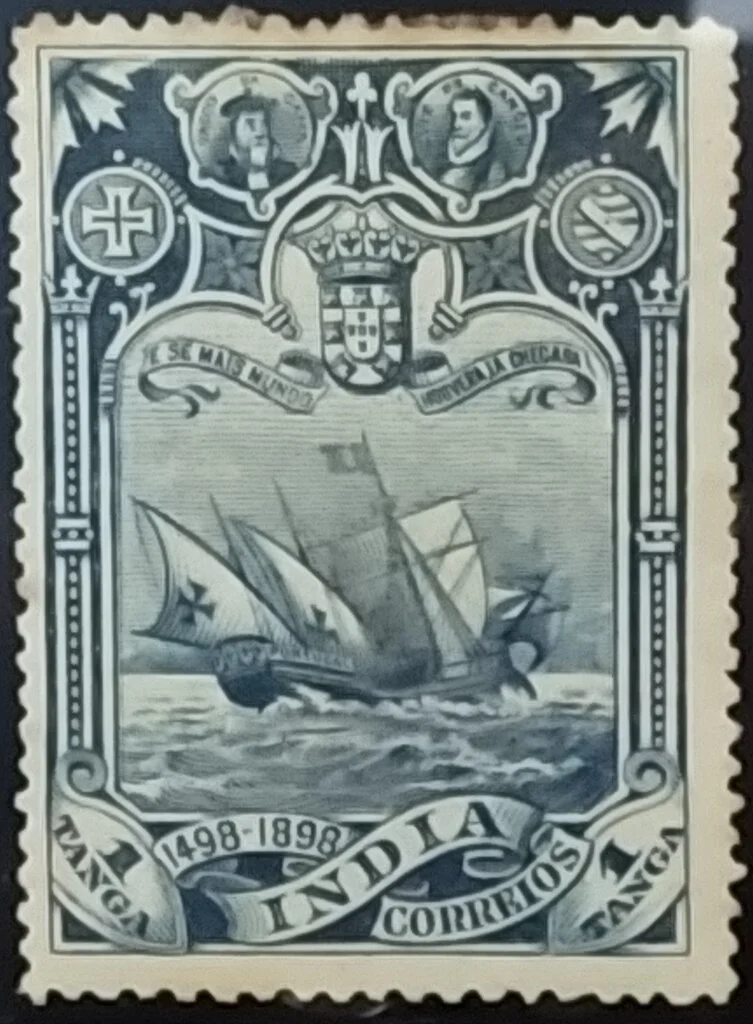
The commemoratives of 1898 marked four hundred years since Vasco da Gama reached India. Their subjects turn the voyage into a picture story: departure, ships, arrival, religious images and portraits. The one-tanga São Gabriel stamp shown here is the historical design; its date of 1898 commemorates 1498 and has nothing to do with the start of Portuguese postage.[1][2][13]
The pictures came back later. The issue of 1925 marked four hundred years since da Gama’s death; the definitives of 1933 combined the allegory Portugal with São Gabriel; and the series of 1938 returned to da Gama and related history. These are separate issues with separate postal lives, even when the same ship or explorer appears.[1][2][13]
The St Francis Xavier exposition of 1931 brought architecture and religion into the sequence. Later portraits and religious commemoratives show how the territory chose to present itself; they can illustrate that policy without our endorsing the colonial story the designs tell.[1][2][13]
A republic printed over the monarchy
The revolution of 1910 changed Portugal’s government while the old colonial stocks were still on hand. REPUBLICA overprints put republican authority across royal and commemorative designs, so a king’s portrait under that word is an ordinary transitional stamp, not a contradiction or an error.[1][12]
The years 1911–13 also produced stamps divided vertically, with a new value for each half. That is more specific than calling any cut stamp a bisect: the way it was divided, the original stamp, the new value and the republican overprint all need identifying, and an intact pair shows how the halves were made.[1][12]
The catalogue groups of the 1900s and 1910s contain many combinations of base values. This section gives the main families and some explicit values, and leaves the full setting-by-setting list of divided stamps open. Not every emergency issue was caused by a wartime shortage, and a random half stamp is not authorised postage.[1][12]
Ceres and the small details of an everyday stamp
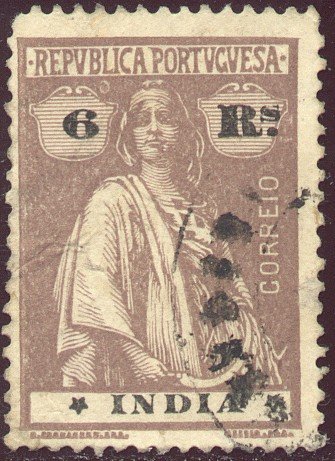
Ceres, the allegory of agriculture, became the definitive image from 1914. Unlike the new inscriptions on old stock, it was designed for the new regime. Its long life makes paper, perforation, colour and small printing differences more useful than one broad “Ceres” label.[1][13]
The album pages used here separate chalky paper perforated 15 × 14, ordinary-paper printings and a later group perforated 12 × 11½. Their values differ, so a value in one group should not be expected in every paper and perforation.[1][13]
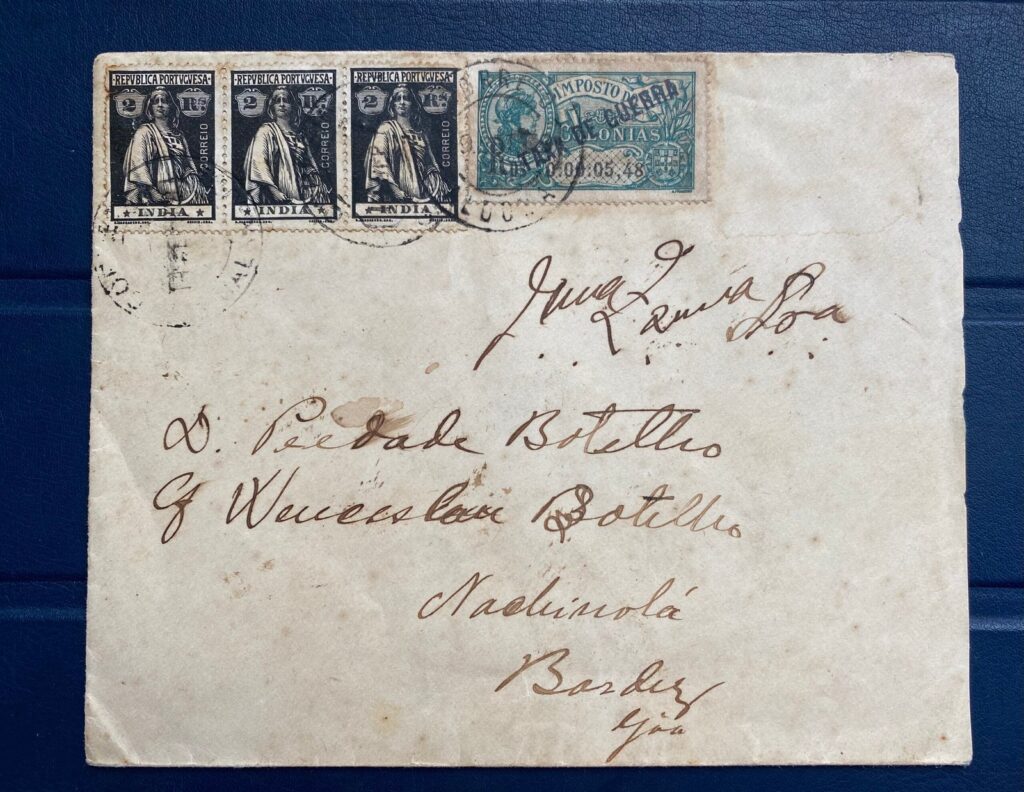
The cover shown has three 2-réis Ceres stamps beside an overprinted colonial tax stamp, with the address and parts of the cancellations. The Commons record describes it as a letter of 1919 from Aldona to Nachinola. It is good evidence of postage and tax paid together, but the file description does not establish the letter rate.[1][13]
Postage due, tax and official mail are different things
The postage-due series of 1904 had its own numeral design. A new-issue report of the time lists values from 2 réis to 1 rupia, including tangas. Dues record money to be collected on underpaid mail; do not merge them with the Carlos postage issue of 1903 because some values match.[11][15][13]
Later dues include PORTEADO overprints and surcharges on ordinary designs, then a numeral group of 1952 and decimal adaptations. A new value can sit on a former postage stamp and change its job, so the word PORTEADO matters as much as the figure.[11][15][13]
War-tax and later postal-tax stamps form another category; the colonial tax stamp on the cover above is not an extra postage stamp. Official correspondence existed, but no separate Portuguese India official stamp set is known, and none is invented here. Rules for free official franking would need the regulations of the time.[11][15][13]
Cards keep the post office’s printed instructions
Postal stationery carries its stamp printed on the card or envelope. The Crown-design bilhete postal belongs here, with later royal, republican and pictorial cards. A cut-out keeps the design but loses the format, wording and layout that identify the complete item.[9][22]
Recorded later examples include the 3-réis Lusíadas card of 1934 and the 7-réis historical-view card of 1946. A card of 1934 described as posted at Goa on 31 May 1939 has an added 6-réis stamp: a recorded franking of 9 réis on one card, not a general postcard rate without a rate notice and a study of the route.[9][22]
Commercial perforated initials on stationery and on added stamps are not postal perforations or official overprints. Catalogue descriptions record the perfins HIRALAL & CO and SHIVRAM JIVATRAM, which mark altered commercial items, not new government designs.[9][22]
The 1950s: people, forts, maps and coins
The later programme went beyond the long-running definitives. Historical figures appeared in 1946 and 1948; religious anniversaries, the Holy Year and the tercentenary of José Vaz’s birth in 1951 followed; and the first stamp exhibition of 1952 made philately itself a subject.[1][2][16][13]
The settlements anniversary of 1956 and the territorial maps of 1957 tie the stamps to the administration’s public image. The 3-réis map stamp names both the coastal Daman districts and the inland enclaves; set its date of 1957 beside the political change of 1954 rather than taking the map as proof of continuing control.[1][2][16][13]
The coin series of 1959 had twenty values; its pictures look back over monetary history, while its face values are in the new decimal currency. The last regular commemorative covered here is the 3-escudo Henry the Navigator stamp of 25 June 1960. Stamps or labels prepared in Portugal after the takeover need separate evidence of local sale and postal validity.[1][2][16][13]
A reform of 1958 at the counter in 1959
The stamps begin in réis and later use the postal scale of 12 réis to 1 tanga and 16 tangas to 1 rupia. Read the catalogue abbreviations R, T and RP as units, not just figures. A tanga is not an anna, and a value in rupias does not make a stamp British Indian.[5][17][18]
Decree 41.680 of 16 June 1958 introduced the monetary reform. Philatelic reports of the time give 1 January 1959 as the change at the counter: the escudo replaced the rupia at six escudos to one, with 100 centavos to the escudo. “The 1958 reform” and “the 1959 surcharges” are both correct and describe different events.[5][17][18]
A report of April 1959 describes local surcharges in the new currency on the designs of 1956 and 1957, and lists values actually on sale at Nova Goa. Decimal figures such as 0.05 and 1.50 are escudos, not réis or tangas. The report itself mentions how hard official information was to obtain, so its list is a contemporary report, not a complete official schedule.[5][17][18]
1954, 1961 and 1974
Dadra and Nagar Haveli left Portuguese control in 1954 and became a Union Territory under Indian law on 11 August 1961, before the military operation in Goa, Daman and Diu that December. Treating all the territories as changing hands on one day erases a crucial difference.[20][19][21][1]
Portuguese rule in Goa, Daman and Diu ended on 19 December 1961. The post did not necessarily change at the same moment. A philatelic survey places the end of the old stamps’ use by January 1962, but the last day they were accepted, mixed frankings and counter supplies need the notices and dated covers.[20][19][21][1]
The treaty signed on 31 December 1974 recognised Indian sovereignty over Goa, Daman, Diu, Dadra and Nagar Haveli from the dates they became part of India; it came into force on 3 June 1975. Recognition did not keep the old postal administration going until 1974, and it does not cancel the evidence of Indian postal working from the takeover.[20][19][21][1]
The INDIA 15 nP folder: a proposal, not an issue
A reported folder holds blocks of the coin series of 1959 and the Henry the Navigator stamp of 1960 overprinted INDIA and 15 nP. The report of February 1990 describes black surcharges on the coins and black, red and purple ones on the Henry stamp; fifteen naye paise was then the inland letter rate.[4]
The essential point is that these stamps were never issued. The report says the authorities seem to have considered reusing Portuguese stock and records the folder examined by Pradip Jain; it gives no government production order. They are an unissued proposal, not Indian postage used in Goa, and a folder title, a proposed value and photographs do not prove approval or sale.[4]
The stamps
The issue groups and their values, from the research checklist. A grouped range does not claim every value in between; where the full list of values was not checked, the family is named and the limit stated. Postage, airmail, postage dues, postal tax, stationery and unissued proposals are marked as such, and the varieties of each issue are not listed.[3][5][6]
| Period | Issue | Values |
|---|---|---|
| 1 October 1871 | First local numeral issue | 10 réis, 20 réis, 40 réis, 100 réis, 200 réis |
| 1871–1883, selected additions | Native numeral developments | 15 réis, 300 réis, 600 réis, 900 réis, 1½ réis, 4½ réis, 6 réis |
| 1877; 1880 colour changes | Crown keytype | 5 réis, 10 réis, 20 réis, 25 réis, 40 réis, 50 réis, 100 réis, 200 réis, 300 réis |
| 1881–1883 | Native stocks with new values (postage surcharge) | Selected: 1½ on 10 réis; 1½ on 20 réis; 4½ on 40 réis; 6 on 100 réis; 6 on 200 réis |
| 1881–1882 | Crown new-value overprints (postage surcharge) | 1½ réis, 4½ réis, 6 réis, 1 tanga, 2 tangas, 4 tangas, 8 tangas |
| 1882 | Crown in newer postal currency | 1½ réis, 4½ réis, 6 réis, 1 tanga, 2 tangas, 4 tangas, 8 tangas |
| 1886 | Embossed Luís I portrait | 1½ réis, 4½ réis, 6 réis, 1 tanga, 2 tangas, 4 tangas, 8 tangas |
| 1895–1896 | Carlos I, corner-numeral design | 1½ réis, 4½ réis, 6 réis, 9 réis, 1 tanga, 2 tangas, 4 tangas, 8 tangas |
| 1898 | Vasco da Gama, seaway quadricentenary (postage commemorative) | 1½ réis, 4½ réis, 6 réis, 9 réis, 1 tanga, 2 tangas, 4 tangas, 8 tangas |
| 1898–1901 family | Later Carlos I portrait | 1 real, 1½ réis, 2 réis, 2½ réis, 3 réis, 4½ réis, 6 réis, 9 réis, 1 tanga, 2 tangas, 2½ tangas, 4 tangas, 5 tangas, 8 tangas, 12 tangas, 1 rupia, 2 rupias |
| 1903 | Carlos I, new colours/values | 1 real, 1½ réis, 2 réis, 2½ réis, 3 réis, 6 réis, 1 tanga, 2 tangas, 2½ tangas, 5 tangas, 8 tangas, 12 tangas, 1 rupia, 2 rupias |
| 1904 | Numeral design (postage due) | 2 réis, 3 réis, 4 réis, 5 réis, 6 réis, 9 réis, 1 tanga, 2 tangas, 5 tangas, 10 tangas, 1 rupia |
| 1911–1914 | REPUBLICA on earlier issues (postage overprint) | Royal and 1898 commemorative base issues; complete combination list not transcribed |
| 1911–1913 | Vertically divided and separately surcharged stamps (postage provisional) | 1 real, 1½ réis, 2 réis, 3 réis, 6 réis |
| 1911; 1914; 1940s–1950s | Republican and later due adaptations (postage due) | Selected 1952 numerals: 2, 3, 6 réis; 1, 2, 10 tangas |
| From 1914 | Ceres, initial chalky-paper group | 1 real, 1½ réis, 2 réis, 2½ réis, 3 réis, 4½ réis, 5 réis, 6 réis, 9 réis, 10 réis, 1 tanga, 2 tangas, 3 tangas, 4 tangas, 8 tangas, 12 tangas, 1 rupia, 2 rupias, 3 rupias |
| 1916–1920 | Ceres, ordinary-paper group | 1 réis, 1½ réis, 2 réis, 2½ réis, 3 réis, 4½ réis, 6 réis, 1 tanga, 2 tangas |
| 1919 | Colonial-tax adhesive used with postage (war tax) | Value on illustrated overprint not independently transcribed |
| 1921–1923 | Ceres, ordinary paper, perforation 12 × 11½ | 1 réis, 1½ réis, 2 réis, 3 réis, 4½ réis, 5 réis, 6 réis, 9 réis, 10 réis, 1 tanga, 1½ tangas, 2 tangas, 2½ tangas, 3 tangas 4 réis, 4 tangas, 8 tangas |
| 1925 | Vasco da Gama death quadricentenary (postage commemorative) | 6 réis, 1 tanga |
| 1925 and 1948–1960 groups | Pombal and mother-and-child families (postal tax / tax due) | Selected 1 tanga group; later units include centavos |
| 1931 | St Francis Xavier exposition (postage commemorative) | 1 real, 2 réis, 6 réis, 1½ tangas, 2 tangas, 2½ tangas |
| 1933 | Portugal and São Gabriel definitives | 1 real, 2 réis, 4 réis, 6 réis, 8 réis, 1 tanga, 1½ tangas, 2 tangas, 2½ tangas, 3 tangas, 5 tangas, 1 rupia, 2 rupias, 3 rupias, 5 rupias |
| Crown period; 1934; 1946 | Bilhete postal and later pictorial cards (postal stationery) | Selected 3 réis Lusíadas card, Selected 7 réis historical-view card |
| 1938 | Vasco da Gama and other historical figures | 1 real, 2 réis, 3 réis, 6 réis, 10 réis, 1 tanga, 1½ tangas, 2 tangas, 2½ tangas, 3 tangas, 5 tangas, 1 rupia, 2 rupias, 3 rupias, 5 rupias |
| 1938 | Aircraft over globe (airmail) | 1 tanga, 2½ tangas, 3½ tangas, 4½ tangas, 7 tangas, 7½ tangas, 9 tangas, 11 tangas |
| 1941–1951, selected groups | Low-value replacements on 1933 and 1938 designs (postage surcharge) | Selected: 1 tanga on higher-value 1933s tocks, 1950–1951 groups: 1 real and 2 réis on 10 réis; 1 real, 3 réis and 6 réis on 2½ tangas |
| 1946; 1948 | Historical personalities (postage commemorative) | Selected illustrated 1946 value: 1 real, 1948: full denomination list not transcribed |
| 1950–1955 | Holy Year, José Vaz, exhibitions and other subjects (postage commemorative) | 1951 José Vaz: 1, 2, 3 réis; 1, 2, 3, 9, 10, 12 tangas, Other families retained by name rather than guessed values |
| 1956–1958 | Settlements, territorial maps and arms (postage commemorative/definitive) | Selected 1957 map value: 3 réis, Additional old-currency values not exhaustively transcribed |
| 1959 | Decimal-currency local overprints (postage surcharge) | Contemporary Nova Goa sales report: 0.05, 0.10, 0.15, 0.20, 0.30, 0.40, 0.50, 0.80, 1, 1.50, 2, 2.50, 4, 4.50, 10, 20, 30 escudos |
| 1959 | Portuguese Indian coins | 5 centavos, 10 centavos, 15 centavos, 30 centavos, 40 centavos, 50 centavos, 60 centavos, 80 centavos, 1 escudo, 1.50 escudos, 2 escudos, 2.50 escudos, 3 escudos, 4 escudos, 4.40 escudos, 5 escudos, 10 escudos, 20 escudos, 30 escudos, 50 escudos |
| 25 June 1960 | Henry the Navigator death quincentenary (postage commemorative) | 3 escudos |
| After 1961; reported 1990 | INDIA 15 nP on coins and Henry stamps (unissued proposal) | 15 naye paise on 1959 coins values, 15 naye paise on 3 escudos Henry the Navigator |
Still to be done: a reconciled chronology of local rates, cancellations office by office, railway marks, the types of postal stationery and the actual validity notices of 1961–62. The combination cover of 1877 and the counter report of 1959 are particular pieces of evidence, not rules for the whole territory. The newest specialist work is Luís and Eduardo Barreiros’s monograph of 2022 on the postal history and first issues to 1900.[3][5][6]
In this section
Eighteen articles follow: the places and a collecting guide; the post before stamps; the first stamps of 1871; the native dies, reprints and forgeries; the Crown and the surcharges of 1881–1883; Luís I and Carlos I; Vasco da Gama in 1898; REPUBLICA and the divided stamps; Ceres; postage dues; war tax and postal tax; postal stationery; the pictorials of 1931–1933; airmail and the colonial issues of 1938; the 1940s and 1950s; decimal currency and the coins; the transfer and the unissued INDIA proposals; and postmarks, rates and covers.
Sources
- [1] Bernard Towler, “Forgotten Countries: Portuguese India”, reprinted from Stamp Lover in IND DAK, July–August 2001, p. 103.
- [2] Bernard Towler, “Illustrations for Portuguese India”, plate, IND DAK, July–August 2001, p. 104.
- [3] M. A. Nayeem, “Portuguese India, British India and Hyderabad Combination Cover”, The Philatelist, August 1964, pp. 263–264.
- [4] “Indian Discovery”, Gibbons Stamp Monthly, February 1990: report of Pradip Jain’s study of the unissued INDIA 15 nP surcharges.
- [5] “Portuguese India”, journal report of 3 April 1959, p. 235, from Dr W. Alexander-Katz of Lisbon.
- [6] Royal Philatelic Society London, publisher’s description of Luís and Eduardo Barreiros, Portuguese India: Postal History and the First Issues—From the “natives” to 1900 (2022), ISBN 978-1-913015-18-3.
- [7] Joaquim Leote, The Native Stamps of Portuguese India: Some Considerations, Edições Húmus, 2006, p. 22.
- [8] Evert Klaseboer, Catalogue: Portuguese India, First Primitive Issues.
- [9] Evert Klaseboer, Catalogue: Portuguese India, Crown Issue.
- [10] The Philatelic Record, vol. 25 (1903), new-issue report, “Issue for Portuguese India”.
- [11] The Philatelic Journal of Great Britain, 25 April 1904, new-issue report on Portuguese colonial postage-due stamps.
- [12] StampWorld, Portuguese India, postage 1910–1919.
- [13] William E. Steiner, Portuguese India album pages (46-page PDF).
- [14] StampWorld, Portuguese India, postage 1930–1939.
- [15] StampWorld, Portuguese India, postage dues 1904–1959.
- [16] StampWorld, Portuguese India, postage 1950–1959.
- [17] Banco Nacional Ultramarino, Breve História do Banco Nacional Ultramarino: the monetary reform of decree 41.680, 16 June 1958.
- [18] International Bank Note Society Journal, 49.3, p. 34, “Seventh Issue by Banco Nacional Ultramarino—1959”.
- [19] Ministry of External Affairs, Government of India, Portugal—Bilateral Brief, 23 November 2022.
- [20] Administration of Dadra and Nagar Haveli and Daman and Diu, “About UT Administration”, historical section.
- [21] Treaty between India and Portugal on recognition of India’s sovereignty over Goa, Daman, Diu, Dadra and Nagar Haveli and related matters, signed 31 December 1974; United Nations Treaty Series, vol. 982, No. 14321, p. 159. In force 3 June 1975.
- [22] Clube Filatélico de Portugal, 31st auction catalogue, lots 461–472.
- [23] Cover described as an Aldona–Nachinola letter of 1919. Photograph by Kamat milind, via Wikimedia Commons, CC BY-SA 4.0.
- [24] Portuguese India 3-réis territorial-map stamp, 1957. Via Wikimedia Commons; public domain.
- [25] Portuguese India one-tanga São Gabriel stamp, 1 April 1898. Via Wikimedia Commons; public domain.
- [26] Evert Klaseboer, Catalogue, Portuguese India: 1886–1913.
- [27] StampWorld, Portuguese India, postage 1900–1909, 1903 Carlos entries 214–227.
- [28] Six-réis Ceres stamp, from Evert Klaseboer’s catalogue.
Notes 0
Add what you know: a cover or stamp in your collection, a date or source, a correction or a question.
No notes yet.
Sign in to add a note.
Notes show straight away. Keep them kind and about the article; anyone can report one that isn't. House rules
