About this stamp
On the Stamp
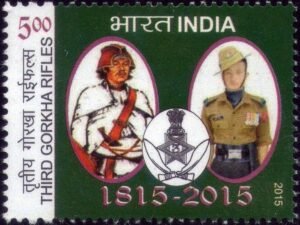
Soldiers of the 1st Gorkha Rifles of the early years and of today.
Two Hundred Years of the Gorkha Rifles
India Post issued two ₹5 stamps on 2 November 2015 for the bicentenary of the 1st and 3rd Gorkha Rifles, both raised on 24 April 1815. The brochure was published in Hindi only; the text below is our translation of it.
1st Gorkha Rifles
The history of the 1st Gorkha Rifles is a thrilling saga of military campaigns and battles. In the eighteenth century the Gorkhas of Nepal had extended their empire as far as Kumaon, Garhwal and the Kangra valley. This brought them into conflict with the British East India Company, which turned into the Gorkha War of 1815. The British were greatly impressed by the fighting skill of the Gorkhas, and after the Treaty of Sugauli the East India Company proposed raising a Gorkha regiment from what remained of Amar Singh Thapa’s army. So it was that on 24 April 1815, at Subathu, where the 14 Gorkha Training Centre now stands, the 1st Nusseree (that is, friendly or loyal) Battalion was raised.
Soon afterwards the regiment began to write its glorious record of valour, winning its first battle honour, “Bharatpur”, in 1826. In 1850 it was made a regular regiment and named the 66th Gorkha Regiment. Lieutenant J. A. Tytler of the regiment won its first Victoria Cross for exceptional gallantry in the battle of Haldwani in February 1858. In the First World War its soldiers proved their mettle in France, Belgium, Mesopotamia (Iraq) and Palestine, and in the Second World War all its battalions fought on the Burma front. Its name changed several times over the years: just before independence it was “The 1st King George V’s Own Gorkha Rifles (The Malaun Regiment)”, and after independence it was renamed the 1st Gorkha Rifles.
Soon after independence its soldiers showed their strength in the operations in Jammu and Kashmir in 1948. In the Congo its 3rd Battalion won the highest honour for gallantry: Captain G. S. Salaria of that battalion was awarded the Param Vir Chakra, posthumously, for exceptional bravery. In recent times the regiment has distinguished itself in operations in Sri Lanka, Punjab and Siachen. Its 2nd and 5th Battalions received the Chief of Army Staff (COAS) Unit Citation for outstanding achievement in counter-terrorism operations, and its 4th Battalion a COAS citation for its fine performance in Operation Rakshak.
Besides these five battalions, 15 Rashtriya Rifles, made up of soldiers of the 1st and 4th Gorkha Rifles, has played a leading part against terrorism. Since it was raised in 1994 it has won 7 Shaurya Chakras, 50 Sena Medals and the COAS Unit Citation three times, in 2001, 2004 and 2006. In all, the regiment has been awarded 31 battle honours and 5 theatre honours since it was raised.
3rd Gorkha Rifles
The 3rd Gorkha Rifles was raised on 24 April 1815 by Sir Robert Colquhoun as the Kumaon Local Battalion. Besides Gorkha soldiers, men from Kumaon and Garhwal were also enlisted in it.
Before the World Wars, its 1st and 2nd Battalions fought in the Afghan War, in Tirah and on the frontiers of the Punjab. In the First and Second World Wars the regiment took an active part in the campaigns in the Middle East, North Africa, Europe and Burma, and won many gallantry awards and battle honours. Rifleman Kulbir Thapa and Rifleman Karan Bahadur Rana of its 2nd Battalion were awarded the Victoria Cross in the First World War.
The valiant 2nd Battalion was decorated with the battle honour “Pir Kanthi” in the Uri sector in 1948, and the regiment’s 5th Battalion with “Shingo River Valley” in the Kargil sector in 1971. Colonel J. R. Chitnis of 1/3 Gorkha Rifles was awarded the Ashoka Chakra, India’s highest peacetime gallantry award, posthumously, for his bravery in operations in Nagaland in 1956.
The regiment has also done outstanding work in adventure and exploration. Subedar N. D. Sherpa of the 5th Battalion, holder of the Kirti Chakra, the Sena Medal and Bar, the Vishisht Seva Medal and the gold medal of the Indian Mountaineering Foundation, raised the flag on the summit of Kangchenjunga in 1977 as a member of an Army mountaineering expedition. Captain Ravindra Mishra and Subedar Bal Bahadur Pun of the 4th Battalion were awarded the MacGregor Silver Medal in 1976 for exceptional work in exploration and mapping in the remote north-eastern areas of Arunachal Pradesh.
In Operation Vijay in 1999, 1/3, 3/3, 4/3 and 5/3 Gorkha Rifles (the 1st, 3rd, 4th and 5th Battalions) took an active part in the fighting in the Kargil, Dras and Batalik sectors, and 3/3 Gorkha Rifles received the commendation of the General Officer Commanding-in-Chief (GOC-in-C) for its fine performance in the war.
The Department of Posts is pleased to issue commemorative postage stamps on the 1st Gorkha Rifles and the 3rd Gorkha Rifles.
The stamps were designed by Nenu Gupta; Security Printing Press, Hyderabad printed 0.6 million of each.
For More Information
Read more here: