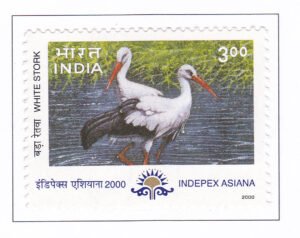
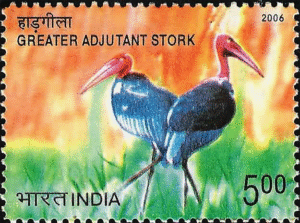
About this stamp
Salim Moizuddin Abdul Ali, born on November 12, 1896, was an extraordinary ornithologist, explorer, ecologist, teacher, and writer. His contributions to ornithology were groundbreaking, especially at a time when the study of birds in India was largely considered a hobby for the British elite. Salim Ali’s passion and dedication turned ornithology into a serious scientific pursuit in India.
Early Life and Contribution to Ornithology
Salim Ali’s interest in birds began at an early age, but it was in 1930 that his journey into professional ornithology truly began. He approached the Bombay Natural History Society (BNHS) with a unique proposal to conduct ornithological surveys across India. Remarkably, he did not seek a salary for his work, asking only for expenses. This commitment allowed him to explore and document the avian life across the subcontinent, from the arid regions of Kutch to the lush landscapes of Kerala, and from the mountainous terrains of Afghanistan to the diverse ecosystems of Sikkim.
Innovative Approach and Legacy
Salim Ali’s approach to ornithology was revolutionary. He didn’t just describe the birds he studied; he integrated history, ecology, and geography into his observations, providing a comprehensive view of each species and its habitat. This holistic method set him apart from his contemporaries and made his work invaluable to the scientific community.
In 1941, Salim Ali published “The Book of Indian Birds,” a landmark publication that became an instant success. The book not only educated a generation of bird enthusiasts but also inspired many to take up ornithology as a serious discipline.
Collaboration with S. Dillon Ripley
During World War II, Salim Ali developed a close friendship with S. Dillon Ripley, a young zoologist with the U.S. Army stationed in Ceylon (now Sri Lanka). Their shared passion for birds led them to collaborate on an ambitious project—the publication of the ten-volume “Handbook of the Birds of India and Pakistan.” This monumental work, combining their vast knowledge, remains a critical resource for ornithologists and bird lovers worldwide.
Legacy and Recognition
Salim Ali’s contributions to ornithology extended beyond his publications. He was a pivotal figure in the conservation movement in India, advocating for the preservation of wildlife and natural habitats. His work earned him numerous accolades, including the Padma Bhushan in 1958 and the Padma Vibhushan in 1976, two of India’s highest civilian honors.
Salim Ali’s life and work continue to inspire generations of ornithologists, conservationists, and nature enthusiasts. His legacy is a testament to the impact one dedicated individual can have on the scientific understanding and conservation of the natural world.
Conclusion
Salim Ali’s pioneering work in ornithology not only transformed the study of birds in India but also laid the foundation for future research in the field. His deep understanding of the natural world and his ability to communicate it to a broader audience made him a revered figure in both scientific and public circles. Today, he is remembered as the “Birdman of India,” a title that reflects his enduring impact on the field of ornithology.