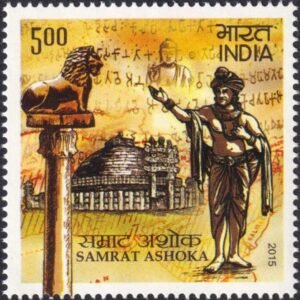
About this stamp
Founder of the Mauryan Empire
Chandragupta Maurya (c. 321–297 BCE) is regarded as one of the greatest empire builders in Indian history. While the Nandas of Magadha are often credited as early empire builders, it was Chandragupta who gave a clear and powerful expression to the idea of a unified Indian empire.
Rise of Magadha as a Powerful Kingdom
The region of Magadha possessed several natural advantages that made it ideal for the rise of a strong empire. Its strategic location provided control over the fertile Gangetic plains and access to thriving river trade routes.
Abundant natural resources, including forests for timber and iron ore for weapons and tools, further strengthened its position. The fertile land ensured high agricultural productivity, enabling the state to collect substantial land revenue and maintain a powerful army.
Sources of History: Indika and Arthashastra
Our understanding of Chandragupta Maurya’s reign comes largely from Indika, written by Megasthenes, and the Arthashastra by Chanakya.
These sources provide valuable insights into the administration, economy, and political strategies of the Mauryan Empire.
Overthrow of the Nandas and Rise to Power
Born into a humble background, Chandragupta Maurya rose to power with determination and strategic brilliance. With the guidance of Chanakya, he successfully overthrew the powerful Nanda dynasty in 321 BCE.
Despite lacking initial military strength, his clever strategies and leadership enabled him to secure the throne and establish a strong foundation for his empire.
Expansion of the Mauryan Empire
Chandragupta Maurya expanded his empire extensively, bringing vast regions under his control. His rule extended across Bihar, Bengal, Odisha, western and north-western India, and parts of the Deccan.
Except for regions like Kerala, Tamil Nadu, and parts of the northeast, the Mauryan Empire covered most of the Indian subcontinent. In the northwest, his influence extended beyond territories later controlled by the British Empire.
Administration and Governance
Chandragupta Maurya was not only a conqueror but also a visionary administrator. He established a well-organized system of governance with a strong financial base.
He believed that the welfare of the ruler depended on the welfare of his subjects. This principle guided his policies and contributed to the stability and longevity of the Mauryan Empire.
Later Life and Spiritual Pursuits
After ruling for nearly 25 years, Chandragupta Maurya is believed to have embraced Jainism under the influence of the saint Bhadrabahu.
He abdicated the throne in favor of his son Bindusara and spent his later years pursuing a spiritual path.
Legacy and Recognition
Chandragupta Maurya remains one of the most influential figures in Indian history. His military achievements, administrative acumen, and vision for a unified empire set the foundation for one of the greatest dynasties in ancient India.
In recognition of his contributions, the Department of Posts issued a commemorative postage stamp, honoring this महान ruler whose legacy continues to inspire generations.
For More Information
Read more here: