About this stamp
On the Stamp
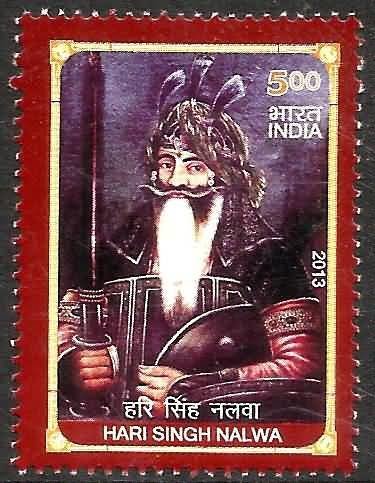
A painted portrait of Hari Singh Nalwa with a long white beard and a plumed turban, holding a sword and a shield, in a red frame, with his name in Hindi and English, on a ₹5 stamp.
Hari Singh Nalwa
India Post issued this ₹5 stamp on 30 April 2013, the 176th anniversary of his death, for Hari Singh Nalwa (1791–1837), who commanded the Khalsa Army of Maharaja Ranjit Singh’s Sikh Empire; the Minister of Communications, Kapil Sibal, released it. Born at Gujranwala, he was taken into Ranjit Singh’s court in 1804, and the story goes that in that year he killed a tiger with a dagger on a hunt, earning the name Baghmar, “tiger-killer”.
He led the Sikh armies that took Kasur, Sialkot, Multan, Attock, Kashmir, Peshawar and Jamrud, carrying the frontier of the Sikh Empire beyond the Indus to the mouth of the Khyber Pass, and governed Kashmir, Peshawar and Hazara, where he set up a mint. He was a builder too: at least 56 buildings are credited to him, among them the planned town of Haripur, founded in 1822, and Gurdwara Panja Sahib at Hassan Abdal.
In April 1837, with troops drawn away to Amritsar for a royal wedding, an Afghan army surrounded the small fort at Jamrud. Nalwa rode out from Peshawar to relieve it and was killed, after ordering that his death be kept secret until help came from Lahore. At his death, Jamrud marked the western boundary of the empire. India Post’s brochure for this issue is not online, so this text draws on Wikipedia and on the stamp itself.
For More Information
Read more here: