

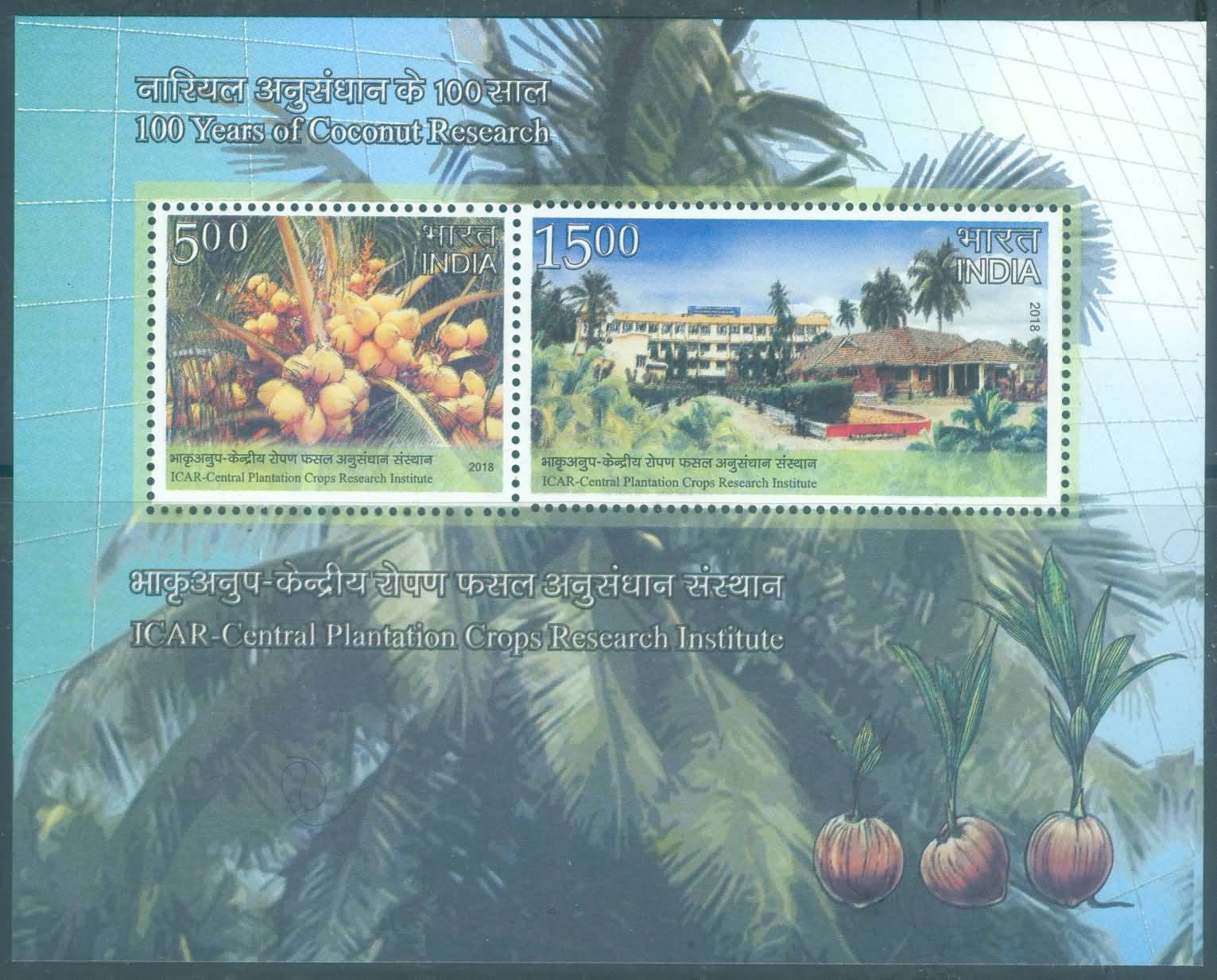
About this stamp
A Century of Excellence in Plantation Crops Research
The Indian Council of Agricultural Research – Central Plantation Crops Research Institute (ICAR-CPCRI), Kasaragod, is celebrating 100 years of dedicated research in plantation crops. Established in 1916 as a Coconut Research Station, the Institute has been a pioneer in research, education and extension activities related to coconut, arecanut and cocoa for nearly a century.
Origin and Early Development
The Coconut Research Station at Kasaragod, Kerala, was initially established in 1916 by the Presidency of Madras. In 1948, it was taken over by the Indian Central Coconut Committee.
In 1970, the ICAR-Central Plantation Crops Research Institute (ICAR-CPCRI) came into existence as part of the National Agricultural Research System (NARS) under ICAR. The Institute was formed by merging:
- Central Coconut Research Station, Kasaragod
- Central Coconut Research Station, Kayamkulam
- Central Arecanut Research Station, Vittal
- Five substations at Palode and Kannara (Kerala), Hirehalli (Karnataka), Mohitnagar (West Bengal) and Kahikuchi (Assam)
Central Coconut Research Station, Kayamkulam
The Central Coconut Research Station (CCRS), Kayamkulam was established in 1948 by the Indian Central Coconut Committee. Its origins trace back to the Agricultural Research Laboratory, started in 1937 with headquarters at Kollam and a field station at Kayamkulam to address coconut plant protection problems.
Following the abolition of commodity committees, ICAR took over CCRS on 1 April 1966. With the establishment of ICAR-CPCRI in 1970, Kayamkulam became one of its regional stations.
Arecanut Research and Regional Centres
Research on arecanut began in 1947 with the formation of an ad hoc committee by ICAR to study issues affecting the arecanut industry. This led to the establishment of the Central Arecanut Research Station (CARS), Vittal in 1956. After 1970, CARS became a Regional Station of ICAR-CPCRI.
- Research Centre, Kahikuchi (Assam) was established in 1959 and later integrated with ICAR-CPCRI in 1970.
- Research Centre, Mohitnagar (West Bengal) was established in 1958 and merged with ICAR-CPCRI in 1970 as a research centre.
Research Centre, Kidu
The ICAR-CPCRI Research Centre, Kidu was established in 1972 as a Seed Farm to produce genetically superior planting material of coconut, arecanut, cocoa and cashew. It was upgraded to a Research Centre in 2002.
The centre presently manages 120 hectares of land, with major area under coconut. In 1998, the International Coconut Gene Bank for South Asia (ICG-SA) under Bioversity – COGENT was established at this centre.
Minicoy Centre
The Minicoy Centre, originally known as the ICAR Research Complex for Lakshadweep, was established in 1976. Its administrative control changed over time and finally reverted to ICAR-CPCRI in 1994. Since 2011, the centre functions as a demonstration-cum-production unit, enhancing fruit and vegetable availability in the islands.
All India Coordinated Research Projects
The All India Coordinated Coconut and Arecanut Improvement Project (AICCAIP) was launched in 1972 with headquarters at CPCRI, Kasaragod. In 1986, it was renamed the All India Coordinated Research Project on Palms (AICRPP) and is currently implemented in 21 centres across 12 State Agricultural Universities and one Central Institute.
CPCRI also serves as the mother institute for plantation crops research under ICAR and played a key role in establishing several specialized institutes, including those dedicated to spices and cashew research.
Major Achievements and Contributions
ICAR-CPCRI has provided inspiring leadership in plantation crops research, contributing significantly to India’s emergence as a global leader in coconut and arecanut production. Major achievements include:
- Development of high-yielding varieties
- Advancements in biotechnology applications
- Biological control of pests and diseases
- Improved cropping system productivity
- Development of pre- and post-harvest machinery
- Creation of value-added products
The Institute has successfully transferred technologies to farmers and stakeholders through innovative extension approaches. In recognition of its outstanding service, ICAR conferred the ‘Sardar Patel Outstanding Institution Award’ in 2002.
Commemorative Postage Stamps
To commemorate 100 years of coconut research, the Department of Posts is pleased to issue a Miniature Sheet consisting of two Commemorative Postage Stamps highlighting the legacy and achievements of the Indian Council of Agricultural Research – Central Plantation Crops Research Institute (ICAR-CPCRI), Kasaragod.
For More Information
Read more here:


