About this stamp
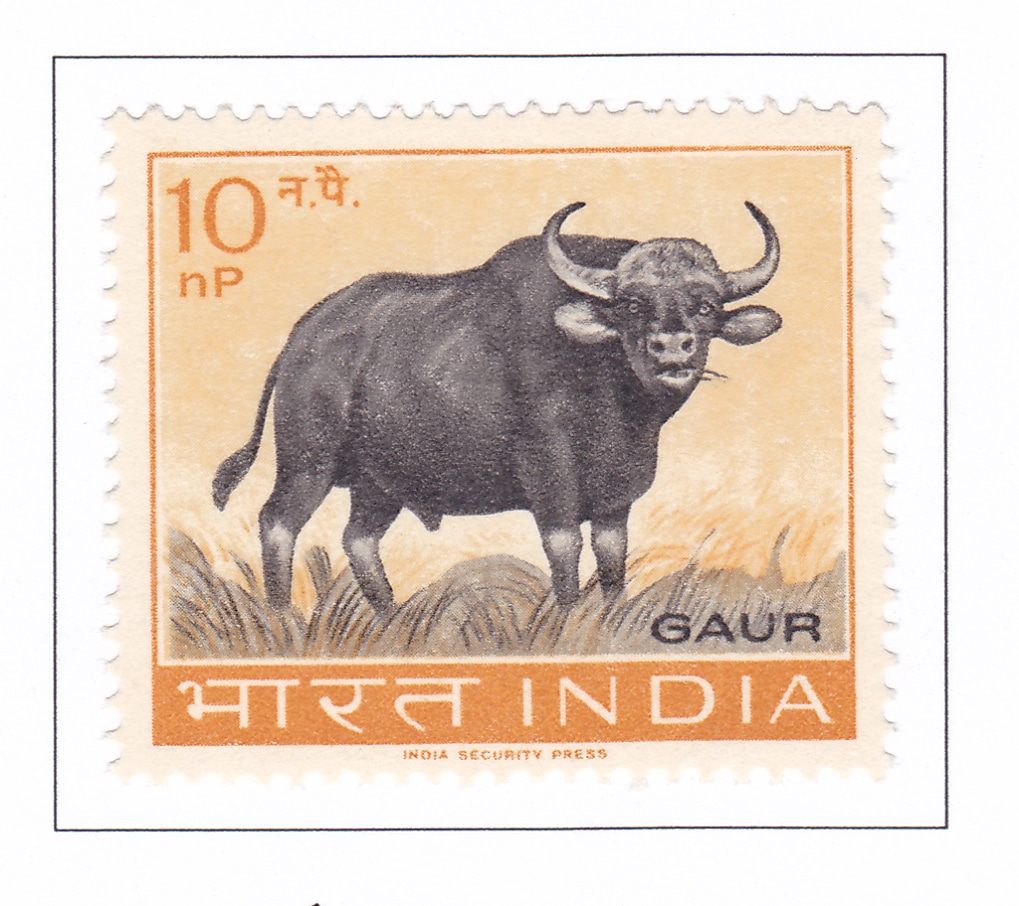
The Gaur, also known as the Indian Bison, is indeed a magnificent creature, distinguished as the largest and most impressive among all bovines worldwide. Standing tall at up to 6 feet 4 inches and weighing over 2,000 pounds, it commands awe and admiration. Found in the forested regions of northeast, central, and south India, as well as parts of southeast Asia, the Gaur is often misidentified as a bison by hunters, despite being a distinct species.
Unlike true bisons found in North America and Europe, the Gaur is a wild ox, exuding a majestic presence with its robust build and striking appearance. A notable characteristic is its dorsal ridge and white “stockings,” adding to its regal demeanor. Calves boast a golden yellow hue, while cows and young bulls display a reddish-brown coat. Mature bulls, on the other hand, showcase a jet-black coloration.
In the Periyar Sanctuary of Kerala, a master bull of a Gaur herd was captured in a moment of repose, epitomizing vitality and vigor. This snapshot served as the inspiration for the postage stamp honoring this noble creature. Interestingly, a domesticated variant known as the “gayal” is found among hill tribes in the mountainous regions of northeast India. While resembling the Gaur, the gayal is slightly smaller and features flat, straight horns instead of the characteristic curved ones.
The origin of the gayal, also referred to as the mithun, remains shrouded in mystery, with speculation suggesting a possible crossbreeding between the Gaur and domesticated breeds in antiquity. Regardless of its origins, the Gaur, with its imposing presence and significance in India’s natural heritage, remains a symbol of strength and resilience in the wilderness.
For More Information
Read more here: