
Kashmir: Srinagar’s Old Rectangulars, 1866–1878
The Kashmir provincial stamps of Srinagar: Rahat Ju and his specimen book, the half-anna single die of 1866, five implements and 38 subjects, mixed-value plates, papers, reprints and false dies.
Updated August 24, 2026
In this article
Srinagar’s early franks, mixed-value implements and travelled covers tell a distinct provincial story.
Start with the valley, not the whole state
Srinagar lay in the Kashmir Valley, with routes towards Jammu, Murree and Ladakh. In early philatelic writing Kashmir can mean the province round Srinagar or the whole princely state; here it means the province, for the Old Rectangulars. Related stamps could circulate in overlapping periods without separate governments.[1]
Rahat Ju and the engraver’s specimen book
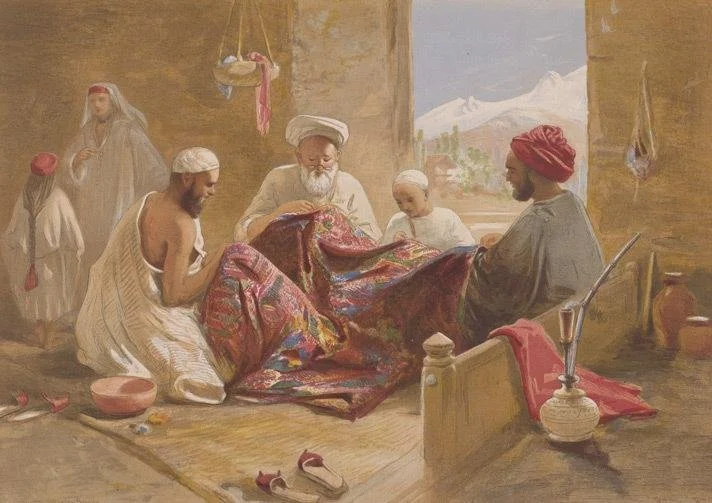
Séfi and Mortimer identify Rahat Ju, a seal-cutter of Srinagar, as engraver of the Kashmir Old Rectangular dies and plates, an engraving role, not a design commission or the printer of each sheet.[9]
In “More Kashmir Notes”, Masson describes an interview, arranged by Captain Stuart H. Godfrey, with the engraver of the rectangular dies, whom he does not name. His specimen book included a complete impression of the plate of twenty half annas and five one annas, which the engraver said he had printed himself, for his own satisfaction and for Maharaja Ranbir Singh’s approval; Masson called them essays because their paper differed from used stamps. The name Rahat Ju comes from the later handbook.[12][9]
Frames, engraved dates and motifs
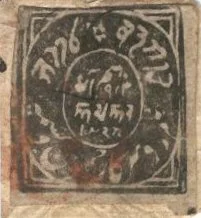
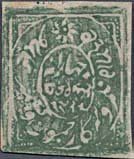
Kashmir designs have a complete outer frame line round each stamp, where the Jammu plate had a line only round its outer margin; their ovals are generally narrower, except on the first half-anna die. The four- and eight-anna dies give the date in Dogra only. The Kashmir form of the last numeral of 1923 has been misread as 1924; following Masson, both are 1866, though that does not mean every value was in use in 1866. Masson argued that the top emblem is a sun, not a lotus.[9][12]
Five implements, thirty-eight subjects
The provincial inventory is three single dies, for the half anna, four annas and eight annas, and two composite plates: twenty half annas in four rows of five above five one annas, and five quarter annas above five two annas. That is thirty-eight engraved subjects on five implements, not thirty-eight varieties.[9]
| Printing unit | Subjects | What it means for the collector |
|---|---|---|
| ½-anna single die | 1 | Early impressions, distinct from the later plate subjects |
| ½-anna / 1-anna composite | 20 + 5 = 25 | Four rows of five half annas above one row of five one annas |
| ¼-anna / 2-annas composite | 5 + 5 = 10 | Two rows; one value could be printed alone |
| 4-annas single die | 1 | Successive separate impressions |
| 8-annas single die | 1 | Successive separate impressions |
Recorded use and the start of an issue
Séfi and Mortimer cite Masson’s cover of 3 October 1866 for the first half-anna single die and found no genuine September use. They record that die as late as 22 April 1867, the plate-printed half anna from 1 April, and blue plate printings from 22 June. Bard places coloured plate printing in April 1867. The overlap in April means there was no single day of replacement.[9][3]
The Stamp-Collector’s Magazine asked when and by what order the stamps were authorised; Cracroft’s reply described their use but gave no dated order, and the editor’s guess of an issue some years after 1854 was inference.[10][11]
Two values on a plate, printed separately
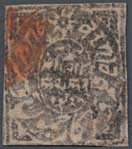
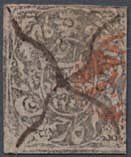
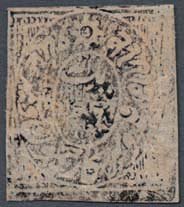
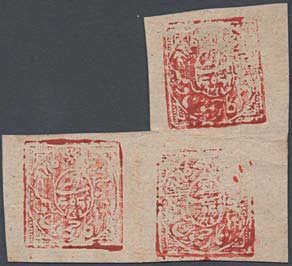
The quarter-anna/two-anna plate’s two values were printed separately. Hellrigl explains the black quarter-anna tête-bêche as two impressions of the quarter-anna half facing opposite ways. Describe a multiple by the part actually printed. A double impression is repeated printing; tête-bêche is orientation. Distinct colours usually meant inking only part of a plate, but Séfi and Mortimer note whole-plate printings at the start of the first plate’s use, in black, then in blue, which they take to have produced the one-anna error of colour.[8][9]
The high values were struck one at a time
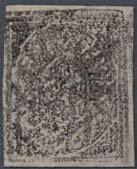
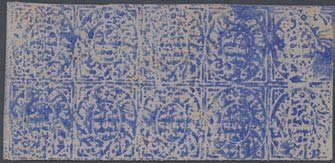
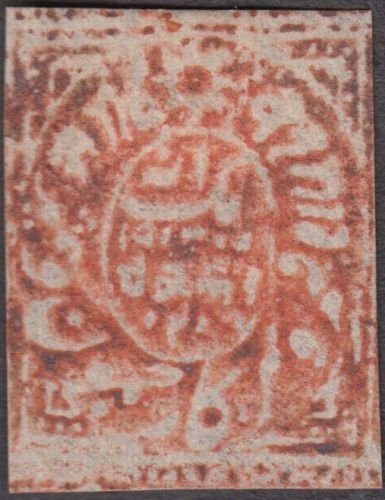
The four and eight annas came from single dies, so a group records where the printer placed each strike. Hellrigl illustrates inverted pairs and sideways impressions: a four-anna emerald block of twenty-two with one sideways stamp near the edge, and the Tapling eight-anna red, a block of seven with five upright and two sideways, correcting an older description of six with two inverted. The body text of Séfi and Mortimer says the four annas was not printed in red, but their footnote on p. 100 reports a used red copy.[8][9]
A qualified end to the provincial period
The provincial period is usually 1866–1878, but the handbook discusses a report in Le Timbre-Poste of January 1879 that the quarter and eight annas had been withdrawn while the four annas remained. A black Srinagar seal does not prove such late use: it was used from November 1877 to August 1879.[9]
Paper, colour and genuine implements
For issued Kashmir Old Rectangulars Séfi and Mortimer specify watercolour on native paper, some almost pelure-thin, with a scarce soft, woolly variety that can be mistaken for European paper. European-paper essays and trials are separate: the unfinished half-anna essay on p. 91 is greyish-black watercolour on coarse diagonally laid European paper. The first half-anna die lacks the dots on the outer frames of the others: design marks, not holes.[9][2]
The Stamp-Collector’s Magazine reported Cracroft’s samples as all rectangular: three pies dull black, six pies bright blue, and one, two, four and eight annas orange-red, light yellow, green and deep vermilion, thinly gummed, imperforate, on laid paper with lines running different ways in different values.[10]
A reprint can come from an original plate
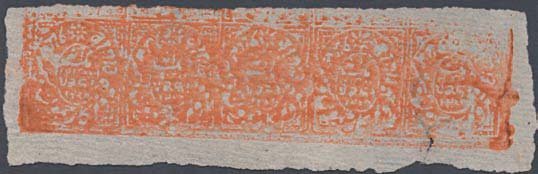
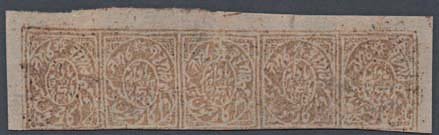
Hellrigl corrects an auction that called red one-anna oil-colour impressions in two opposed strips of five a proof: they are a reprint from the one-anna row of the original plate. Séfi and Mortimer reject the idea that every impression in Rahat Ju’s specimen book was an early printing. Dawson describes the issued Old Rectangulars as watercolour and the later reprints as oil colour, a rule for this series only, not for Jammu’s genuine oil-colour issues or the New Rectangulars; he also records watercolour trials on European laid and pelure papers.[8][9][7]
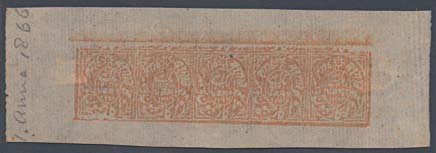
Evans in 1902 described European-paper watercolour impressions he had not seen used, including a set that A. H. Wilson said Sir Daniel Cooper had received from Kashmir in 1869, and an eight anna on thin yellowish wove found among reprints in June 1902; he called them doubtful. He traced the first black half anna to notices of November 1866 whose illustrations were fanciful and were copied by forgers, and his plate facing p. 76 mixes a reprint strip, a European laid strip and three imitations.[11]
Some false dies alter the frame
Dawson illustrates imitation two, four and eight annas: the false two annas too tall, with rounded corners; the false four and eight annas with two thin outer frame lines instead of one heavier line, and no small dots in the corners. These identify that family only. The editor of 1868 guessed at ivory dies and hand stamping; that was speculation.[7][10]
The stamps
The Kashmir provincial issues from the research checklist. The later common New Rectangulars and the postal card are in the Jammu and Kashmir articles.
| Period | Issue | Values |
|---|---|---|
| Late 1866–1867, reported | Single-die black Old Rectangular | ½ anna |
| Early 1867 | Composite-plate black Old Rectangulars | ½ anna, 1 anna |
| 1867–1878 | Coloured Kashmir Old Rectangulars | ¼ anna, ½ anna, 1 anna, 2 annas, 4 annas, 8 annas |
Sources
- [1] Winthrop S. Boggs, Jammu and Kashmir: Notes on Their Stamps, The Stamp Specialist Blue Book, 1941, pp.46–58; online transcription with editorial corrections.
- [2] Collecting Kashmir, Papers: illustrated paper study, with references to Tim Eames and Séfi and Mortimer.
- [3] Anthony S. Bard, “The Postal History of Jammu and Kashmir State: The Resident’s Dak 1867–1870”, Part One, Stamp Monthly, November 1982, pp. 85–88.
- [6] Christoph Gärtner, 17th auction, 7 March 2011, India and Indian States.
- [7] L. E. Dawson, “Indian Feudatory States—II: Jammu and Kashmir”, The Philatelist, April 1965, pp.152–155; Kashmir Old Rectangular and forgery discussion specifically pp.154–155.
- [8] Wolfgang Hellrigl, “The Tête-Bêches and Semi-Tête-Bêches of Jammu and Kashmir”, The London Philatelist, vol.115, October 2006, Kashmir Old Rectangular and reprint discussion pp.308–311.
- [9] A. J. Séfi and C. H. Mortimer, The Stamps of Jammu-Kashmir (1937).
- [10] “The Stamps of Cashmere”, The Stamp-Collector’s Magazine, vol. VI, 1 February 1868, pp.22–23; includes Major J. E. Cracroft’s letter from Rawul Pindee, 10 November 1867, to Alfred Smith & Co.
- [11] [E. B. Evans], “The Stamps of some of the Native States of India: The Kashmir Rectangular Stamps”, Stanley Gibbons Monthly Journal, vol. XIII, 30 August and 31 October 1902.
- [12] D. P. Masson, “More Kashmir Notes”, The Philatelic Journal of India, vol. 2 (1898), pp. 343–344; and Captain Stuart H. Godfrey’s translation of the early State post records, The Philatelic Journal of India, 1900.
Notes 0
Add what you know: a cover or stamp in your collection, a date or source, a correction or a question.
No notes yet.
Sign in to add a note.
Notes show straight away. Keep them kind and about the article; anyone can report one that isn't. House rules
