
Jammu: the Circular Dies and the Old Rectangulars, 1866–1878
Jammu’s provincial stamps: relay runners and the Dāk Zarūrī, the octagonal frank, the three circular dies ordered in Samvat 1922, the four-subject Old Rectangular plate, papers, inks and reprints.
Updated September 12, 2026
In this article
The early Jammu field within the Dogra state: circulars, Old Rectangulars, a disputed seal provisional and the beginning of the common issues.
A provincial field within one state
Jammu lay south of the Kashmir Valley, towards the Punjab plains and the exchange offices of British India. The word Jammu on a circular stamp belongs to the larger Dogra state that Gulab Singh founded in 1846; Ranbir Singh ruled when the stamps appeared in 1866. Separating the provincial issues in an album is useful, but they do not make a second state.[1]
The Provincial Gazetteer of 1909 describes Jammu town as the capital of Jammu province and the Maharaja’s winter headquarters, on the right bank of the Tawi, with the railway towards Sialkot on the opposite bank. That geography does not prove that a nineteenth-century cover went by rail.[17]
Before stamps: relay stations and the Jammu route
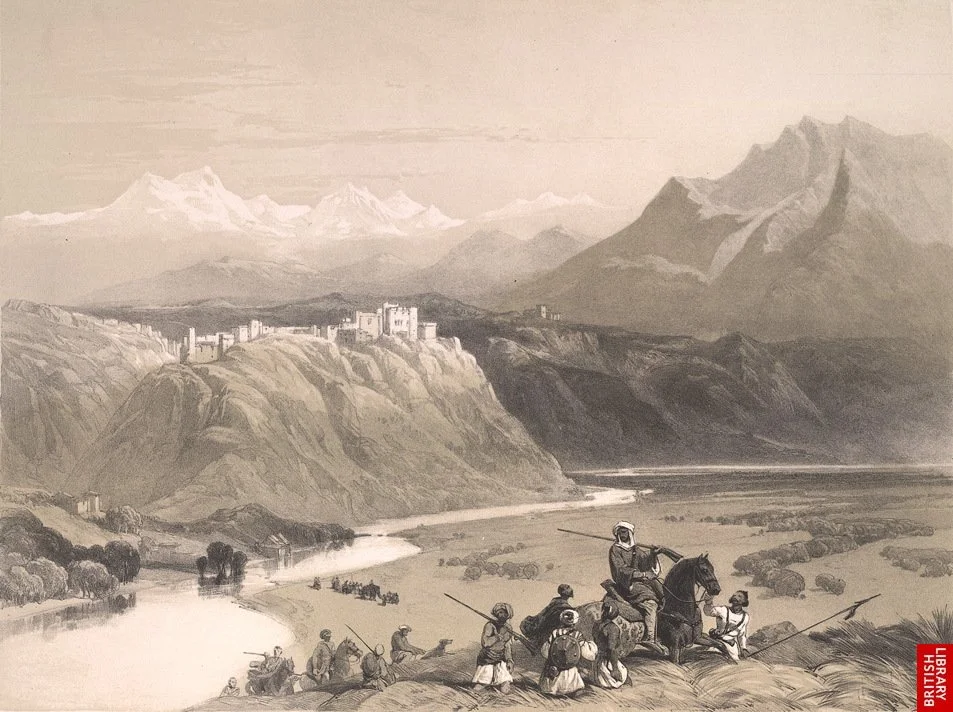
The earlier service depended on relays. Prassoli reconstructs a public route under Gulab Singh in 1847, then closer staging and more staff. A relay station, where a bag changed hands, was not a post office serving the public, and a list of stages is not a register of offices. He describes sealed bags, recorded departure times and checking at the next stage; those controls concern the bag, not a handstamp on every letter, and his delivery speeds are not schedules.[5]
Godfrey’s translation of March 1900 lists seventeen stations from Srinagar to Jammu through Shupiyan, then changes involving Banihal and closer relays, with dispatch slips, runners’ warning calls and pine torches at night. For urgent official dispatches Masson describes relays of runners by day and night with a timing sheet, recording passage between tehsils (1899) or from village to village (1900).[11][41][43]
The Gazetteer of Kashmir and Ladák (1890) quotes Girdlestone’s account of 1874: a daily packet limited to a few pounds, with a change of runner every two or three miles in the hills. Wingate later described newspapers, and sometimes letters, left behind because of the weight limit. Heavy rain slowed the Jammu route and snow could close the Banihal Pass despite shelters for the runners.[48]
The Dāk Zarūrī
The red impression called Dāk Zarūrī shows a sun with a human face and has no value. Masson read its Persian and Dogri inscriptions as “urgent letter” and “urgent document”, left the Shastri inscription untranslated, and traced an example to the specimen book of the Srinagar engraver Rahat Ju (his Rahat Joo). Séfi and Mortimer quote Godfrey attributing it to the Srinagar stonecutter who made it for Ranbir Singh. Masson relayed the Rev. Mr. Knowles’s report of used examples; Séfi and Mortimer doubted that such dispatches passed through a post office. No authenticated dispatched example, date of introduction or postage rate is known, and its likeness to the circulars does not identify their engraver.[41][43][44][45]
The octagonal frank
The Jammu frank invokes Sri Raghunath Ji and names the post office. Prassoli describes an octagonal class about 33 × 25 mm, distinct from the later smaller cancelling devices; his dates for its preparation come before the earliest dated examples he knew. Séfi and Mortimer linked the franks with specially important letters, while Prassoli argued, by deduction, for official letters carried without postage. Godfrey in 1900 noted that the diaries disagreed over the earlier seals and suggested one was an office seal and another a letter-paid mark. None of these makes every octagonal mark registration or express evidence.[5][11]
The circular dies and their difficult values
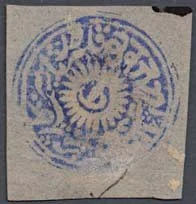
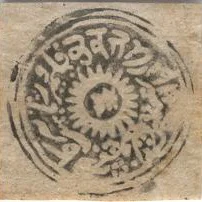
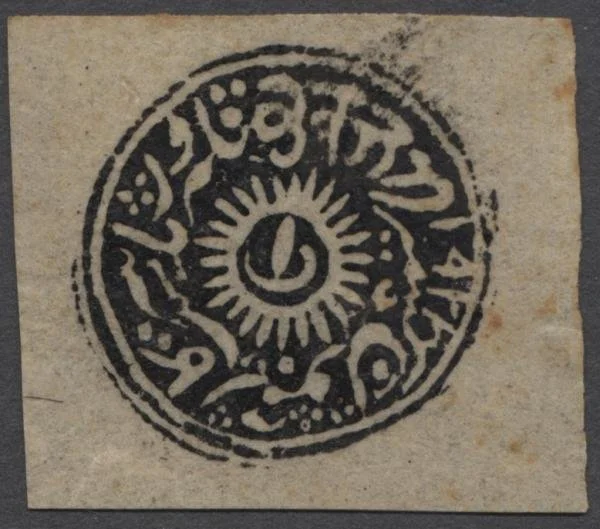
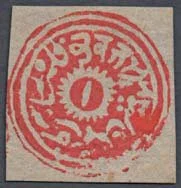
The circulars carry Dogri and Persian inscriptions with an abbreviated merchants’ notation for the value. The half anna, one anna and four annas have a long literature because earlier catalogue assignments were reversed; Stanley Gibbons reversed its one-anna and four-anna assignments in 1986. The date 1923 is in the indigenous calendar and corresponds to 1866. Séfi and Mortimer describe inscriptions in a double-lined circle round a central sun; the three designs were engraved separately on brass dies at Jammu, by an engraver they do not name. The numeral read as a quarter on the four annas is a quarter-rupee.[1][12]
The order for the dies
Godfrey’s translation of a Persian record, published in March 1900, says that Ranbir Singh ordered postal dies to be sunk at Jammu in Samvat 1922 under the supervision of Wazir Zorawar, the Tosha Khana or Treasury officer: a commissioner and a supervisor, not the craftsman. It names Dewa Ram Majjoo in stamp sales and records Gwash Ram Misre appointed as a vendor in Kashmir through Shah Diwan Singh, Zorawar’s agent.[11]
Godfrey had inspected old Persian documents and sales registers, but only his English account survives. It gives 11 Jeth Samvat 1923 for the instruction to put stamps on letters, with inconsistent Christian-era equivalents beside it, so the date is an attributed record, not a proved first day. In his February article he corrects his Sanskrit diarist’s Samvat 1921 for the circulars, and explains that the end of the Jammu seal inscription reads Sambat and a date, not Tibet.[11][10]
The Old Rectangular plate
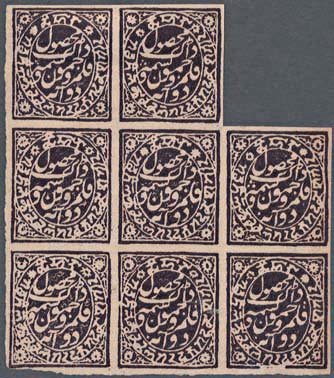
The Jammu Old Rectangulars are half anna and one anna. Boggs describes a four-subject unit of three half annas and one one anna, with the one anna at lower left. The ornament moves to the top of the outer oval; the handbook prefers a sun to the earlier star or lotus readings. The plate has an outer frame but no lines dividing the four subjects, so joined impressions can have very narrow separations without having been trimmed. Strips and blocks keep relationships a loose stamp loses.[1][12]
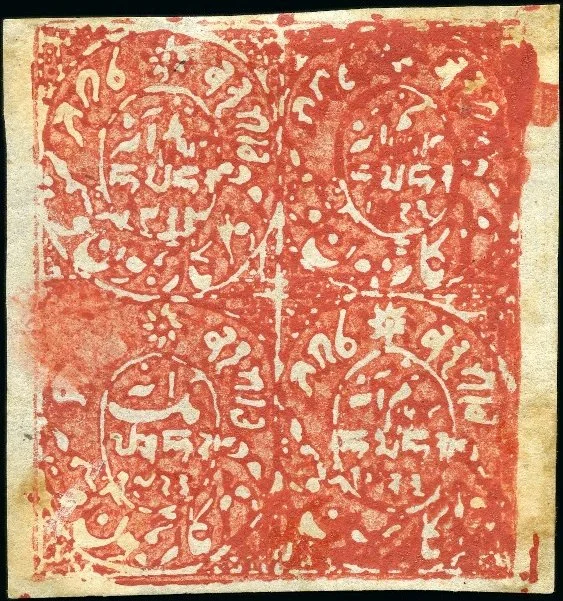
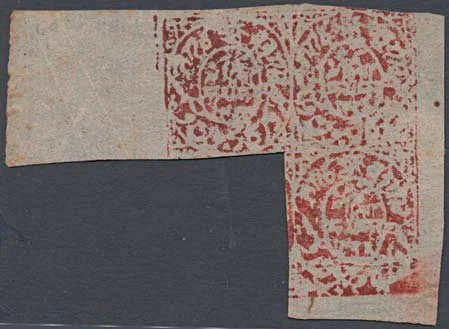
Séfi and Mortimer attributed the plate to Rahat Ju but left the circular-die engraver unnamed; later commentary doubts that his work extended to Jammu. They also record Godfrey’s recollection that stamps were printed in the provincial governors’ offices, without proof of separate establishments. “State Printer” should not become an invented office or firm.[12][13]
Why the circulars continued beside the rectangulars
Each impression of the four-subject plate gave only three half annas and one one anna, so the circular dies went on supplementing it, including the four annas, which the plate lacked. This was a Jammu pattern and should not be read into Kashmir’s separate programme.
Sideways plates and a complete sheet
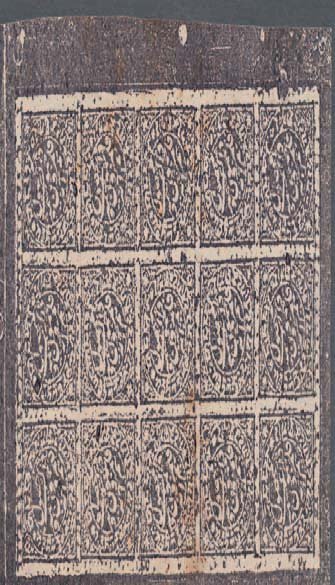
A sheet in the Tapling collection keeps sixteen impressions of the four-subject plate, four by four, with the two lower corner impressions turned sideways: 64 stamps in all. Hellrigl’s study separates three results: pairs of half annas with one sideways, half-anna and one-anna se-tenant pairs, and a pair of one annas with one sideways. He calls them semi-tête-bêches, keeping tête-bêche for inverted pairs. His counts of 2006 are not a current census.[7]
Paper and ink
Séfi and Mortimer separate the watercolour printings on native paper from Jammu’s oil-colour groups of 1877–78, on both native and European papers, with the circular dies and the four-subject plate working side by side. Native paper has irregular striations and varies in thickness; European laid has regular lines. Watercolour runs in water, so do not soak.[12][2]
Watermarks belong to particular papers. Séfi and Mortimer describe large armorial devices and lettering whose fragments fall on only some stamps, distinct from a watermark repeated on every stamp, and place two armorial types on both Jammu oil-colour papers of 1877–78 and New Rectangular papers. A stamp without a fragment is not proof of unwatermarked paper, and no paper maker is named. Scott (2009) says the stamps were issued without gum.[12][51]
Inverted circulars occur among reprints too
Inversion alone does not separate an original from a later impression. Hellrigl records inverted circular multiples among the Jammu watercolour and oil-colour groups and in reprints from the original dies; his red one-anna reprint sheet has 77 subjects in eleven rows of seven, with inverted impressions. Record value, die, paper, pigment, orientation and provenance separately, and keep reprints in a marked group.[7]
Towards the common rectangulars
The New Rectangular period began in 1878, with experimental perforations and early printings at Jammu before production moved to Srinagar. The value sits at the bottom of the inner oval; Dogri fills the outer oval, Persian the inner, with ornaments in the corners. The issued quarter anna came from a fifteen-subject plate, not the later twelve-subject plate from which no stamps were issued. Printed dots like perforations on the half-anna and high-value plates are design, not holes.[1][12]
Séfi and Mortimer list slate half annas and violet two annas among the early Jammu laid-paper printings of 1878–80, but some red printings cannot be given to one town without plate-state or cancellation evidence. The blue quarter anna on thin laid bâtonné paper of March 1880 they give to Jammu; modern commentary suggests Srinagar, with the plate still in State I.[20][13]
Sources
- [1] Winthrop S. Boggs, “Jammu and Kashmir: Notes on Their Stamps”, The Stamp Specialist Blue Book (1941), pp. 46–58, edited online transcription.
- [2] Collecting Kashmir, Papers: illustrated paper study, with references to Tim Eames and Séfi and Mortimer.
- [5] Armando Prassoli, “Kashmir: notizie sul servizio postale prefilatelico” / “Kashmir: pre-philatelic postal service”, pp. 95–118 (English, pp. 111–118).
- [7] Wolfgang Hellrigl, “The Tête-Bêches and Semi-Tête-Bêches of Jammu and Kashmir”, The London Philatelist, vol.115, October 2006, Jammu circular and Old Rectangular portions, pp.304–308.
- [9] Christoph Gärtner, Park Collection, 7 March 2011, lots 1206, 1207, 1223, 1237, 1242, 1271 and 1275.
- [10] Captain S. H. Godfrey, “The First Kashmir Postal Dies”, The Philatelic Journal of India, vol. IV, no. 2, February 1900, pp.52–54.
- [11] Captain Stuart H. Godfrey, “The First Kashmir Postal System”, The Philatelic Journal of India, vol. IV, no. 3, March 1900, pp.101–105.
- [12] A. J. Séfi and C. H. Mortimer, The Stamps of Jammu-Kashmir (1937).
- [13] Carol A. von der Lin, Collecting Kashmir, “The Printing Implements”, Old Period and New Rectangular Period sections.
- [17] Imperial Gazetteer of India, Provincial Series: Kashmir and Jammu, Calcutta, 1909, pp. 71–74 and 114.
- [20] A. J. Séfi and C. H. Mortimer, The Stamps of Jammu-Kashmir (1937), chapter XVIII, pp. 298 and 300–302: the Jammu and transition lists.
- [41] The Philatelic Record, vol. XXI, March 1899, pp. 53–54, “Kashmir Remainders”.
- [43] D. P. Masson, The Stamps of Jammu and Kashmir, Part I (1900), p. 36, §9, “Service Stamp”.
- [44] A. J. Séfi and C. H. Mortimer, The Stamps of Jammu-Kashmir (1937), pp. 69–70.
- [45] Collecting Kashmir, “The Zarūrī”.
- [48] Gazetteer of Kashmir and Ladák, 1890: Communications, Postal, and Levy of Kashmir postage.
- [51] Scott Standard Postage Stamp Catalogue, 2009, vol. 3, pp. 938–939.
- Mridu Rai, Hindu Rulers, Muslim Subjects (2004): Ranbir Singh’s accession in 1856, before Gulab Singh’s death in 1857.
Notes 0
Add what you know: a cover or stamp in your collection, a date or source, a correction or a question.
No notes yet.
Sign in to add a note.
Notes show straight away. Keep them kind and about the article; anyone can report one that isn't. House rules
