
Portuguese India 1898: Vasco da Gama and the Voyage in Pictures
The commemoratives of 1898 turned the voyage of 1498 into a sequence of stamps that the republic later adapted.
Updated May 23, 2026
In this article
The dates on the stamps tell a commemorative story
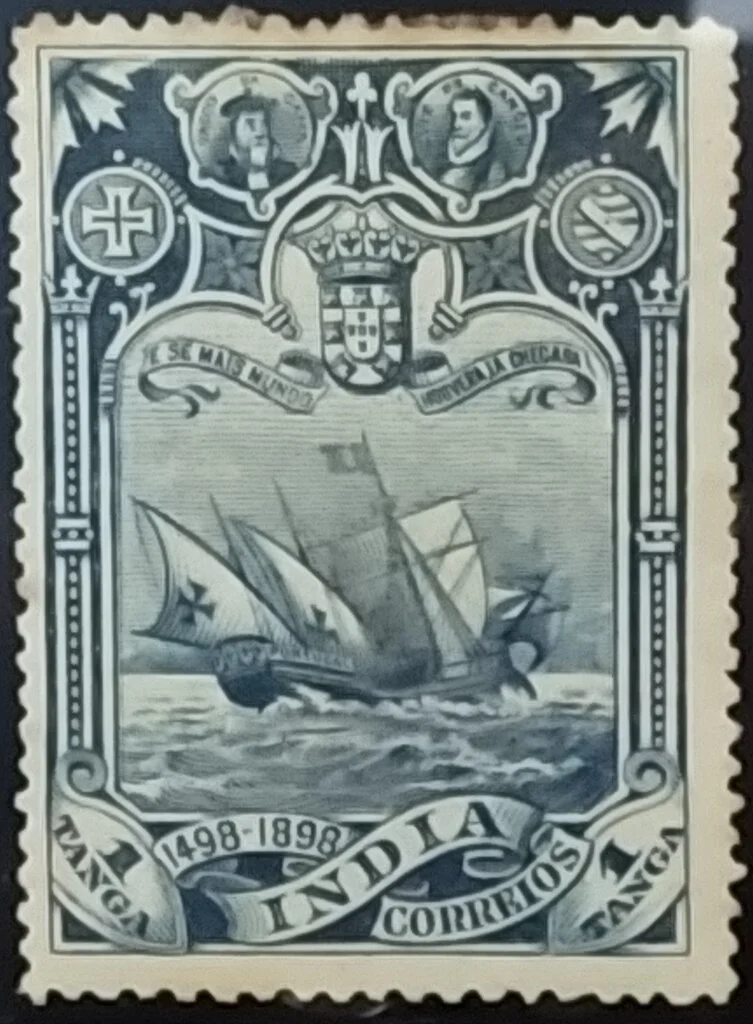
The issue of 1898 marked four hundred years since Vasco da Gama reached India; the paired dates 1498 and 1898 describe the anniversary. They do not date the Portuguese Indian post or its first stamps, which belong to 1871.[1][2]
The ship, the portraits and the historical scenes make the voyage into official imagery. Read it as the administration’s chosen commemoration, and keep the stamp’s issue date apart from the event pictured. An engraved ship can be a historical picture without being an exact reconstruction of the original vessel.[1][2]
A sequence, not one repeated picture
Different values show different scenes and subjects, so the set can be studied two ways at once: as a range of values for paying postage and as a story in pictures. The one tanga shown here depicts the São Gabriel; the rest of the series carries the story beyond one ship.[1][2]
A catalogue list gives the range of values, not the postage on every cover bearing them. A commemorative on a letter does not make it a philatelic production, but a pretty full set on an envelope does not prove ordinary commercial use either; route, charge and addressee still need checking.[1][2]
Look at each design
Identify the scene, the value and the territorial wording separately. Sailing ships appear elsewhere in Portuguese colonial stamps, so a shared subject is not an identification.[2][1]
A picture of the face shows the design and the value; it cannot certify the paper, watermark, exact shade or genuineness. Do not match a small photograph by colour when another value in the series uses related images; read the value tablet first.[2][1]
Republican wording on a royal commemoration
The remaining commemorative stocks were later overprinted REPUBLICA, and some got new values. These adaptations keep the royal symbols and anniversary dates while declaring a new authority: the apparently mixed message comes from reusing stock, not from an impossible chronology.[2][1]
A full description keeps the base value, the republican overprint and any surcharge apart. A new value can be much lower than the old; the old printed figure is evidence of the stock used, not an extra sum. Specialist study then looks at the particular overprint setting and colour, rather than treating every republican version as the same.[2][1]
The voyage came back in later issues
The commemorative of 1925 marks four hundred years since da Gama’s death, a different event from the voyage anniversary of 1898. The definitives of 1933 again used the São Gabriel beside the allegory Portugal, and the programme of 1938 returned to navigators and history.[1][3]
Related pictures should not merge these programmes into one long issue: their dates, purposes, inscriptions and values differ. A thematic collection can set them together to show how the empire presented itself, while a postal-history study keeps their supplies and periods of use apart. Later articles follow them in their own periods.[1][3]
From a picture to postal evidence
A stamp’s scene gives cultural context; a cover gives different information. Record the date, office, destination, class of mail and any other stamps before suggesting why a particular value was used. A ship on the stamp is no evidence that the letter travelled on that ship.[1][4]
A good exhibition page can tell both histories without mixing them: a caption about the voyage of 1498 beside the design, a dated route beside the cover. If the back or the rate notice is missing, say what is certain and leave the rest open rather than finishing an appealing voyage story by assumption.[1][4]
Sources
- [1] Bernard Towler, “Forgotten Countries: Portuguese India”, originally The Stamp Lover, reprinted in IND DAK, July–August 2001, pp. 103–104.
- [2] Evert Klaseboer, Catalogue, Portuguese India: 1886–1913.
- [3] William E. Steiner, Portuguese India album pages (46-page PDF).
- [4] “Cancellations of British & Portuguese India”, undated collection mounts nos. 1, 8 and 9.
- [5] Portuguese India one-tanga São Gabriel stamp, 1 April 1898. Via Wikimedia Commons; public domain.
Notes 0
Add what you know: a cover or stamp in your collection, a date or source, a correction or a question.
No notes yet.
Sign in to add a note.
Notes show straight away. Keep them kind and about the article; anyone can report one that isn't. House rules
