
Portuguese India: Places, Rulers and a Collecting Guide
A framework of places, dates, inscriptions and currencies for the stamps and postal items of Portuguese India.
Updated June 28, 2026
In this article
Start with separated places
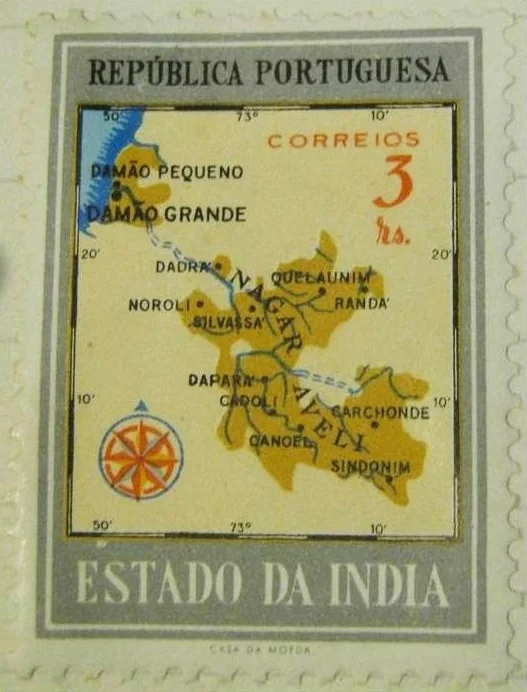
A Portuguese Indian cover can link small territories hundreds of kilometres apart, with British Indian country between them. Goa was the largest block on the western coast; Daman and Diu lay further north; Dadra and Nagar Haveli were inland dependencies attached to Daman. They shared an administration, but their addresses and histories cannot be squeezed into one town called Goa.[1][2][3]
Start with the office actually named on the item. The territory named on a stamp is its issuer; the postmark may name the place of handling, and the address the destination. All three can be different places, which is why an ordinary-looking letter across a border can tell you more than an unused high value.[1][2][3]
INDIA does not name one postal authority
The inscriptions follow a recognisable sequence: SERVIÇO POSTAL and INDIA PORT on the local numerals; INDIA PORTUGUEZA on the Crown and royal issues; republican wording and the figure of Ceres; and later ESTADO DA INDIA. The word INDIA alone cannot separate a Portuguese stamp from British Indian or independent Indian material.[1][4][5]
Keep spelling and accents when transcribing an inscription, but allow historical variants in an index. Damao and Damão can be the same settlement, while Panjim, Pangim and Nova Goa need care in context. A modern place-name helps readers find the office without replacing the wording on the stamp or letter.[1][4][5]
Royal portraits and republican authority
Luís I authorised local stamp production before the first issue appeared in 1871. The royal portraits came later: his embossed definitive in 1886, then Carlos I on the stamps in 1895. Carlos’s accession and his first appearance on these stamps were different events.[1][6]
The revolution of 1910 produced a republic, and REPUBLICA overprints adapted the old stock before proper republican definitives took over. A royal portrait under republican wording is understandable transitional material. Towler notes that Manoel II had no Portuguese India portrait issue; filling an album space for an expected reign would invent a stamp programme.[1][6]
A practical order for the collection
Divide the material first by postal function, then by issue family. Ordinary postage, postage due, postal tax and stationery did different jobs. Within postage, the local numerals, the Crown keytype, the royal portraits, the republican adaptations, Ceres and the later pictorials make a workable chronology. A surcharge should be described with its base stamp as well as its new value.[1][7][8]
This arrangement lets an album grow. A new paper or perforation can be added under its family without disturbing the political chronology, and a complete cover can sit beside its stamps with its own origin, destination and rate. Essays, reprints, forgeries and unissued proposals should be clearly labelled, not used to fill spaces meant for issued stamps.[1][7][8]
| Division | What decides it |
|---|---|
| Administration | Place, governing authority and date |
| Issue family | Inscription, design, value and production |
| Postal function | Postage, due, tax or stationery |
| Postal use | The complete item, dated marks, route and charge |
Read the units before adding the figures
The early stamps are in réis. The later postal scale is twelve réis to one tanga and sixteen tangas to one rupia, and an item of 1959 may instead be in escudos and centavos. Read each figure with its unit before adding up a franking or comparing it with a tariff.[9][1]
A currency reform could leave an older design carrying a later value; such an item has both a manufacturing history and an accounting history. Record the original value, the added value and the value it actually had. A tanga that matches a British Indian anna in number is not proof that the two paid the same charge or could be swapped.[9][1]
Several political endings
Dadra and Nagar Haveli changed hands in 1954, before Goa, Daman and Diu in December 1961. Diplomatic recognition came later, by the treaty signed in 1974 and in force from 1975. These are different acts and should stay distinct in a chronology.[3][10][11]
The change in the post needs its own evidence. An old handstamp can stay in use after the government changes, and unused stock still lying about does not prove continued sale or validity. The article on the transfer separates the political events, the reported last postal use and the never-issued INDIA 15 nP proposals; the last page of a collection should explain these rather than impose one end date on everything.[3][10][11]
Sources
- [1] Bernard Towler, “Forgotten Countries: Portuguese India”, originally The Stamp Lover, reprinted in IND DAK, July–August 2001, pp. 103–104.
- [2] Ministry of External Affairs, Government of India, Portugal—Bilateral Brief, 23 November 2022.
- [3] Administration of Dadra and Nagar Haveli and Daman and Diu, “About UT Administration”, historical section.
- [4] Evert Klaseboer, Catalogue, Portuguese India: 1886–1913.
- [5] “Cancellations of British & Portuguese India”, undated collection mounts nos. 1, 8 and 9.
- [6] Royal Philatelic Society London, publisher’s description of Luís and Eduardo Barreiros, Portuguese India: Postal History and the First Issues—From the “natives” to 1900 (2022), ISBN 978-1-913015-18-3.
- [7] Evert Klaseboer, Catalogue, Portuguese India: First primitive issues.
- [8] William E. Steiner, Portuguese India album pages (46-page PDF).
- [9] “Portuguese India”, journal report of 3 April 1959, p. 235, from Dr W. Alexander-Katz of Lisbon.
- [10] United Nations Treaty Series, vol. 982, No. 14321: treaty of 31 December 1974 recognising Indian sovereignty over Goa, Daman, Diu, Dadra and Nagar Haveli, p. 159; in force 3 June 1975.
- [11] “Indian Discovery”, Gibbons Stamp Monthly, February 1990: report of Pradip Jain’s study of the unissued INDIA 15 nP surcharges.
- [12] Portuguese India 3-réis territorial-map stamp, 1957. Via Wikimedia Commons; public domain.
Notes 0
Add what you know: a cover or stamp in your collection, a date or source, a correction or a question.
No notes yet.
Sign in to add a note.
Notes show straight away. Keep them kind and about the article; anyone can report one that isn't. House rules
