
The One Anna Red, 1854: Dies, Substituted Transfers and a Block Rebuilt
The lithographed one-anna red of 1854: its three dies, the substituted transfers on its stones, and how Sir Eric Studd rebuilt a block of four from two pairs cut from a cover.
Updated June 26, 2026
In this article
A companion with a history of its own
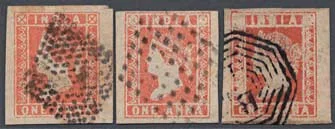
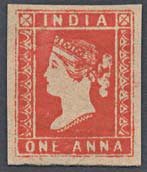
The one-anna red looks broadly like the half anna and was lithographed in Calcutta too, but it is not simply the same stamp in another colour: its die and transfer history has to be studied on its own terms. The official centenary album places it among the first four values for general use, and the photographs here show both unused and cancelled stamps.[1][4]
The ordinary issued stamp must be kept apart from early blue one-anna trials and from heads that were never issued. A blue item reading ONE ANNA may be an essay or a proof, not a rare issued colour. Its status depends on the design and on what is documented about that object, not on a colour name in a sale heading.[1][4]
A lithographed red stamp
Richard Morel’s study of the archives, published in 2022, places the printing of the deep-red one anna in July–August 1854, and the centenary album confirms that it was lithographed. The move towards stamps for general use was well advanced by then, but approval, printing, delivery and sale were still separate events.[2][4]
The catalogue divides the stamp into Dies I, II and III. The photograph of three stamps below shows that division as a group attributed by the catalogue; the picture alone does not identify every stone, and colour on a screen cannot separate all the catalogue shades. The shape and position of details are better first evidence than a red that has not been calibrated.[2][4]
Substituted transfers change the questions
A substituted transfer is not a printing accident on one stamp. It is a change to the set of transferred impressions from which sheet after sheet was printed. A surviving pair or block can therefore show relationships that a single stamp never can.[3]
Sir Eric Studd’s note begins with two horizontal pairs recovered from part of a cover. He identified the upper pair as positions 41–42, from a substituted transfer, and the lower pair as ordinary positions 49–50 of type A. Their watermark and a matching scrap of frame line at the cut led him to conclude that they had once been a single block of four, cut apart to fit the envelope. His reconstruction is an argument built from several related observations.[3]
Why a narrow strip of paper is evidence
The rebuilt block let Studd compare the join between the upper, substituted part and the ordinary lower part. He looked at the vertical spacing, the sideways alignment and an extra line below one subject. These are measurements of one multiple, not a rule that every one-anna stamp has an extra line in a predictable place.[3]
He reported differences between blocks and strips, among them an unusually small vertical gap in the rebuilt block and an extra line shifted sideways, and he openly raised other explanations, such as more than one stone with different spacing. Part of the note’s value is its restraint: an observation can be secure while its explanation stays open.[3]
| Evidence | Use in the argument |
|---|---|
| Matching watermark | Supports a link between the two separated pairs |
| Scrap of frame line at the cut | Supports their having been next to each other |
| Positions 41–42 and 49–50 | Places the proposed join in the pane |
| Different vertical spacing | Tests how the upper and lower parts relate |
| Extra line shifted sideways | Challenges an over-simple explanation of where it came from |
A sheet watermark is not a stamp-sized emblem
The large arms watermark belongs to the sheet of paper. A single stamp may carry a fragment that is hard to read without knowing which way up it was or comparing it with others. Multiples can keep the watermark running across several stamps, evidence quite independent of the portrait.[1][3]
Identifying the die, plating the position and examining the paper should therefore support one another. An opinion on the die narrows the search but does not replace testing the proposed position. If only the face of a stamp is photographed, a watermark link stays dependent on whoever reports it.[1][3]
Read the whole account, not just the one anna
A one-anna stamp could be used alone, in a pair or with other values. What it paid depended on the route, the weight and the service. A letter abroad may show an inland payment alongside an onward charge, or an endorsement about how it was to be sent, and a British address does not prove that the stamp paid for the whole voyage.[4][5]
The catalogue’s unused and used examples are good references for the design; a complete cover would add the dated postal setting. A pair photographed without its back cannot show an arrival date or that it has not been repaired. A study of postal use should keep those levels of certainty apart.[4][5]
What a one-anna study should keep
Record the die, the stone or transfer, the watermark and the provenance as separate facts. When an older writer’s position numbers are used, say whose system it is, and do not quietly translate a historical code into a different modern numbering.[3][4]
This article sets out the main divisions and one investigation of substituted transfers. A full plate-by-plate reconstruction and a complete count of shades are still to be written.[3][4]
Sources
- [1] Indian Posts and Telegraphs Department, India Postage Stamp Centenary 1854–1954: Souvenir Album, 1 October 1954, plate 1 and its commentary, p. 1.
- [2] Richard Scott Morel, “India: Discovery of the Earliest Essay for the 1854 Stamp Issue”, The London Philatelist, vol. 131, October 2022, pp. 424–430.
- [3] Sir Eric Studd, “India: Substituted Transfers of the One Anna Red, 1854”, The London Philatelist, from p. 87, with its continuation and block illustration.
- [4] Auktionshaus Christoph Gärtner, India: Park Collection, auction catalogue, 7 March 2011.
- [5] Geoffrey Clarke, The Post Office of India and Its Story, John Lane/The Bodley Head, London, 1921, chapters II–III and XIX.
Notes 0
Add what you know: a cover or stamp in your collection, a date or source, a correction or a question.
No notes yet.
Sign in to add a note.
Notes show straight away. Keep them kind and about the article; anyone can report one that isn't. House rules
