
Portuguese India 1871: the First Locally Printed Stamps
Five first values, the New Goa press, and the difference between an order to print and a stamp that was issued.
Updated September 11, 2026
In this article
The first issue was a postal reform
On 1 October 1871 Portuguese India’s first stamps came into use. Their central numerals and oval inscriptions were modest to look at, but the change was administrative: a paper stamp could now record prepayment in an organised public post. It did not create communication between Goa and Portugal from nothing.[1][2][3]
Luís I had authorised local manufacture in 1869, so the issue belongs to the New Goa press, not to the Portuguese keytype programme that came later. The usual name nativos refers to this local production; it is not a label for the people who used or made the stamps.[1][2][3]
Five first values
The first programme had 10, 20, 40, 100 and 200 réis, prescribed in black, red, blue, green and orange. This list of five is a firmer starting point than one large group of every numeral stamp made in the years that followed.[3][1]
Keep value, die and paper in separate fields. A later stamp can repeat a first value while differing in background, lettering or perforation, and a higher value ordered after the first issue is not a sixth value of the first day. The table summarises the programme; it does not list every shade, reprint or abnormal impression.[3][1]
| Value | Prescribed colour |
|---|---|
| 10 réis | Black |
| 20 réis | Red |
| 40 réis | Blue |
| 100 réis | Green |
| 200 réis | Orange |
Read the frame and the numeral separately
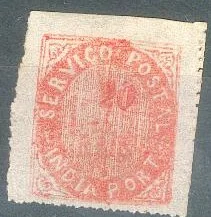
SERVIÇO POSTAL runs across the top of the design and INDIA PORT across the bottom; the value sits in an oval with a lined background. Letter size, separators, the form of REIS and the inner border become useful marks when several native dies look alike.[3][4]
The value was a separate element in manufacture, so an abnormal numeral has to be told apart from a flaw in the surrounding design; a double numeral and a doubled frame are different questions. Look at the whole impression first, then the figures, and do not let a dramatic number decide the identity of an otherwise unmatched stamp.[3][4]
What the production debate changes
Leote discusses how hard it is to explain the stamps by one rigid method of printing whole sheets. Uneven impressions and odd pairs led him to doubt that the main impressions were always made together. His reconstruction, and the observations behind it, are an argument, not a surviving press record.[3][4]
For the collector, the practical lesson is to keep multiples. Position, spacing and strength of impression can tell what single stamps cannot. A scan may show how impressions relate, but it cannot show paper thickness or exactly how they were made, so say which feature you observed and which explanation you are testing.[3][4]
An order is not proof of issue
The later 300, 600 and 900 réis need care. Leote separates the order for higher values from what was actually made in the first die and its printing on thick paper: he accepts the later 300-réis material but disputes the usual attribution of first-die 600 and 900 réis. Later die families should not be confused with that argument.[3][4]
This shows why an official instruction and an issued stamp are different evidence. The instruction proves intention; an authenticated stamp, a dated use and production papers can prove it was carried out. A large numeral with an old catalogue listing does not settle every question about its status.[3][4]
A record that stays useful
Start with value and colour, then add the visible die features. Note paper transparency or thickness only after handling the stamp. Measure the perforation on each side rather than forcing irregular perforation into one average, and tell a damaged edge from a genuinely imperforate one.[4][1]
A good reference picture shows the whole stamp and its margins, and says whether it is an issued stamp, a proof, a reprint or a disputed item. The red 20 réis shown here illustrates the design but is not given a first-issue die; that keeps it useful without turning a pretty picture into an unsupported identification.[4][1]
Three makers and two language versions
Joaquim Leote, citing José António Ismael Gracias, credits the design to the engineer Assa Castel Branco, the plate-making to the smith Goindosó and the printing to the National Press typesetter Silvestre de Sousa. These are three separate attributions at second hand, and the variant spellings of Goindosó should not be merged into a modern biography without evidence.[5][6][7]
Leote gives Portaria 284, Boletim 63, 16 August 1871, for the reform and Portaria 319, Boletim 75, 26 September 1871, for putting it into effect from 1 October. A review in O Occidente of 11 February 1890 (p. 40) confirms that Gracias’s 135-page memoir from the National Press existed and gives its administrative background, but does not confirm the passage on the makers.[5][6][7]
The Portuguese and English versions of Leote’s page 22 differ. The Portuguese says British stamps were needed for letters passing through British India, in addition to postage for the Portuguese stage; the English adds an exception for Portuguese territory. Follow the Portuguese until the original regulation is found; neither version alone fixes the charge on a particular cover.[5][6][7]
Knowing who made the stamps does not settle whether they were handstamped or printed in sheets, the order of the dies, the papers, the reprints or the forgeries. The existing identifications of values and the dispute over the high values stand.[5][6][7]
Permission to buy machinery is not a production record
The reform law of 1869, discussed in the article on the post before stamps, allows spending on manufacturing machinery but names no machine, supplier, invoice, delivery, printing method or output. Its dates (decree of 16 August, royal law of 1 September, publication of 7 September) are none of them a first-issue date, and the law cannot settle the local notices of 1871 or what equipment the workshop actually had.[8][9]
Because the law required the government to account to the Cortes, the ministry’s reports, purchases and shipping records are a promising line of research. Cunha’s Index Remissivo de Legislação de Fazenda desde 1850 a 1880 (p. 98) points to the law. No tariff can be read from the permission to spend or from the stamp values.[8][9]
Sources
- [1] Bernard Towler, “Forgotten Countries: Portuguese India”, originally The Stamp Lover, reprinted in IND DAK, July–August 2001, pp. 103–104.
- [2] Royal Philatelic Society London, publisher’s description of Luís and Eduardo Barreiros, Portuguese India: Postal History and the First Issues—From the “natives” to 1900 (2022), ISBN 978-1-913015-18-3.
- [3] Joaquim Leote, The Native Stamps of Portuguese India: Some Considerations, 3rd electronic edition, Edições Húmus, January 2006, ISBN 972-99937-0-X, pp. 11–31.
- [4] Evert Klaseboer, Catalogue, Portuguese India: First primitive issues.
- [5] Joaquim Leote, Os Selos Nativos da Índia Portuguesa: Algumas Considerações, 3rd electronic edition, January 2006, pp. 2 and 22.
- [6] Joaquim Leote, The Native Stamps of Portuguese India, 3rd electronic edition, p. 22 (English version).
- [7] O Occidente XIII, no. 401, 11 February 1890, p. 40, “Publicações”.
- [8] Collecção Official da Legislação Portugueza, Anno de 1869 (Lisboa: Imprensa Nacional, 1870), p. 407, Direcção Geral do Ultramar, 2.ª Repartição.
- [9] Henrique Augusto David e Cunha, Index Remissivo de Legislação de Fazenda desde 1850 a 1880, p. 98.
Notes 0
Add what you know: a cover or stamp in your collection, a date or source, a correction or a question.
No notes yet.
Sign in to add a note.
Notes show straight away. Keep them kind and about the article; anyone can report one that isn't. House rules
