
Jammu and Kashmir: Follow the Paper, Question the Impression
The Dogra state ran its own posts from 1866 to 1894: Jammu’s circulars, the provincial Old Rectangulars, the common New Rectangulars, the rulers, a chronology and the checklist.
Updated August 29, 2026
In this article
Circular stamps, rectangular designs and a long history of scrutiny turn this short series into a lesson in reading evidence.
The state behind the stamp
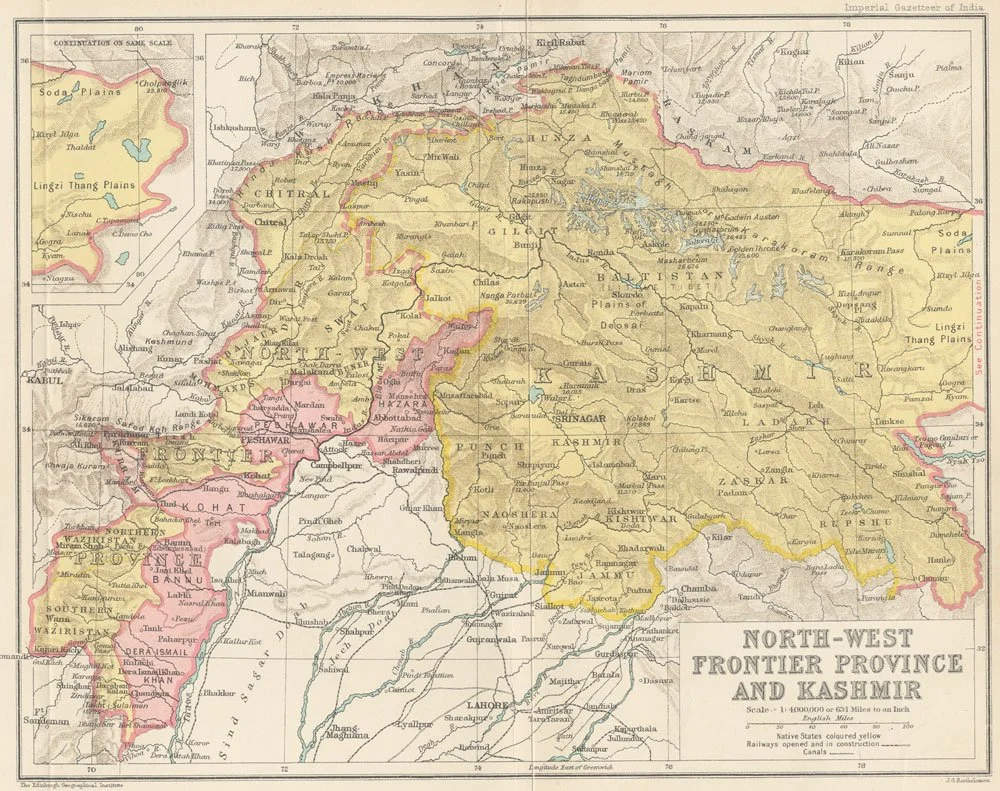
The state lay in the north-western Himalayas. Jammu stood towards the southern plains; Srinagar was in the Kashmir Valley, with Ladakh farther east. Its capitals were Srinagar and Jammu, and its rulers were the Dogra Maharajas. The Gazetteer map of 1909 shows the territory and claims of its time, not today’s borders or sovereignty.
The princely state took shape under Gulab Singh in 1846, after the Anglo-Sikh war and the treaties of Lahore and Amritsar. It joined Jammu, the Kashmir Valley and wide Himalayan regions, including Ladakh, so the name on its stamps describes a state much larger than the valley. Ranbir Singh and Pratap Singh ruled while it issued its own stamps; Hari Singh belongs to its later political history.
The rulers
| Reign | Ruler | Note |
|---|---|---|
| 1846–1856 (died 1857) | Gulab Singh | First Dogra Maharaja; Mridu Rai dates the transfer of the throne to his son to 1856, older summaries use his death in 1857 |
| 1856–1885 | Ranbir Singh | The circulars and the provincial Old Rectangulars appeared in his reign; the New Rectangulars in 1878 |
| 1885–1925 | Pratap Singh | Succeeded in September 1885; the separate stamp system ended in 1894; died 23 September 1925 |
| from 1925 | Hari Singh | Pratap’s nephew and successor; ruler at the transfer of power in 1947, long after the state’s own stamps |
Pratap Singh’s reign is not the same as uninterrupted power. Aitchison records administration by a council from 1889, a partial restoration in November 1891, wider responsibility under conditions in October 1905 and full administrative powers again in March 1921: stages of administration, not four accessions.[K14][K15]
One collection, many questions
The British Library’s Tapling Collection catalogue records a box for Cashmere, or Kashmir: 63 pages holding 1,405 items, catalogued as 1865–1886. Those figures describe a collection, not a count of designs, and the date range does not prove stamps were issued in 1865. Even a reliable record answers only the question it was made for.[1]
For the stamps themselves, a good starting point is L. E. Dawson and E. A. Smythies’s handbook of 1937, The Postage Stamps of Jammu & Kashmir Simplified. It begins with the seals, then separates the first joint circular issues, the provincial issues and the later joint rectangulars, with official stamps, proofs, reprints and forgeries in chapters of their own. Following that sequence keeps a collector from treating every unfamiliar impression as a separate postal system.[2]
Choose the right scale
These articles work at two scales. The Jammu and Kashmir articles cover the common issues, the official black printings, the postal cards and the later native post; the Jammu and Kashmir provincial articles cover the earlier local issues and their routes. A provincial heading does not mean a separate sovereign state, and a combined heading must not hide the mixed-value plates and different printing arrangements.[2][4]
Go from design to physical evidence: where the value sits, the printing implement, the paper, the ink and the separation. Only then propose a catalogue number. Proofs from genuine implements and later reprints belong to the history of the plates, not automatically to the issued stamps, and a complete cover adds dated use and route evidence that the face of a stamp cannot.[2][4]
A shape is only the beginning
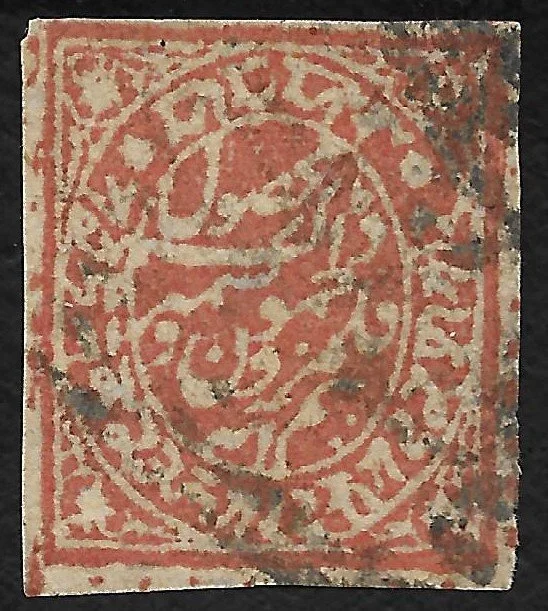
The handbook places the first circulars in 1866–67 and the provincial issues in the wider period 1866–78, then divides the joint New Rectangulars into 1878–83 and 1883–94. These are study categories for overlapping evidence; they do not mean that Jammu and Kashmir used wholly separate stamps until one sudden change. The red two-anna stamp shown here is catalogued by its source as an issue of 1878.[2][3]
What an engraver’s proof could reveal
In “Kashmir Notes” (The Philatelic Record, 1899), D. P. Masson described an investigation by Captain Stuart H. Godfrey, who found the engraver of the genuine rectangular dies and examined proofs in his specimen book. The impressions matched dies later defaced, and among them was a composite sheet of twenty half-anna and five one-anna subjects. Masson told the proofs from used stamps by their paper, and the engraver confirmed he had made the sheets for himself and for the Maharaja’s approval. An impression can come from a genuine implement without being an issued stamp.[4]
Why the whole object matters
The 1937 handbook gives separate chapters to proofs, reprints and forgeries, including the “Brighton” forgeries of 1900–02, and makes telling originals from imitations one of its aims. The problem was already in the literature a generation after the stamps stopped being used. Paper, ink, cancellation and provenance deserve as much attention as design: a colour on a screen cannot identify a pigment, and an old-looking impression cannot prove postal use.[2]
Chronology
| Date | Event |
|---|---|
| 1846 | The Dogra state formed under Gulab Singh |
| 1866 | Circular stamps introduced; the Kashmir half-anna single die in use by 3 October 1866 |
| March 1867 | The Resident’s Dak rules, notice No. 673 (16 March in Wakefield, 23 March in Bard) |
| 1867 | The Jammu and Kashmir Old Rectangulars |
| 1877 | The disputed Jammu iron-mine seal provisional |
| 1878 | The common New Rectangulars, with perforation experiments; the first black officials |
| 1883 | The quarter-anna postal card |
| 1890 | Agreement with the Imperial post; railway from Sialkot to Jammu |
| 1890–1894 | The three-ring cancellation system |
| 1 November 1894 | The native post taken over by the Imperial post (Singhee); 1894 and an initial term of twenty-five years in the official accounts |
| 23 August 1898 | The State Council names the Rev. C. B. Simons agent for the remaining stamps |
| February 1898 | Postal dies and plates defaced |
The stamps
The issues and their values, from the research checklist: the circular dies, the Jammu and Kashmir Old Rectangulars, the disputed seal provisional, the New Rectangulars printed at Jammu and at Srinagar, the later New Rectangulars and the Leh bisects. The official black printings, shades, paper varieties, plate states, proofs, reprints and telegraph stamps are not listed. Values are in annas.[2][K12]
| Period | Issue | Values |
|---|---|---|
| 1866–1878 | Circular dies | ½ anna, 1 anna, 4 annas |
| 1867–1878 | Jammu Old Rectangulars | ½ anna, 1 anna |
| 1877 | Jammu seal provisional (contested provisional) | ½ anna (no value inscribed) |
| 1866–1878 | Kashmir Old Rectangulars | ¼ anna, ½ anna, 1 anna, 2 annas, 4 annas, 8 annas |
| 1878–1880 | New Rectangulars: Jammu | ¼ anna, ½ anna, 1 anna, 2 annas, 4 annas |
| 1880–1882 | New Rectangulars: Srinagar | ¼ anna, ½ anna, 1 anna, 2 annas, 4 annas, 8 annas |
| 1883–1894 | Later New Rectangulars | ⅛ anna, ¼ anna, ½ anna, 1 anna, 2 annas, 4 annas, 8 annas |
| 1883 | Leh bisects (provisional) | ½-anna red bisect, 1-anna orange bisect |
Sources
- [1] British Library, Philatelic 69/11, Tapling Collection Box 11: Kashmir collection scope and extent.
- [2] L. E. Dawson and E. A. Smythies, The Postage Stamps of Jammu & Kashmir Simplified (1937), contents and general outline.
- [3] Wikimedia Commons, Jammu and Kashmir two-anna stamp of 1878: image record.
- [4] D. P. Masson, ‘Kashmir Notes’, The Philatelic Record, 1899, vol. 21, p. 52 (from The Indian Philatelist).
- [K12] A. J. Séfi and C. H. Mortimer, The Stamps of Jammu-Kashmir (1937), chapter XVIII, pp. 300–302: the Jammu and Srinagar New Rectangular printings.
- [K14] Imperial Gazetteer of India, Provincial Series: Kashmir and Jammu (Calcutta: Superintendent of Government Printing, 1909), pp.71–72.
- [K15] C. U. Aitchison, A Collection of Treaties, Engagements and Sanads, vol. XII, revised and continued up to 1929 (Calcutta: Government of India, 1931), p.9.
- Mridu Rai, Hindu Rulers, Muslim Subjects (2004): Ranbir Singh’s accession in 1856, before Gulab Singh’s death in 1857.
Notes 0
Add what you know: a cover or stamp in your collection, a date or source, a correction or a question.
No notes yet.
Sign in to add a note.
Notes show straight away. Keep them kind and about the article; anyone can report one that isn't. House rules
