
The Scinde Dawk, 1852: Asia’s First Adhesive Postage Stamps
A half-anna provincial experiment in Sindh: three fragile forms, red, white and blue, the argument over who made them, their postmarks, forgeries and the recall that was not carried out.
Updated October 8, 2026
In this article
A small stamp with a large job
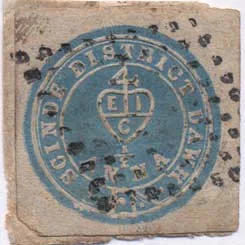
At first sight the red Scinde Dawk looks more like a seal than a postage stamp. Its raised merchant’s mark sits inside a circular inscription, and the fragile wafer cracks easily at the edge. Yet its purpose was plainly postal: a half-anna adhesive that showed the postage had been paid in advance. The experiment belonged to Sindh, not to an all-India stamp issue.[1][2][6]
That is where the story begins. These stamps were used in a provincial post under Bartle Frere. Two years later a different programme produced the familiar Queen Victoria stamps for use across British India. The Scinde Dawk is best understood as a local reform that came to hold a very large place in the history of stamps.[1][2][6]
Sindh, its post and the people behind the reform
Period sources write Scinde, Sind and Sindh for the province, and Kurrachee for Karachi; the province is in present-day Pakistan. It must not be confused with Hyderabad State in the Deccan: Hyderabad here means the city in Sindh. Bijo Paul names Karachi, Hyderabad, Sukkur and Shikarpur as the important postal centres, a good starting point for research office by office, though not a complete dated list.[4][1][2]
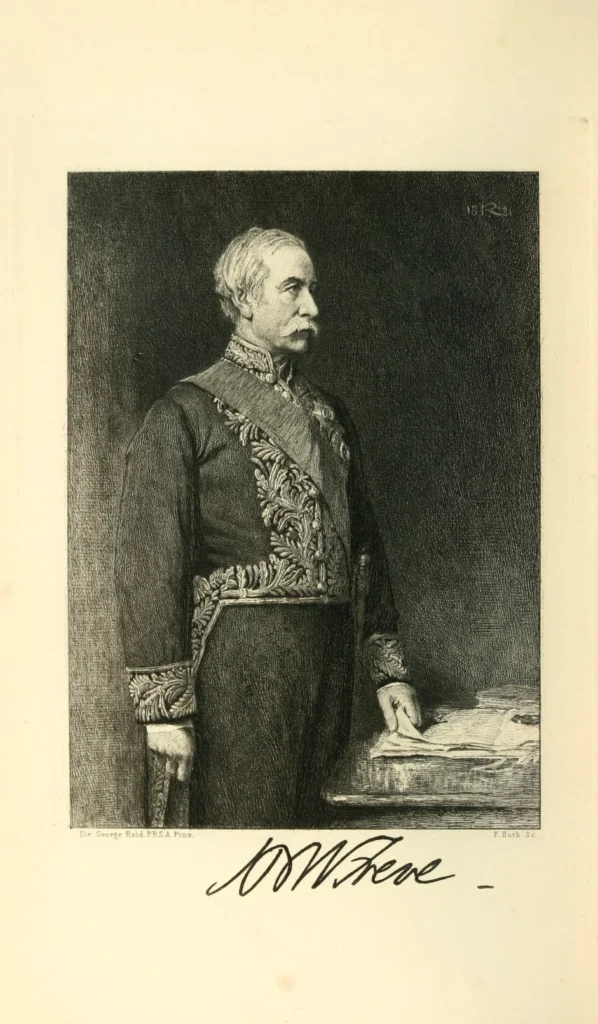
Frere’s part was administrative. D. E. Wadia places the experiment in Frere’s time as Commissioner; Pradip Jain names the Karachi postmaster, Edward Lees Coffey, as his collaborator. A stamp accounts for a payment, but it does not carry a letter, so the prepayment of postage should be kept apart from the horses, camels, runners and other means that actually moved the mail. The slogan that stamps replaced runners squeezes two separate changes into one.[4][1][2]
All three forms of the stamp share one value, half an anna. A full study of the rates still needs the regulations: the value on a stamp does not tell us every weight step, permitted destination or extra charge, and no weight limit is given here because none has been confirmed.[4][1][2]
What can be dated
Wadia gives 1 July 1852 as the day the half-anna stamps were introduced. In his account the red wafer came first, followed by the colourless embossing on paper and then the blue; Paul follows the same order. This is the usual reconstruction of the sequence, but it does not give separate, documented first days for the white and the blue.[1][4][5][7][10]
For that reason the three forms are dated here to the period 1852–1854, rather than with an invented date for each colour. Catalogue numbering does not prove the order of issue either: in the Stanley Gibbons catalogue used here the white is S1, the blue S2 and the red S3.[1][4][5][7][10]
The State Bank of Pakistan Museum gives 30 September 1854 as the date of withdrawal. That is an administrative date, not proof that every office stopped selling or accepting the stamps on that day; Col. D. R. Martin’s note of 1965, described below, reports that the recall was neglected and that stamps went on being sold. The last genuine use can only come from a census of surviving examples.[1][4][5][7][10]
| Date or period | Event or evidence | Qualification |
|---|---|---|
| 1 July 1852 | Introduction, reported by Wadia and later writers | Separate release days for white and blue not established |
| 21 August 1852 / 25 September 1852 | Two different dates of archive letters discussed in the printer correspondence of 1950 | Two different documents; not to be merged into one |
| 28 April 1853 | Frere’s letter cited in Jain’s study of 2017 | Archive evidence as reported |
| 30 September 1854 | Withdrawal date given by the State Bank of Pakistan Museum | A policy date, not a count of every surviving use |
| February 1857 report, described in January 1965 | Neglected recall and continued sales, reported by Martin | An archive reference as reported by Martin |
| September 2017 | Jain publishes an unused red example | A statement as of 2017, not a current census |
After withdrawal: the recall that was not carried out
The story did not end neatly in September 1854. In a note of January 1965, Col. D. R. Martin reported an account by the Postmaster-General of February 1857: Frere had ordered Coffey to recall the old stamps in September 1854, but the order had been neglected. The enquiry that followed was about which revenue account should receive the money. Continued supply was therefore an administrative matter as well as a question of finding a late cancellation.[10][5]
Martin gives 51,989 stamps issued after October 1854: 22,484 sold, with the money entered in the general cash collections, and 29,505 returned to the Karachi treasury to be destroyed. These are the figures of that account; they are not the total printed, a count by colour, or a count of the stamps that survive. The instructions also covered stock held by Kardars, the local revenue officials, and by local offices.[10][5]
In the same note Martin argued that a blue half-anna with the numeral 96 in Renouf’s Type 4, illustrated in December 1964, must have been used at Hyderabad in Sindh after April 1855. That is his argument for a date, not a date that can be read on the stamp. Gärtner’s lot 9, shown below, is catalogued as numeral 95 and is a different stamp. Neither an unattributed numeral nor the withdrawal date of 1854 can settle the postal history of a particular stamp.[10][5]
| Recorded category | Number of stamps | What it means |
|---|---|---|
| Issued after October 1854 | 51,989 | Supply as reported, not the total original production |
| Sold; money entered in the general cash collections | 22,484 | Sales accounted for, not individually dated uses |
| Returned to the Karachi treasury to be destroyed | 29,505 | Returned stock; no breakdown by form or colour |
Three forms, one half-anna value
How the three were made matters more than the simple labels red, white and blue. The red is a raised impression in brittle vermilion wafer. The white is a colourless impression in paper. The blue is embossed in colour on paper. Calling all three “wax stamps” hides the first and most useful distinction.[1][2]
The round design should also be kept apart from the shape of the paper that survives around it. White and blue stamps may keep rectangular margins, while others were cut close round the design. A stamp cut to shape has lost the surrounding paper that might have kept a dividing line, part of the next impression or signs of how it was stuck down.[1][2]
| Form | Value | How it was made | SG number |
|---|---|---|---|
| White | ½ anna | Colourless embossing on paper | S1 |
| Blue | ½ anna | Coloured embossing on paper | S2 |
| Red | ½ anna | Embossed vermilion wafer | S3 |
The red wafer: survival and condition
The red form is a conservation problem from the start. Its brittle raised surface cracks and flakes, and a handsome face does not tell the whole story of its condition: the edge, the backing, how it is attached and any restoration all need looking at. Wadia recommends a cushion for displaying such fragile pieces; that is no reason to handle an original wafer more than necessary.[1][2]
Writing in 1962–1963, Wadia said he knew of no unused red. Jain’s article of 2017 illustrates a red described as unused, with Royal Philatelic Society London certificate number 134987, and traces it from the Singapore exhibition sale of 1995 through later exhibitions. That later publication overturns the old claim that no unused red can exist, though it does not amount to a complete count of the examples known today.[1][2]
White and blue: paper, lines and multiples
The white embossing can be hard to read, because its detail is in relief rather than in coloured ink. Wadia discusses differences in the thickness of the paper and how light held behind a stamp shows up thinning. A stamp that looks clean from the front may still have damaged paper.[1][4]
Wadia notes that some blue stamps have a fine blue line in the margin, while some multiples have none. He also describes an irregular unused multiple of the white with fourteen impressions, which he reads as an original eighteen with four removed. Its uneven spacing and alignment led him to suggest that each stamp was embossed separately, rather than printed in a regular sheet. These are his observations and his interpretation of them.[1][4]
The blue shows the clearest contrast between the coloured ground and the pale raised details. Screen colour, fading, staining and the lighting of a photograph all make shades hard to compare. Pale and deep blue should be named against an identified catalogue or reference collection, not from photographs alone.[1][4]
Reading the merchant’s mark
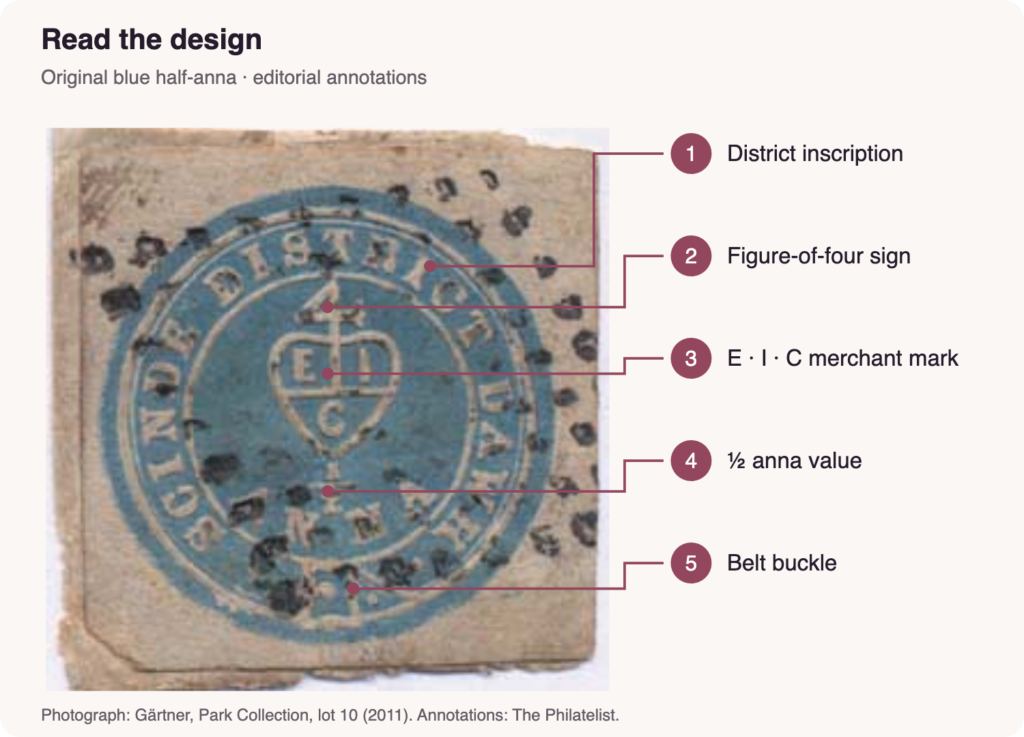
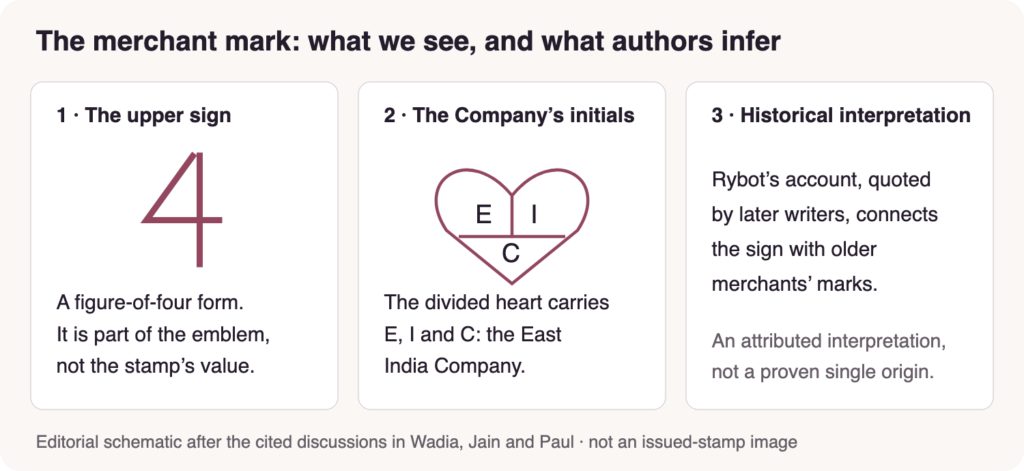
The outer inscription reads SCINDE DISTRICT DAWK. Inside it is the East India Company’s merchant’s mark: a divided heart holding the letters E, I and C, with a sign like the figure 4 above it. The value is written separately below. The prominent “4” in the emblem is therefore not a value of four annas.[2][1][4]
Jain quotes Major Rybot’s reading of 1928, that the sign survives from the old protective marks of merchants, and Wadia develops the same idea by comparing other marks. It is a published historical reading, with its author and date, and should be given as such rather than as settled fact; the same goes for claims of a religious origin or of a meaning such as fair dealing.[2][1][4]
The belt, the buckle, the lettering and the positions of the inner elements all matter when comparing a stamp with a forgery. A labelled drawing helps to name the parts, but it is a diagram, never a substitute for a photograph of an actual stamp.[2][1][4]
| Element | What it tells us | |
|---|---|---|
| 1 | SCINDE DISTRICT DAWK | Names the provincial post |
| 2 | Sign like a figure 4 | Part of the merchant’s mark; not a value of four annas |
| 3 | E, I and C in a divided heart | The East India Company’s initials |
| 4 | ½ ANNA | The stamp’s value |
| 5 | Belt buckle | Part of the belt that encloses the design; useful in close comparison |
Who made them? The die and the finished stamp
Who made the stamps needs care, because cutting an embossing die, supplying the equipment and producing the finished stamps are three different jobs. A reference to an embossing device sent from England does not prove where each wafer or paper impression was made.[3][1][2]
In letters to Philately in 1950, E. F. Hurt and L. N. and M. Williams challenged the earlier attribution to De La Rue. They reported that the firm had searched its records and could not confirm that it made the Scinde Dawk, and they separated a reference to Frere’s successors at Bombay from one to his time as Commissioner in Sindh. G. A. Harris replied by explaining that he had relied on Jal Cooper’s book on Bombay and on correspondence quoted there, and accepted that what was made in England might have been the device rather than the stamps.[3][1][2]
Later writers went further. Wadia states that the stamps were made in England, and Jain cites Frere’s letter of 28 April 1853 in support of De La Rue. These publications show how the attribution grew; they are not a reason to forget the earlier objection. Until the original correspondence and the firm’s surviving records are compared, the maker is best given as “De La Rue, London (attributed)”, with the reasons.[3][1][2]
Postmarks: a way of identifying them
A cancellation records how a stamp was treated and may help link it with an office or a letter. Whether the cancellation is genuine is a separate question from whether the stamp is. Wadia warns that convincing cancellations can be found on false stamps, so the strike, the ink, the paper and the way stamp and paper fit together all have to be compared.[1][8][4][10]
The table below sets out the categories in the Jain–Kothari classification, as published online, and the forms of the stamp each has been seen on. It is a working classification, not a promise that every strike belongs to one device or one office; “not given” means no size is stated. Where other lists differ, the difference is kept: Paul’s table gives the blue for some cancellations that the online list records only on the white. A dated study of examples is needed to settle such differences.[1][8][4][10]
One difference can be stated exactly. The online list gives the barred numeral 96 on the white only, but Martin’s note of 1965 discusses a blue with 96. The table keeps the list’s own associations; Martin’s report shows why what one published sample records should not be made an exclusive rule for every surviving stamp.[1][8][4][10]
| Type | Size reported | Forms reported |
|---|---|---|
| Diamond of 49 dots, 7 × 7, larger corner dots | 22 × 19 mm across the diagonals | White, blue |
| Diamond of 64 dots, 8 × 8 | 19 × 17 mm across the diagonals | White, blue, red |
| Large round dots | Not given | White |
| Small round dots | Not given | White |
| Diamond of 51 dots: outer rows of 8, five inner rows of 7 | 22 × 19 mm across the diagonals | White |
| Large sunburst or star | Not given | White, blue |
| Small sunburst or star | Not given | White |
| Diamond of seven parallel lines | 24 × 18 mm across the diagonals | White, blue |
| Diamond of 81 dots, 9 × 9 | 26 × 20 mm across the diagonals | White |
| Barred diamond with 96 inset | 26 × 20 mm across the diagonals | White |
| Cross-hatched pen cancellation | Not given | White, blue |
| Kardar-type scoring or defacement | Not given | All forms |
A piece is not a whole journey
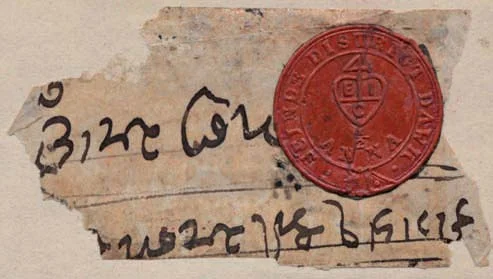
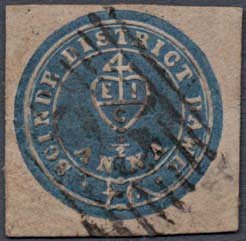
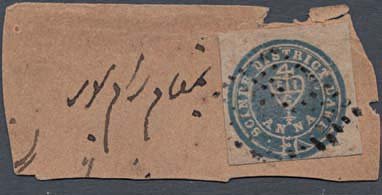
A stamp on piece keeps what a loose stamp loses: the handwriting next to it, part of the strike and where the stamp sat on the paper. Even so, a fragment is not a complete cover. It may lack the date, the address, the evidence of the rate and the marks on the back that would let us rebuild the journey.[1]
So a loose stamp, a stamp on piece and a complete letter are kept apart here. The two fragments with handwriting shown in this article are not complete covers, and neither a catalogue description nor a numeral is used to supply an origin, a destination or a date of delivery. A future census of covers should record the front and back, every dated mark, where the correspondence came from and the basis of any translation.[1]
Forgeries: compare several features together
Wadia’s illustrated comparison looks at where the final A of ANNA stands against the K of DAWK, at the S of SCINDE, at the position of the upright above the heart, at the inner letters and at the buckle. It is especially useful because it takes the reader from a pleasing first impression to particular differences that can be seen.[1][4]
Those tests belong to one comparison. They are not a rule for detecting every forged die. A forger can copy one correct alignment, and a faint or damaged genuine stamp can hide another. A bright colour, a light cancellation or clear embossing proves nothing either way.[1][4]
For a serious attribution, record the size, the relief, the lettering, the paper or wafer, the margins, the condition, the cancellation and the provenance together. Where an expert certificate is mentioned, note who issued it, its number, its date and any reservations. An auction’s statement that a certificate exists is not the same as seeing it.[1][4]
| Feature to look at | What the comparison examines | Limit |
|---|---|---|
| Final A of ANNA and K of DAWK | How they line up across the stamp | Applies to the comparison described by Wadia and Paul |
| S of SCINDE and A of ANNA | Their positions round the lower left of the circle | Damage or a faint impression can hide the detail |
| Upper sign like a 4 | Where its upright stands against the letters of DISTRICT | Compare with an example whose origin is secure |
| E, I and C | How the letters are formed, their serifs, spacing and line | One correct letter does not prove a stamp genuine |
| Belt and buckle | The rim, the tongue and small projecting details | Judge together with the material, embossing, cancellation and provenance |
Collecting without turning rarity into a price
The most useful record of a purchase keeps the stamp’s history: dated sales, pictures that identify it, owners’ notes and expert opinions. The prices in Wadia’s chatty account belong to their own time and cannot be turned into a current price guide by changing the currency.[1]
Condition and completeness count for a great deal. Cracking, thinning, cut margins, repaired paper, a wafer that has come off and been stuck back, or an unrelated backing all change both the evidence and the collector’s judgement. No value in rupees is given here, and catalogue prices, estimates and prices realised at auction are not the same thing.[1]
A beginner can learn the genuine stamps from well-documented published photographs before buying one. The six photographs here come from one identified auction catalogue; they show the three forms and several kinds of cancellation, but not every shade, die, paper or postmark.[1]
What is settled and what is still open
Put together, the evidence gives the three forms and their common half-anna value, how each was made, their catalogue numbers, the argument over who made them, a way of classifying their cancellations and what to watch for when collecting them. It corrects the old claim that no unused red exists, and it adds Martin’s figures for stock and the evidence that the stamps went on being used after they were meant to be withdrawn.[3][2][1][10]
The open questions are specific: the original letters of 1852–1853 need examining; separate evidence for the release of the white and the blue may survive; the full tariff and list of offices need confirming; the certificates need inspecting; complete covers, front and back, need adding; the postmark lists need reconciling; and the count of surviving examples needs bringing up to date from identifiable records.[3][2][1][10]
Sources
- [1] D. E. Wadia, “The Scinde Dawks and Lithographs of India”, The Philatelic Journal of India, September 1962–June 1963; reprint, pp. 5–19.
- [2] Pradip Jain, “India, 1852 Half Anna Red ‘Scinde Dawk’”, The London Philatelist, vol. 126, September 2017, pp. 338–339.
- [3] E. F. Hurt and L. N. & M. Williams; G. A. Harris, correspondence headed “Scinde Dawks”, Philately, June 1950 (letters dated 21 April and 30 March 1950).
- [4] Bijo Paul, A Philatelic Journey through British India: A Beginner’s Companion, chapter 2, “The Scinde Dawks: From the Home of Mohenjo-Daro”, pp. 13–14 and following.
- [5] Auktionshaus Christoph Gärtner, India: Park Collection, 7 March 2011, lots 6–11 (plates pp. 6 and 8; descriptions p. 65).
- [6] Geoffrey Clarke, The Post Office of India and Its Story, John Lane/The Bodley Head, London, 1921, chapter XIX, pp. 178–180, and chapter III.
- [7] State Bank of Pakistan Museum & Art Gallery, “Scinde District Dawk”, online collection introduction.
- [8] Manik Jain and S. B. Kothari, The Silver Key to the Golden Treasure of Indian Philately, cancellation classification as reproduced on IndianPostageStamps.com, “Scinde District Dawks — Postmarks”.
- [9] John Martineau, The Life and Correspondence of the Right Hon. Sir Bartle Frere, Bart., vol. I, John Murray, London, 1895, frontispiece (portrait after Sir George Reid, engraved by F. Huth).
- [10] Col. D. R. Martin, “Late Use of the Scinde District Dawk Stamps”, January 1965, p. 84, citing Collections to Public Despatches, vol. 14 (1859), collection no. 33.
Notes 0
Add what you know: a cover or stamp in your collection, a date or source, a correction or a question.
No notes yet.
Sign in to add a note.
Notes show straight away. Keep them kind and about the article; anyone can report one that isn't. House rules
