About this stamp
On the Stamp
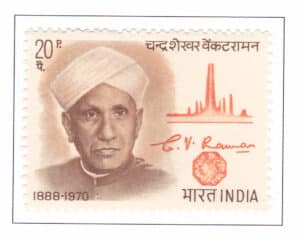
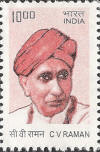
A portrait of C. V. Raman in his turban, on the ₹10 definitive stamp. The pagri was his everyday dress, though turbans were not usual in the south; he joked that it kept his head from swelling with praise.
C. V. Raman
India Post issued this ₹10 definitive stamp on 11 May 2009 on C. V. Raman (1888–1970), the physicist who studied how light is scattered. It was one of three values added that day to the ninth definitive series, “Builders of Modern India”, whose first stamps had appeared on 1 December 2008; the other two honour E. V. Ramaswamy (50 paise) and Rukmini Devi Arundale (₹50). An earlier stamp on Raman came out in 1971.
Born at Tiruchirappalli on 7 November 1888, Raman joined the Indian Finance Service in Calcutta at 19, doing research in his spare hours at a Calcutta society, the IACS (Indian Association for the Cultivation of Science). From 1917 he was the first Palit Professor of Physics at the University of Calcutta. With his student K. S. Krishnan he found that light passing through a transparent material changes its wavelength, the effect now named after him. The discovery was made on 28 February 1928, a date India now keeps as National Science Day, and in 1930 he received the Nobel Prize in Physics, the first Asian to win it. In 1933 he moved to Bangalore to head the Indian Institute of Science, its first Indian director, and later founded the Raman Research Institute there. India Post’s brochure for this issue is not online, so this text draws on Wikipedia and on the stamps themselves.
For More Information
Read more here: