
Forts of India on Stamps
 An exhibit plan by Alok Jain
updated 24 November 2026
About this exhibit
India is a land of forts. Rajput clans built them on hilltops and desert ridges, the Vijayanagara kings and the Deccan sultans on granite outcrops, the Mughals beside their rivers, and the Marathas on the crests of the Sahyadris. Many were capitals as well as strongholds, with palaces, temples, wells and whole towns inside their walls.
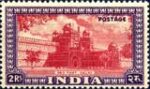
India Post has put forts on stamps since the first definitive series of 1949, which showed the Red Fort on its 2 rupees value. This exhibit travels through 26 stamps in the catalogue, from the hill forts of Rajasthan to the forts of the south and the Mughal north, and ends with forts that played a part in the long road to Independence.
The hill forts of Rajasthan
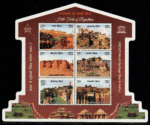
In June 2013 UNESCO added six forts in Rajasthan to the World Heritage List together, as the Hill Forts of Rajasthan, for the way Rajput builders used hills, rivers and desert as part of their defences. India Post gave them a set of six stamps and a miniature sheet on 29 December 2018, the first issue in its series on India's World Heritage Sites.
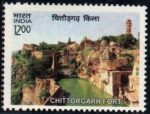
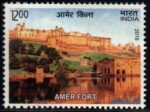
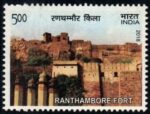
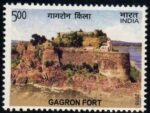
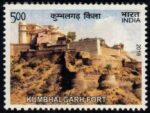
Chittorgarh, capital of Mewar, spreads over a long hilltop and was besieged by Alauddin Khalji, by Bahadur Shah of Gujarat and by Akbar. Kumbhalgarh, ordered by Rana Kumbha in 1448, is ringed by walls said to run for some 36 kilometres; Maharana Pratap was born there. Ranthambore, inside today's tiger reserve, was a Chauhan stronghold, probably begun in the 10th century. Gagron, built in the 12th century, is a water fort, with the Ahu and Kali Sindh rivers on three sides. Amer, above Maota Lake near Jaipur, was built up by Raja Man Singh I and Jai Singh I and was the Kachwaha capital until Jaipur was founded in 1727.
The Chittorgarh and Amer stamps are ₹12 each; Kumbhalgarh, Ranthambore and Gagron are ₹5.
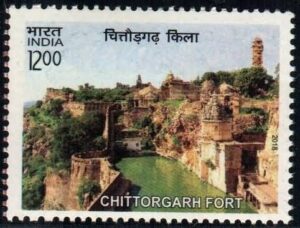
29 December 2018
UNESCO World Heritage Sites in India: Hill Forts of Rajasthan
Chittorgarh Fort
- Commemorative
- Fortresses / Strongholds
- UNESCO World Heritage Sites
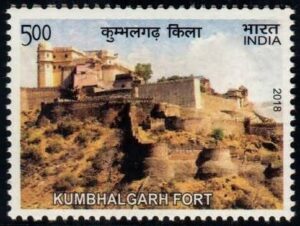
29 December 2018
UNESCO World Heritage Sites in India: Hill Forts of Rajasthan
Kumbhalgarh Fort
- Commemorative
- Fortresses / Strongholds
- UNESCO World Heritage Sites
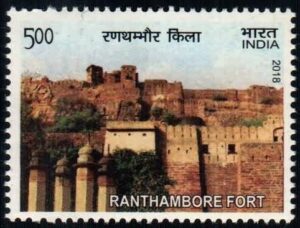
29 December 2018
UNESCO World Heritage Sites in India: Hill Forts of Rajasthan
Ranthambore Fort
- Commemorative
- Fortresses / Strongholds
- UNESCO World Heritage Sites
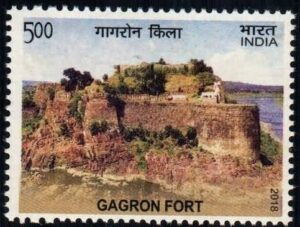
29 December 2018
UNESCO World Heritage Sites in India: Hill Forts of Rajasthan
Gagron Fort
- Commemorative
- Fortresses / Strongholds
- UNESCO World Heritage Sites
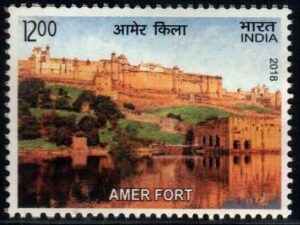
29 December 2018
UNESCO World Heritage Sites in India: Hill Forts of Rajasthan
Amer Fort
- Commemorative
- Fortresses / Strongholds
- UNESCO World Heritage Sites
Jaisalmer, the golden fort
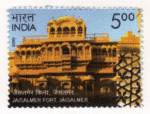
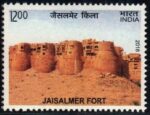
Jaisalmer Fort stands on Trikuta Hill in the Thar Desert. Tradition says the Bhati Rajput Rawal Jaisal founded it in 1156. It is built of yellow sandstone that turns gold in the evening sun, which gives it the names Sonar Qila and the Golden Fort, and it has 99 bastions along its walls.
Unlike most old forts, it is still lived in: a large part of the old town's people have their homes inside, among palaces, havelis and Jain temples. That life brings its own dangers, as water seeping into the hill has weakened parts of the walls, and conservation bodies have worked on it for years.
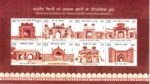
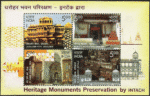
It has two stamps. The ₹5 stamp of 28 January 2009 belongs to a set marking the conservation work of INTACH, the Indian National Trust for Art and Cultural Heritage. The ₹12 stamp of 2018 marks its place among the UNESCO hill forts.
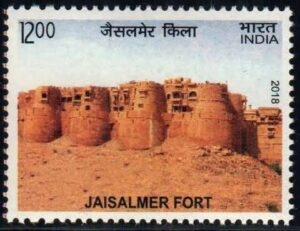
29 December 2018
UNESCO World Heritage Sites in India: Hill Forts of Rajasthan
Jaisalmer Fort
- Commemorative
- Fortresses / Strongholds
- UNESCO World Heritage Sites
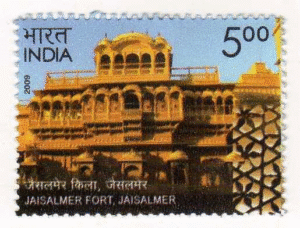
28 January 2009
Heritage Monuments Preservation by INTACH
Jaisalmer Fort, Jaisalmer
- Commemorative
- Fortresses / Strongholds
- UNESCO World Heritage Sites
Four forts of 1984
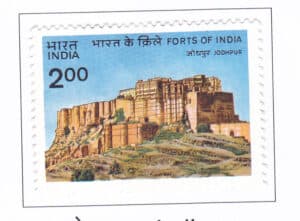
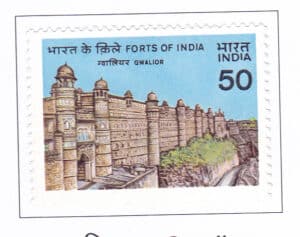
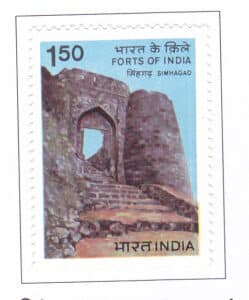
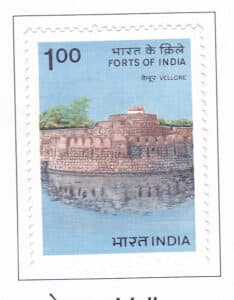
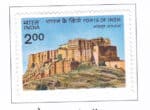
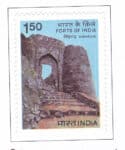
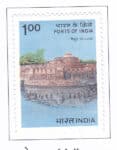
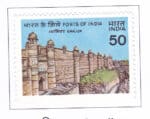
India Post's first set devoted to forts came out on 3 August 1984: four stamps, one each for Gwalior (50 paise), Vellore (₹1), Simhagad (₹1.50) and Jodhpur (₹2).
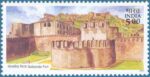
Mehrangarh, the fort of Jodhpur, was founded in 1459 by Rao Jodha of the Rathores, who moved his capital there from Mandore; it sits on a sheer rock above the city. Gwalior's fort holds temples and palaces from many centuries; the Tomar king Man Singh (ruled 1486 to 1516) built its painted palace, the Man Mandir, and the Scindias held it from the 1750s. Simhagad, near Pune, was once called Kondhana. Shivaji's general Tanaji Malusare took it from the Mughals in 1670 and died in the attack; the story goes that Shivaji said the fort was won but the lion lost, and the fort took the name Simhagad, the lion's fort. Vellore, built in granite under the Vijayanagara rulers around 1566 and ringed by a moat, has a story of its own, told later in this exhibit.
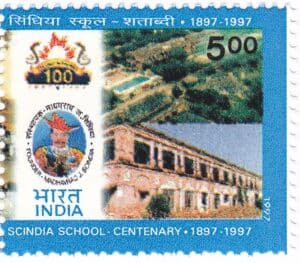
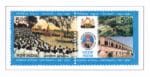
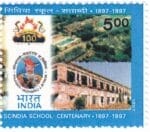
Gwalior Fort appears again on a ₹5 stamp of 20 October 1997 for the centenary of the Scindia School, founded in 1897 by Maharaja Madho Rao Scindia, which has had its campus on the fort since 1908.
20 October 1997
Centenary of Scindia School, Se-tenant Pair
M. Scindia (founder) and Gwalior Fort
- Commemorative
- Anniversaries and Jubilees
- Famous people
Forts of the Deccan: Golconda and Chandragiri
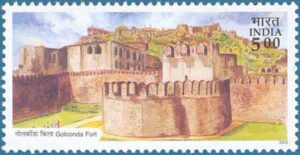
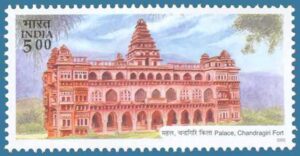
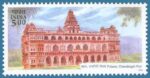
On 31 December 2002 India Post issued two ₹5 stamps on forts of Andhra Pradesh, as the region then was.
Golconda, on the western edge of Hyderabad, began as a mud fort of the Kakatiyas. Under the Qutb Shahi sultans, who ruled from 1518, it grew into a great granite fortress and capital, and a market for diamonds from the mines nearby. A clap under the dome at its entrance can be heard at the hilltop pavilion, a warning system that guides still show visitors. In 1687 Aurangzeb took it after a siege of eight months, ending the Qutb Shahi kingdom.
Chandragiri, about 12 kilometres from Tirupati, is said to date from around 1000 AD. In the last years of the Vijayanagara empire it became the kings' seat, and the Raja Mahal shown on the stamp was built in the early 17th century. In 1639 the English East India Company obtained, from the ruler of Chandragiri's lands, the strip of coast where it built Fort St George, the beginning of Madras. The palace is now a museum of the Archaeological Survey of India.
Mughal forts by the river: Delhi, Agra, Ajmer and Allahabad
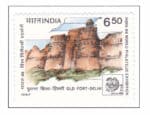
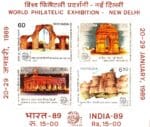
The Purana Qila, the Old Fort of Delhi, stands where tradition places the Indraprastha of the Mahabharata. Humayun began his city of Dinpanah there, and Sher Shah strengthened it during his reign of 1540 to 1545; how much belongs to each is hard to say. It appeared on a ₹6.50 stamp of 17 October 1987, one of four Delhi monuments issued ahead of the INDIA-89 exhibition.
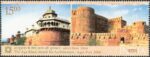
Akbar rebuilt Agra Fort in red sandstone from 1565 to 1573, beside the Yamuna. His grandson Shah Jahan added marble halls, and spent his last years there, from 1658 until his death in 1666, as a prisoner of his son Aurangzeb. The fort became a UNESCO World Heritage Site in 1983. It appears on a ₹15 stamp of 28 November 2004 for the Aga Khan Award for Architecture.
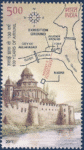
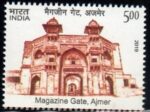
At Ajmer, Akbar built a fort and palace in 1570, where he stayed on visits to the dargah of Khwaja Moinuddin Chishti. Here his son Jahangir received Sir Thomas Roe, the English ambassador, in 1616. The British later used it as an arsenal, so its gate is called the Magazine Gate (₹5, 2019). Akbar's largest fort, built in 1583 at Allahabad near the meeting of the Ganga and Yamuna, is seen beneath a map of the world's first official airmail flight of 1911 on a ₹5 stamp of 12 February 2011.
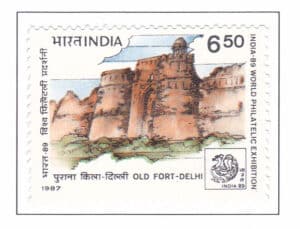
17 October 1987
INDIA – 89 World Stamp Exhibition: Old Fort, Delhi
- Commemorative
- Fortresses / Strongholds
- Philatelic Exhibitions
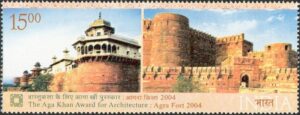
28 November 2004
The Aga Khan Award for Architecture
Agra Fort
- Commemorative
- Architecture
- Fortresses / Strongholds
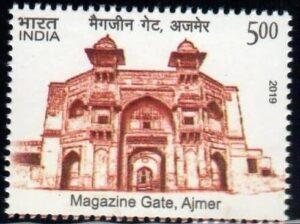
19 October 2019
Historical Gates of Indian Forts and Monuments
Magazine Gate, Ajmer
- Commemorative
- Fortresses / Strongholds
- Gates
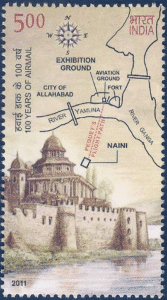
12 February 2011
100 Years of Airmail
Allahabad Fort and Map of the Flight
- Commemorative
- Anniversaries and Jubilees
- Fortresses / Strongholds
The Red Fort and Shah Jahan's Delhi
Shah Jahan moved his capital from Agra to Delhi and built a new city, Shahjahanabad, with a palace fortress at its heart. Work on the Red Fort began in 1638 (some sources say 1639) and ended in 1648. Its design is credited to Ustad Ahmad Lahori, and its name comes from its red sandstone walls. With the rest of the Red Fort Complex it became a UNESCO World Heritage Site in 2007.
The fort was on the 2 rupees value of India's first definitive series, issued on 15 August 1949, and on a ₹5 My Stamp design of 22 July 2014.
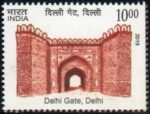
The city around it had its own walls and gates. Shah Jahan built the Delhi Gate, its southern gate, and rode through it to the Jama Masjid for prayer. It stands today in the middle of the road at the edge of Daryaganj, and is on a ₹10 stamp of 19 October 2019, one of eight in a set on historical gates of forts and monuments.
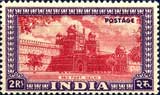
15 August 1949
Definitive Series I: Archaeological
Archaeological Series – Red Fort, Delhi
- Definitive
- Buildings
- Fortresses / Strongholds
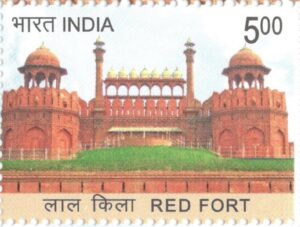
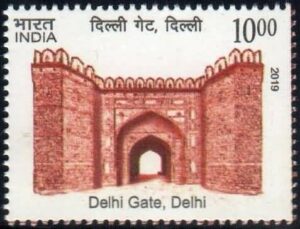
19 October 2019
Historical Gates of Indian Forts and Monuments
Delhi Gate, Delhi
- Commemorative
- Fortresses / Strongholds
- Gates
Forts that made cities: Patiala and Jaipur
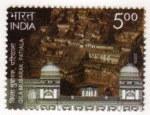
Some forts came first and the city grew up around them. Qila Mubarak, in the old city of Patiala, was begun in 1763 by Baba Ala Singh, founder of the Patiala state, first as a fort of mud and brick and later rebuilt in baked brick. Its inner palace, the Qila Androon, has rooms painted with murals, and its Darbar Hall, built in 1859, now holds a museum of arms. INTACH has worked to restore it, and it is on a ₹5 stamp of the INTACH set of 28 January 2009.
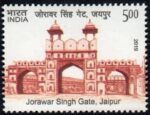
Jaipur, founded in 1727 by Sawai Jai Singh II when the Kachwahas moved down from Amer, was a planned city inside a wall with gates on every side. The Jorawar Singh Gate opens to the north, towards Amer; it is also known as the Dhruv Pol, after the Pole Star. It is on a ₹5 stamp of the 2019 gates set.
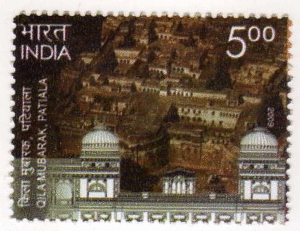
28 January 2009
Heritage Monuments Preservation by INTACH
Qila Mubarak, Patiala
- Commemorative
- Fortresses / Strongholds
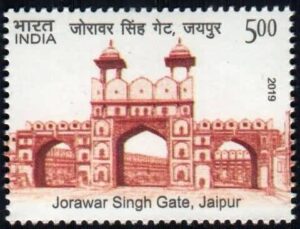
19 October 2019
Historical Gates of Indian Forts and Monuments
Jorawar Singh Gate, Jaipur
- Commemorative
- Fortresses / Strongholds
- Gates
Forts and the road to freedom
Forts were also places of resistance. Before dawn on 10 July 1806, Indian soldiers in the garrison at Vellore rose against the East India Company. New rules on dress, a round hat in place of the turban and orders to remove caste marks and trim beards, had angered them, and the family of Tipu Sultan was held prisoner in the fort. Cavalry from Arcot retook it within hours, and hundreds of the soldiers were killed. India Post marked the bicentenary with a ₹5 stamp on 10 July 2006.
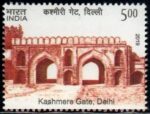
In 1857 Delhi was the rebels' capital. On 14 September British troops blew in one leaf of the Kashmere Gate, the city's northern gate, to begin their final assault. The gateway standing today is usually credited to Robert Smith, who rebuilt the walls for the British in 1835. It is on a ₹5 stamp of 2019.
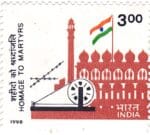
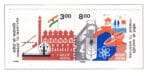
On 15 August 1947 Jawaharlal Nehru raised the national flag above the Lahori Gate of the Red Fort, and every Prime Minister since has hoisted it there on Independence Day. A ₹3 stamp of 15 August 1998, in a pair titled Homage to Martyrs, shows the fort with the flag, a spinning wheel and barbed wire.
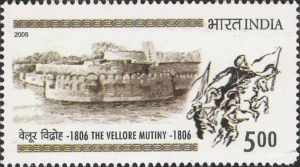
10 July 2006
The Vellore Mutiny, 1806
- Commemorative
- Anniversaries and Jubilees
- Fortresses / Strongholds
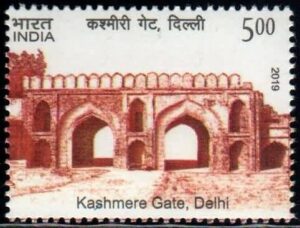
19 October 2019
Historical Gates of Indian Forts and Monuments
Kashmere Gate, Delhi
- Commemorative
- Fortresses / Strongholds
- Gates
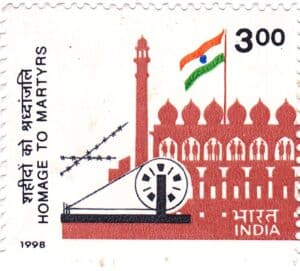
15 August 1998
Homage to Martyrs, Se-tenant Pair
Homage to Martyrs: Red Fort and Spinning Wheel
- Commemorative
- Fortresses / Strongholds
- Textile Industry
Sources
India Post's issue folders; the Press Information Bureau; iStampGallery; Wikipedia and its cited sources; museum and archive records.
Stamps in this plan
Comments 0
No comments yet. Be the first to say something kind or useful.
Sign in to join in.
Comments show straight away. Keep them kind and about the exhibit; anyone can report one that isn't. House rules
