
Tracks Across India: Indian Railways on Stamps
 An exhibit plan by Alok Jain
updated 24 November 2026
About this exhibit
India's first passenger train ran in Bombay on 16 April 1853. In the years since, the railways have climbed into the Himalaya and the Nilgiris, crossed the rivers and ghats of the Konkan coast, and grown into one of the largest railway systems in the world. They built great stations and their own factories, and moved from steam to diesel and electric power.
India Post has followed that story on stamps since the centenary issue of 1953. This exhibit travels through 40 stamps in the catalogue: the first train, the engines, the hill railways, the great stations, some lines with stories of their own, the works that build engines and coaches, a century of electric trains, the railway's heritage and service today, and the people behind its stories.
The first train, 16 April 1853
On the afternoon of 16 April 1853, a public holiday in Bombay, a train of 14 carriages carrying about 400 people left Bori Bunder for Thane, 34 kilometres (21 miles) away. Three engines built by the Vulcan Foundry in England, named Sahib, Sindh and Sultan, hauled it, and the run took 57 minutes. The line belonged to the Great Indian Peninsula Railway, incorporated in 1849.
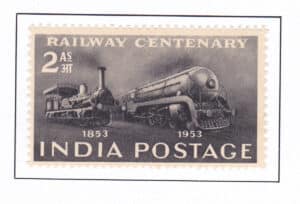
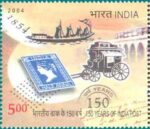
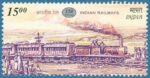
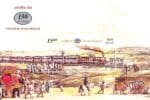
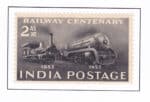
India Post marked the centenary with a 2 annas stamp on 16 April 1953, showing an early steam engine beside a modern one. On 16 April 2002 a ₹15 stamp, also issued in a miniature sheet, began a year of celebrations for the 150th anniversary. It shows the first train steaming across open country towards Thane.
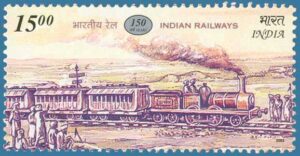
16 April 2002
150 Years of Railways in India
The First Indian Railway Train, 1853
- Commemorative
- Anniversaries and Jubilees
- Locomotives
Engines on stamps: the locomotives of 1976, and again in 2011
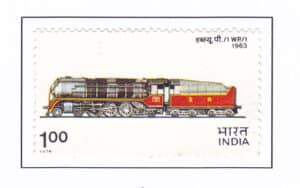
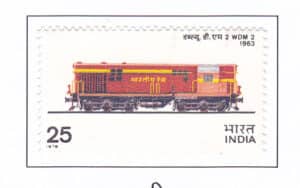
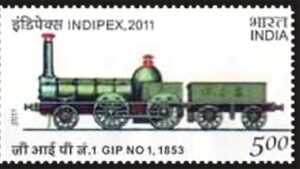
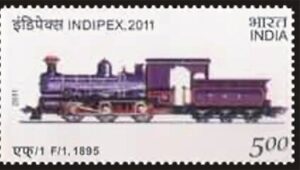
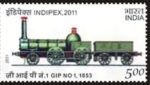
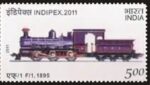
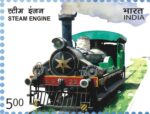
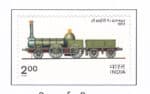
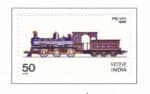
On 15 May 1976 India Post issued four stamps on Indian locomotives. The ₹2 stamp shows GIP No. 1, one of the first eight engines the Great Indian Peninsula Railway ordered from the Vulcan Foundry for its Bombay line. The 50 paise shows an F/1 of 1895, a metre gauge engine of the Rajputana-Malwa Railway. One of the class, F-734, built that year at the Ajmer workshops, is described by the National Rail Museum as the first locomotive made in India. It is kept at the museum in New Delhi.
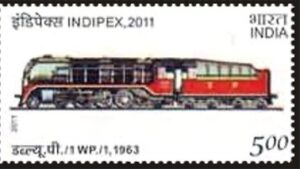
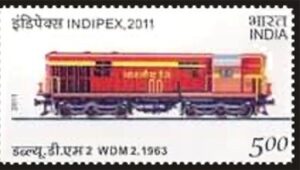
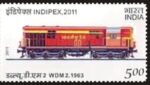
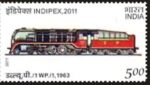
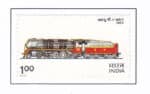
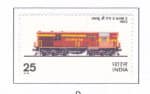
The ₹1 stamp shows a WP/1, the bullet-nosed express steam engine that the Chittaranjan Locomotive Works began building in 1963. The 25 paise shows a WDM2 diesel of 1963, designed by the American Locomotive Company (ALCO) and later built at the Diesel Locomotive Works in Varanasi. More than 2,700 were made, and it became the most common engine on Indian Railways.
In February 2011 the same four engines came back, with the same pictures and captions, on ₹5 stamps in a new frame lettered "INDIPEX 2011". They were issued for the world philatelic exhibition in New Delhi, where India Post first offered My Stamp, its sheets of stamps printed beside a picture of the buyer's choice.
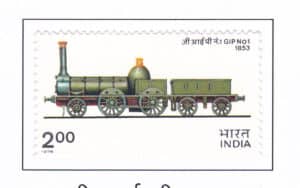
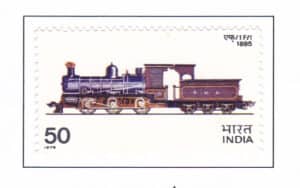
15 May 1976
Rajputana Malwa Railway Class F/1 Steam Locomotive, 1895
- Commemorative
- Locomotives
- Railways
Into the hills: the mountain railways
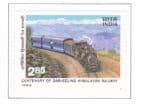
The British built narrow lines into the hills to reach their summer retreats. The Darjeeling Himalayan Railway, on a two-foot gauge, was built between 1879 and 1881 and reached Darjeeling in July 1881. It climbs by loops and zig-zags, and at Ghum, about 2,258 metres up, has India's highest railway station. India Post marked its centenary with a ₹2.85 stamp on 18 December 1982, showing a small steam engine pulling blue carriages through the tea gardens.
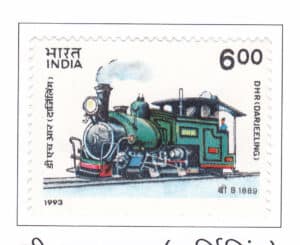
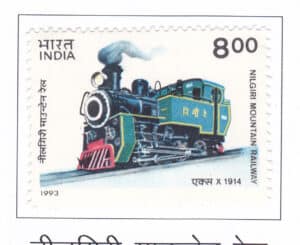
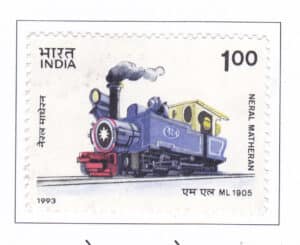
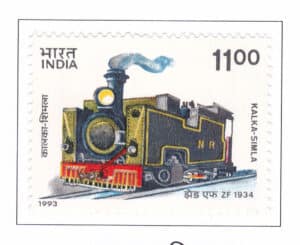
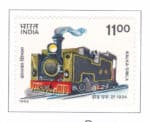
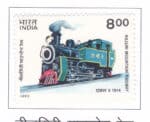
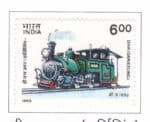
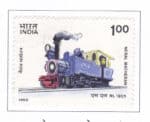
On 16 April 1993 India Post issued four stamps on mountain locomotives: the Neral–Matheran line (₹1), built by Abdul Hussein Adamjee Peerbhoy and opened in 1907; Darjeeling (₹6), with a B class saddle tank engine of the kind still at work there; the Nilgiri Mountain Railway (₹8), a metre gauge line that uses a toothed rack rail between Kallar and Coonoor, the only rack railway in India; and Kalka–Shimla (₹11), a 2 ft 6 in line to the summer capital of British India.
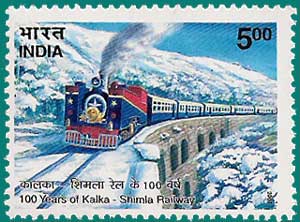
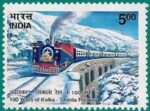
The Kalka–Shimla line opened on 9 November 1903, and a ₹5 stamp marked its centenary on that day in 2003. It runs through more than a hundred tunnels.
UNESCO named the Darjeeling line a World Heritage Site in 1999, and added the Nilgiri line in 2005 and Kalka–Shimla in 2008, together as the Mountain Railways of India. The Matheran line is on UNESCO's tentative list.
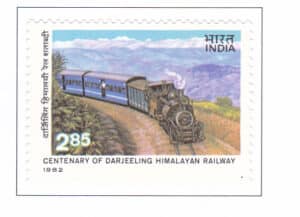
18 December 1982
Centenary of Darjeeling Himalayan Railway
- Commemorative
- Anniversaries and Jubilees
- Locomotives
Great stations
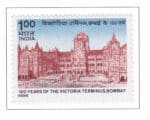
The Great Indian Peninsula Railway replaced its old station at Bori Bunder with the Victoria Terminus, begun in 1878 and finished in 1888 to the design of F. W. Stevens, and named for Queen Victoria's Golden Jubilee. A figure of Progress, holding a torch and a spoked wheel, stands on its central dome. India Post marked its centenary with a ₹1 stamp on 30 May 1988. Renamed Chhatrapati Shivaji Terminus in 1996, it became a UNESCO World Heritage Site in 2004.
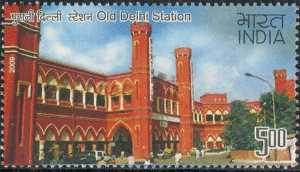
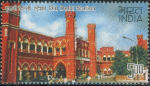
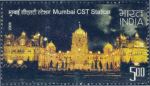
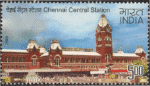
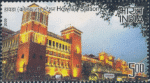
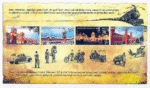
On 16 August 2009 India Post issued four ₹5 stamps, also as a miniature sheet, on heritage railway stations of the four great cities. Mumbai CST is one. Howrah began in 1854 as a tin shed, from which the East Indian Railway's first train ran to Hooghly on 15 August 1854; its present red-brick building dates from 1905. Chennai Central opened as Madras Central in 1873 and is known for its clock tower, added in a redesign by Robert Chisholm. Delhi's old station dates from 1864, and its present building, opened in 1903, has turrets in the spirit of the Red Fort nearby.
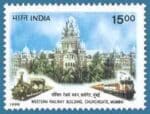
Stevens also designed the headquarters of the Bombay, Baroda and Central India Railway at Churchgate, built between 1894 and 1899 and now the head office of the Western Railway. A ₹15 stamp of 6 February 2001 marked its centenary.
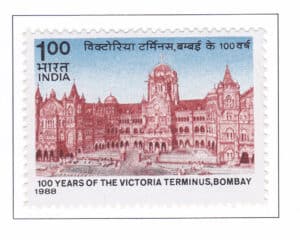
30 May 1988
100 Years of the Victoria Terminus, Bombay
- Commemorative
- Anniversaries and Jubilees
- Buildings
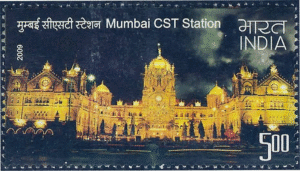
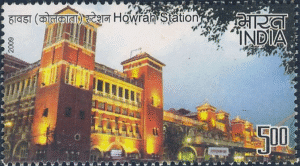
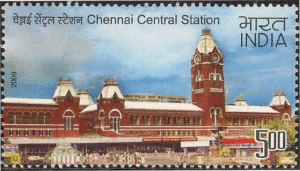
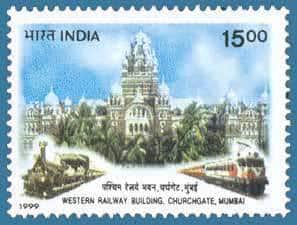
6 February 2001
Western Railway Building, Churchgate, Mumbai
- Commemorative
- Anniversaries and Jubilees
- Buildings
Lines across the land: steel country, the Doon Valley and the Konkan coast
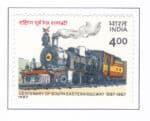
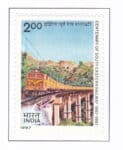
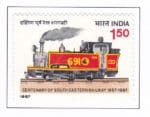
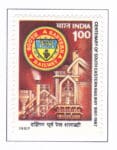
The South Eastern Railway grew from the Bengal-Nagpur Railway, which began in 1887 and became the South Eastern Railway in 1955. Its lines serve the steel plants at Tatanagar, Rourkela, Bhilai, Bokaro and Burnpur, and on 28 March 1987 India Post issued four stamps for its centenary. The ₹1 stamp shows the railway's badge before a blast furnace; the ₹2 shows an electric train crossing a viaduct among green hills.
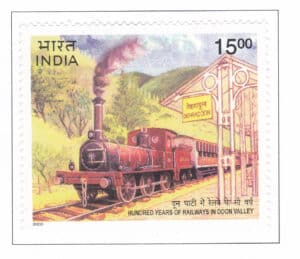
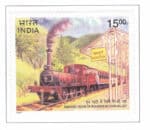
The line from Haridwar to Dehradun, the Doon Valley Railway, opened on 1 March 1900, through forests that are now part of the Rajaji National Park. Its ₹15 centenary stamp of 6 May 2000 shows a Shatabdi Express in the valley.
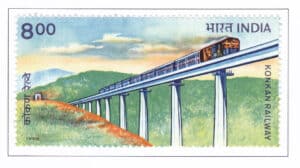
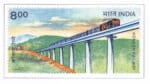
The Konkan Railway, along the west coast between Roha, south of Mumbai, and Thokur, near Mangaluru, had been dreamt of since the 1880s. The Konkan Railway Corporation was formed in 1990, with Maharashtra, Goa, Karnataka and Kerala as partners. The line needed 92 tunnels and more than 2,000 bridges, among them the Karbude tunnel, some 6.5 kilometres long, and the tall Panval Nadi viaduct. The whole line opened on 26 January 1998, and a ₹8 stamp followed on 1 May 1998.
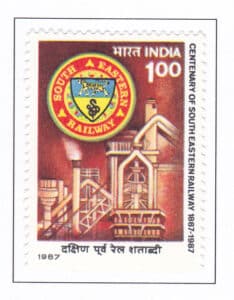
28 March 1987
Centenary of South Eastern Railway: Blast Furnace
- Commemorative
- Anniversaries and Jubilees
- Industry
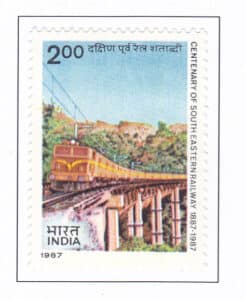
28 March 1987
Centenary of South Eastern Railway: Electric Train on Viaduct
- Commemorative
- Anniversaries and Jubilees
- Bridges
Where engines and coaches are made
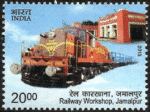
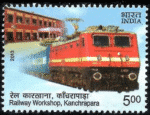
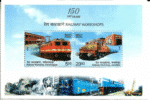
The railways have long made and mended their own rolling stock. The East Indian Railway opened its workshop at Jamalpur, in Bihar, on 8 February 1862, and the Eastern Bengal Railway opened one at Kanchrapara, near Kolkata, in 1863. Jamalpur built its own steam engines from 1899 and later turned to diesel engines, wagons and cranes; Kanchrapara became a leading workshop for overhauling electric locomotives and suburban EMU coaches. Their 150th anniversaries were marked by a ₹20 stamp for Jamalpur and a ₹5 stamp for Kanchrapara, issued together in a miniature sheet on 26 November 2013.
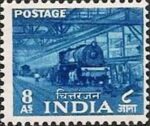
After Independence came new factories. Production began at Chittaranjan, in West Bengal, on 26 January 1950, and on 1 November 1950 President Rajendra Prasad dedicated its first steam engine, the Deshbandhu; the works took its name from Deshbandhu Chittaranjan Das. An 8 annas stamp of 26 January 1955, in the Five Year Plan series, shows it.
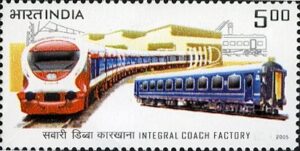
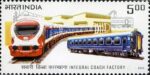
The Integral Coach Factory at Perambur, Chennai, built with help from a Swiss firm, turned out its first coach on 2 October 1955. A ₹5 stamp of 19 December 2005 marked its fiftieth year.
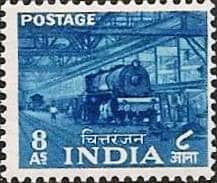
26 January 1955
Definitive Series II: Five Year Plan
Five Year Plan – Chittaranjan Locomotive Works (1955)
- Definitive
- Industry
- Locomotives
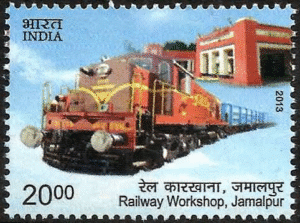
26 November 2013
Railway Workshops, Jamalpur and Kanchrapara
Jamalpur
- Commemorative
- Anniversaries and Jubilees
- Locomotives
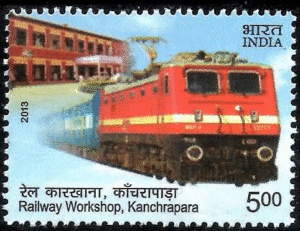
26 November 2013
Railway Workshops, Jamalpur and Kanchrapara
Kanchrapara
- Commemorative
- Anniversaries and Jubilees
- Locomotives
A hundred years of electric trains
India's first electric train ran on 3 February 1925, on Bombay's Harbour line between Victoria Terminus and Kurla, on 1,500 volts DC. It was an electric multiple unit, or EMU, a train that carries its own motors along its coaches and needs no separate engine.
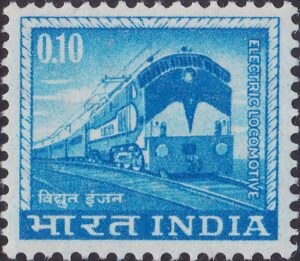
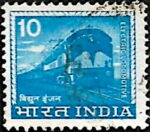
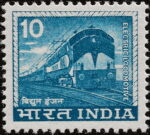
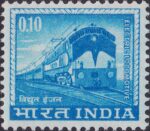
The Chittaranjan works built its first electric locomotive in 1961: a 1,500 volt DC engine named Lokmanya, which Jawaharlal Nehru put into service on 14 October that year. An electric locomotive at the head of a passenger train appears on a 10 paise everyday stamp, issued on 1 July 1966.
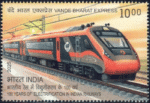
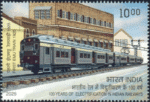
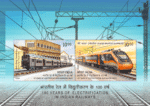
For the centenary of electric traction, India Post issued a miniature sheet of two ₹10 stamps on 31 December 2025. One shows the first EMU of 1925, its coaches lettered "G.I.P.". The other shows the Vande Bharat Express, also an electric multiple unit, built by the Integral Coach Factory in Chennai; the first Vande Bharat service began on 15 February 2019.
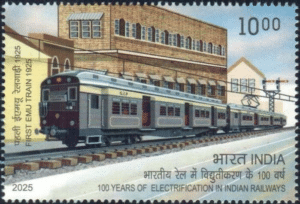
31 December 2025
100 Years of Electrification in Indian Railways
First EMU Train 1925
- Commemorative
- Anniversaries and Jubilees
- Electricity
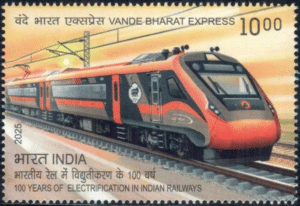
31 December 2025
100 Years of Electrification in Indian Railways
Vande Bharat Express
- Commemorative
- Anniversaries and Jubilees
- Electricity
The railway's heritage and its service
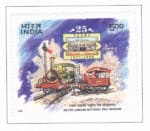
The National Rail Museum in New Delhi keeps the railway's past. President V. V. Giri laid its foundation stone on 7 October 1971, and it opened on 1 February 1977. A ₹5 stamp marked its silver jubilee on 7 October 1996, 25 years to the day after the foundation stone.
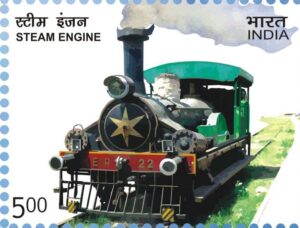
One of its best-known engines is the Fairy Queen, built in 1855 by Kitson, Thompson and Hewitson of Leeds for the East Indian Railway. Restored to working order in 1997, it was recognised in 1998 as the oldest steam locomotive in regular service in the world. It is on a ₹5 My Stamp design of 22 July 2014.
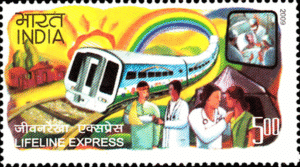
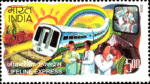
The railway also serves in other ways. The Lifeline Express, or Jeevan Rekha Express, is a hospital on rails, run by the Impact India Foundation with Indian Railways. Since its first journey in July 1991 it has carried operation theatres to rural districts, where doctors give free surgery and treatment. Its ₹5 stamp was issued on 12 May 2009.
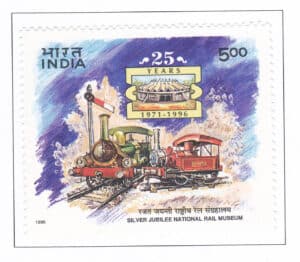
7 October 1996
25th Anniversary of National Rail Museum
- Commemorative
- Anniversaries and Jubilees
- Locomotives
The people behind the railways
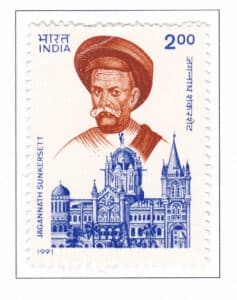
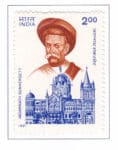
Railways are built and run by people. Indians in Bombay pressed for the first line: Jagannath Shankarseth, a merchant and public figure, formed the Inland Railway Association, which urged the British to lay a line from Bombay to Thane, and he and Sir Jamsetjee Jejeebhoy were among the first Indian directors of the Great Indian Peninsula Railway. His ₹2 stamp of 15 February 1991 shows him above the towers of a Bombay terminus.
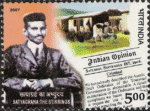
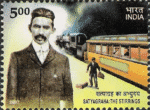
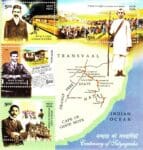
A railway journey shaped Mahatma Gandhi. In 1893, in South Africa, he was put off a train at Pietermaritzburg for refusing to leave a first-class compartment, a night he spent deciding to stand up for his rights; a ₹5 stamp of 2 October 2007 recalls it. Back in India he travelled widely in third class, and in 1917 wrote a pamphlet, Third Class in Indian Railways, on the crowding and dirt its passengers had to bear.
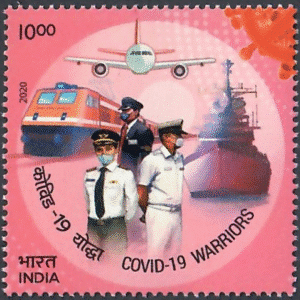
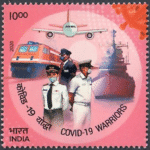
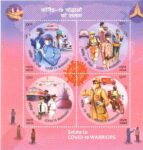
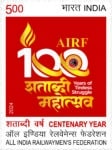
Railway workers came together on 24 April 1924 in the All India Railwaymen's Federation, which spoke for them through the freedom struggle and after; its centenary stamp, at ₹5, was issued on 27 February 2024. In the COVID-19 lockdown of 2020, railway staff ran Shramik Special trains that carried more than 63 lakh migrant workers home between May and August. A ₹10 stamp for transport workers, in the Salute to COVID-19 Warriors sheet of 24 December 2020, honours them.
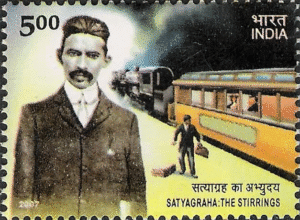
2 October 2007
Satyagraha: The Stirrings
Gandhi and the Train
- Commemorative
- Anniversaries and Jubilees
- Famous people
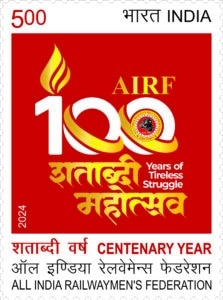
27 February 2024
Centenary Year All India Railwaymen’s Federation
- Commemorative
- Anniversaries and Jubilees
- Labour Organisations
Sources
India Post's issue folders; the Press Information Bureau; Indian Railways, Konkan Railway and National Rail Museum records; UNESCO via Wikipedia and its cited sources; iStampGallery.
Stamps in this plan
Comments 0
No comments yet. Be the first to say something kind or useful.
Sign in to join in.
Comments show straight away. Keep them kind and about the exhibit; anyone can report one that isn't. House rules
