
Jasdan’s chiefs, a regency and the state’s territory, 1852–1948
The chiefs of Jasdan from Khachar Ala Chela to Khachar Ala Vajsur, the conflicting succession dates between them, the regency recorded in 1920–21, the railway land ceded and the maps of Kathiawar.
Updated November 24, 2026
In this article
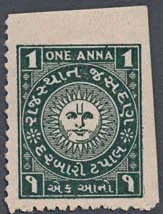
Jasdan’s single stamp shows the sun, not a ruler, so the chiefs do not identify any stamp. They matter because they frame the state that ran the two posts, and because the list of chiefs between 1893 and 1948 is still full of conflicting dates. Each name and date below keeps its source.
Khachar Ala Chela and the inheritance of 1904
Lethbridge’s Golden Book of India of 1893 names Khachar Ala Chela as chief, born in 1833 and succeeding in 1852, of a Kathi family, with Jasdan in Kathiawar under the Bombay administration and paying tribute to Baroda and Junagadh.[2]
A question in the House of Commons on 8 July 1908 shows what followed his death. Lamb’s question places the death in 1904 and objects to the settlement of the estate; Buchanan’s answer for the government defends keeping the estate undivided rather than sharing it equally among the heirs, and says maintenance was provided for the other sons and grandsons. It is a contested policy and its defence, not a court’s verdict, and nothing in it bears on Jasdan’s later postal borders.[23]
The chiefs between 1904 and 1919
A modern genealogy fills the years between Ala Chela and Ala Vajsur with two chiefs: Odha Ala Khachar II, reported from 1904 to 1912, and Vajsur Odha Khachar II, reported from 1912 to 1919. The names are kept so that the interval is not skipped, but neither range has been confirmed from an original record of succession.[24]
An official source gives one fixed point within those years. Aitchison’s treaty collection of 1932 prints two deeds, dated 9 August and 9 September 1913, signed in the name of Vajsur Khacher, Chief of Jasdan. That confirms a chief of that short name in 1913; it does not confirm the fuller name in the genealogy or the dates of his reign, and the original signed deeds have not been seen.[31]
Ala Vajsur, the regency and the date of 1919
The Indian Annual Register for January–June 1946 names the chief as Darbar Shree Ala Kachar and gives his succession as 11 June 1919. That is a directory entry of the time, not the instrument of succession. The genealogy instead gives July 1919 and speaks of an accession in 1924. The two have not been reconciled, and the 1924 date should not be explained away as the grant of full powers without a record that says so.[22][24]
An original government report supports a minority. The Bombay Presidency’s administration report for 1920–21 says that regencies were introduced in Jasdan and Lathi during the year. It does not name Jasdan’s regent, give the date of the appointment or say when full powers followed.[27]
At the end of the stamp period the London Gazette of 1 January 1948 names Darbar Shri Khachar Ala Vajsur, Chief of Jasdan, among the new Companions of the Order of the Indian Empire. The page gives no accession date.[5]
| Dates as reported | Chief | Source and note |
|---|---|---|
| Born 1833; succeeded 1852; died 1904 | Khachar Ala Chela | Lethbridge, 1893; death year from the 1908 Commons question |
| Reported 1904–1912 | Odha Ala Khachar II | Modern genealogy only |
| Reported 1912–1919; chief in August and September 1913 | Vajsur Odha Khachar II (Vajsur Khacher in the 1913 deeds) | Genealogy; Aitchison prints the 1913 deeds under the short name |
| Succeeded 11 June 1919 (1946 register) or July 1919 (genealogy); a regency in 1920–21 | Khachar Ala Vajsur (Ala Kachar in 1946) | Indian Annual Register; Bombay report for 1920–21; the genealogy also mentions 1924 |
| Chief on 1 January 1948 | Darbar Shri Khachar Ala Vajsur | London Gazette honours list |
Railway land and a change of agency
The same treaty collection records that Jasdan ceded jurisdiction over the land occupied by the Botad–Vinchhia and Vinchhia–Jasdan railway sections, with their stations and other railway premises, and that the state was moved from the Eastern to the Western Kathiawar Agency in 1923. These are administrative facts. They do not show that any letter went by rail, that Jasdan had a postal exchange with the Imperial post, or that the whole state was ceded, and no boundary has been drawn from them.[31]
What the maps show
Plate 38 of the Imperial Gazetteer Atlas of 1931 names Jasdan in the Kathiawar region at a scale of 1:4,000,000. Its legend colours all Indian states the same yellow and shows the railways separately, so it gives the setting but not Jasdan’s own boundary, the territory of its twelve postal groups or the route of a letter. The British Library holds a more detailed sheet, the 1936 Map of Kathiawar and part of Bombay Presidency showing railways in relation to State boundaries, at 1:1,000,000 (IOR/X/12164); it has not yet been published with this study.[25][26]
Where the missing dates may be
The British Library holds Jasdan’s own administration reports: a bound volume for 1909/10 to 1925/26 and 1927/28 to 1928/29 (IOR/V/10/1283) and the report for 1931/32 (IOR/V/10/1284). They cover the years of the disputed successions and the regency, though not the stamp scheme of 1942 or its end.[21][20]
Sources
- [2] Sir Roper Lethbridge, The Golden Book of India, London: Macmillan, 1893, p. 209, “Jasdan, Khachar Ala Chela”.
- [5] The London Gazette, supplement to issue 38161, 1 January 1948, p. 8: Darbar Shri Khachar Ala Vajsur, Chief of Jasdan, among the Companions of the Order of the Indian Empire.
- [20] British Library, IOR/V/10/1284, Jasdan Administration Report 1931/32.
- [21] British Library, IOR/V/10/1283, Jasdan Administration Report 1909–1929 (covering 1909/10–1925/26 and 1927/28–1928/29, one bound volume).
- [22] N. N. Mitra, ed., The Indian Annual Register, January–June 1946, vol. I, p. 26, Western India States: Jasdan.
- [23] UK Parliament, Hansard, 8 July 1908, House of Commons, vol. 191, col. 1644, “Rights of Kathiawar Chiefs”.
- [24] Rajput Provinces of India, Jasdan genealogy.
- [25] Imperial Gazetteer Atlas of India, 1931 edition, plate 38, Bombay, Sind, Baroda and States of Western India (Northern Section), via the Digital South Asia Library.
- [26] British Library, IOR/X/12164, Map of Kathiawar and part of Bombay Presidency showing railways in relation to State Boundaries, 1936, scale 1:1,000,000.
- [27] Government of Bombay, Report on the Administration of the Bombay Presidency 1920–21, p. 3 (IOR/V/10/316/5, f. 335r), via the Qatar Digital Library.
- [31] C. U. Aitchison, A Collection of Treaties, Engagements and Sanads, vol. VI, Western India States and Baroda, revised to 1930, Calcutta: Government of India Central Publication Branch, 1932, pp. 270 and 275 (Jasdan).
Notes 0
Add what you know: a cover or stamp in your collection, a date or source, a correction or a question.
No notes yet.
Sign in to add a note.
Notes show straight away. Keep them kind and about the article; anyone can report one that isn't. House rules
