
Shahpura’s Stamps: the One Pice, the Black One Anna and the Receipt Stamps Used for Postage
The three-line one-pice and one-anna stamps, the types with and without POSTAGE used both for mail and revenue, and Jaiswal’s types A to H of the red one-anna receipt stamps.
Updated August 15, 2026
In this article
Adhesives and fiscal paper
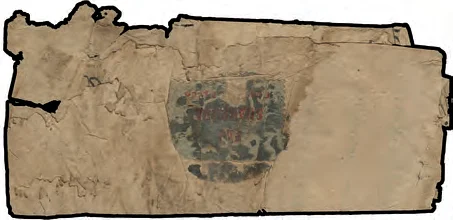
The older display divides the stamps into one-pice scarlet stamps on coloured papers, an imperforate one-anna black on rose-pink, and the postal use of a red one-anna receipt stamp. The one-pice design also exists without the word POSTAGE. Paper, separation and inscription all have to be recorded; a colour name alone cannot identify a printing.[1]
Using a receipt stamp on a letter is a particular use of a fiscal stamp; it does not make every fiscal die, value or sheet a postage stamp. A court-fee stamp needs stronger evidence still: a whole cover showing that it was carried by post. Sandeep Jaiswal’s earlier exhibit records an exceptional use of a four-anna court-fee stamp, and Rajasthan-overprinted postal fiscals, which are treated separately in the next chapter.[3]
The same inscription, on letters and on documents
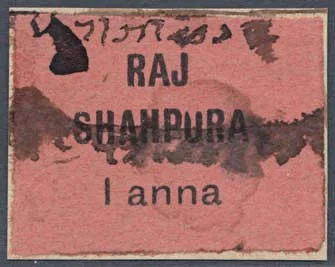
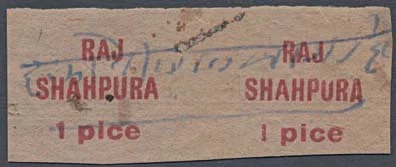
Frits Staal’s study of 2012 illustrates fiscal documents bearing both the one-pice type without POSTAGE and the black one anna on pink, beside examples he identifies as postal covers. His aim was to show that both types were used in both ways. That strengthens the dual-use classification without making every manuscript-cancelled loose stamp postal. The missing word POSTAGE is a design difference; how the stamp was used on its document is the stronger evidence.[14]
The fiscal examples are not identified just by handwriting across a stamp. Staal follows parts of a borrower’s or beneficiary’s name across the stamp and onto its document. His postal examples keep an address, an envelope or a folded-letter format, and sometimes a State postal seal. Small crosses, lone signatures and weak ties occur in both. That is a reason to keep the whole document, not a new rule for reading cancellations.[14]
Christoph Gärtner’s lot 1557 identifies the carmine-on-drab pair as SG 3. Its three lines read RAJ / SHAHPURA / 1 pice, without POSTAGE, so SG 3 belongs to the type without POSTAGE, and only to that carmine-on-drab group, not to every paper. The black one anna is Gärtner’s SG 4.[6]
What the printing evidence shows
The early stamps share a compact three-line English design. The first one pice includes the word POSTAGE; the later one pice and the black one anna leave it out. Jaiswal describes the designs as typographed on coloured wove papers, the bluish-wove one pice with POSTAGE perforated 11 on two or more sides, and the later types without POSTAGE imperforate. No printer, designer or engraver is named in the sources.[2][4]
The makers are less well documented than the people who handled the mail. The postmen Bhanru and Chhaganlal signed refusal and return endorsements in 1909 and 1914; Bhagchand Somani and Narotamal Malji were the Kishangarh dealers who supplied the covers in 1962. None of them should be confused with the makers of the stamps.[5][4]
The Scottish Mission Industries Company, Vedic Yantralaya and Chandmal Chandak appear in the imprints of the administration reports. They printed the reports, not, so far as anyone knows, the stamps. The general officials of the reports, including the Musahib Ala, should not be made into a head of the post without a specific postal appointment.[9][12][13]
Comparing the receipt designs
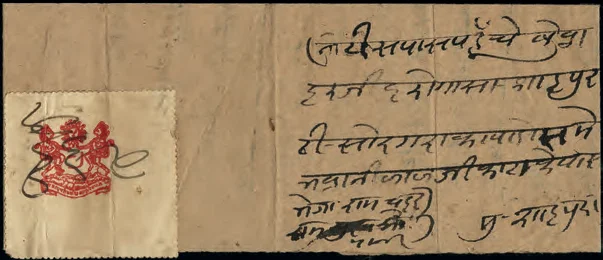
Jaiswal tells the red one-anna receipt designs apart by the inner diameter of the sun and the distance between the lions’ tails, in millimetres. Measure the stamp itself; a resized screen image is no gauge. The type names below follow his exhibit; its year headings carry the cautions about dates in the next chapter.[2]
Different positions in the D2 setting give different tail distances. F3 includes impressions facing opposite ways, and G and H occur together. These are types and arrangements, not extra values, and not a new postal authorisation for every fiscal printing. In Jaiswal’s classification C2 is on horizontally laid paper and the rest on wove; A and B are perforated 10 and 11; C1, C2, D1, D2 and E are perforated 12; F1 to F3, G and H are pin-perforated.[2]
| Type | Paper and separation | Arrangement | Sun / tails, mm | Notes |
|---|---|---|---|---|
| A | Wove; perforated 10 | Unknown | 2.5 / 23 | Rose |
| B | Wove; perforated 11 | Unknown | 2.5 / 23 | Red |
| C1 | Wove; perforated 12 | Unknown | 2.5 / 23 | Indian red |
| C2 | Horizontal laid; perforated 12 | Unknown | 2.5 / 23 | Rose red |
| D1 | Wove; perforated 12 | 2 rows of 4 | 3.5 / 24 | Red |
| D2 | Wove; perforated 12 | 4 rows of 2 | 3.5 / 23.5 or 24 | Positions 1, 3, 6, 7 and 8 measure 24 mm; positions 2, 4 and 5 measure 23.5 mm |
| E | Wove; perforated 12 | 2 rows of 4 | 3.5 / 23.5 | Orange red; a full sheet is illustrated |
| F1 | Wove; pin-perforated | 4 rows of 2 | 2.5 / 23 | Brick red; table heading 1947, illustrated notice dated 10 March 1946 |
| F2 | Wove; pin-perforated | 2 rows of 4 | 2.5 / 23 | Brick red |
| F3 | Wove; pin-perforated | Unknown | 2.5 / 23 | Vermilion; horizontal tête-bêche pairs; at least six columns and two rows inferred |
| G | Wove; pin-perforated | Occurs with H | 3.5 / 23.5 | Red; positions 1 and 3 of the exhibited block |
| H | Wove; pin-perforated | Occurs with G | 2.5 / 22.5 | Red; positions 2 and 4 of the exhibited block |
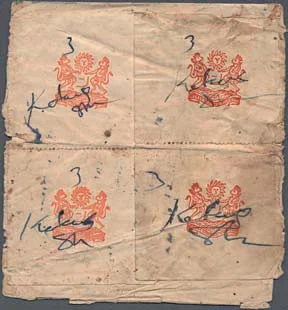
Sheets and multiples
Multiples say more about the layout than single stamps. The type E sheet Jaiswal illustrates has eight impressions in two rows of four, perforated between the stamps with unperforated outer margins. F3 includes horizontal tête-bêche pairs, but its full sheet is unknown. Cut edges need care too: the exhibit describes four type E stamps on a letter of 1943 as trimmed. No watermark is recorded for Shahpura.[2]
Staal records part of a receipt-stamp sheet of two rows of four, and a strip of five with two tête-bêche pairs. These are the multiples he saw, not proof that every printing was a sheet of eight.[14]
Jaiswal’s later scheme of types A to H is not the same as the two dies and four clichés of the earlier version of his exhibit, and no concordance between them has been shown. His type F1 and Gärtner’s catalogue number F1 for the postal fiscal also belong to different systems and are not the same thing.[2][3][6]
An uncertain edge is not a new variety
For the four one-pice stamps on a folded letter dated 4 March 1917, Staal leaves open whether they were imperforate or had their perforations cut away. He also considers more than one explanation for a franking of four pice. The photograph and the letter’s date are useful, but they do not settle the stamps’ original separation or prove a change of rate.[14]
Sources
- [1] “Shahpura”, anonymous and undated display reproduction, 20 sheets numbered 25–44, ISC accession 1322.
- [2] Sandeep Jaiswal, “Shahpura—A newly discovered stamp issuing Indian Princely State”, eight-page exhibit reproduction, printed pp. 37–44, hosted by Stamps SA.
- [3] Sandeep Jaiswal, “Shahpura—A newly discovered stamp issuing Indian Princely State”, sixteen-page exhibit version currently hosted by Richard Frajola.
- [4] P. M. Medhora, “A New Find: Shahpura State”, The Philatelic Journal of India, vol. LXVI, no. 9, September 1962, pp. 169–171.
- [5] “Further Light on Shahpura State”, The Philatelic Journal of India, vol. LXVI, no. 11, November 1962, pp. 221–222, 224; printed byline M. P. Medhora.
- [6] Christoph Gärtner, auction 17, Park Collection, 7 March 2011, Shahpura lots 1557–1561, descriptions printed p. 150 and illustrated plate p. 94.
- [9] Rajkumar Umaid Singh, Musahib Ala, Annual Administration Report of the Shahpura Chiefship for the Year 1916–1917 (Ajmer: Scottish Mission Industries Company, Ltd., 1917), introductory information §14 and p. 13 §§72–73.
- [12] Annual Report on the Administration of the Shahpura State for the Year 1937–38 (Ajmer: Vedic Yantralaya, printed by Chandmal Chandak, 1939), p. 13, Post Office.
- [13] Annual Report on the Administration of the Shahpura State for the Year 1939–40, 1 November 1939 to 31 October 1940 (Ajmer, printed by Chandmal Chandak, 1941), p. 25, Post Office.
- [14] Frits Staal, “Shahpura”, India Post, vol. 46, no. 184, January–March 2012, pp. 6–15.
Notes 0
Add what you know: a cover or stamp in your collection, a date or source, a correction or a question.
No notes yet.
Sign in to add a note.
Notes show straight away. Keep them kind and about the article; anyone can report one that isn't. House rules
