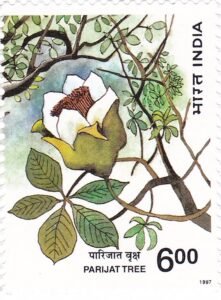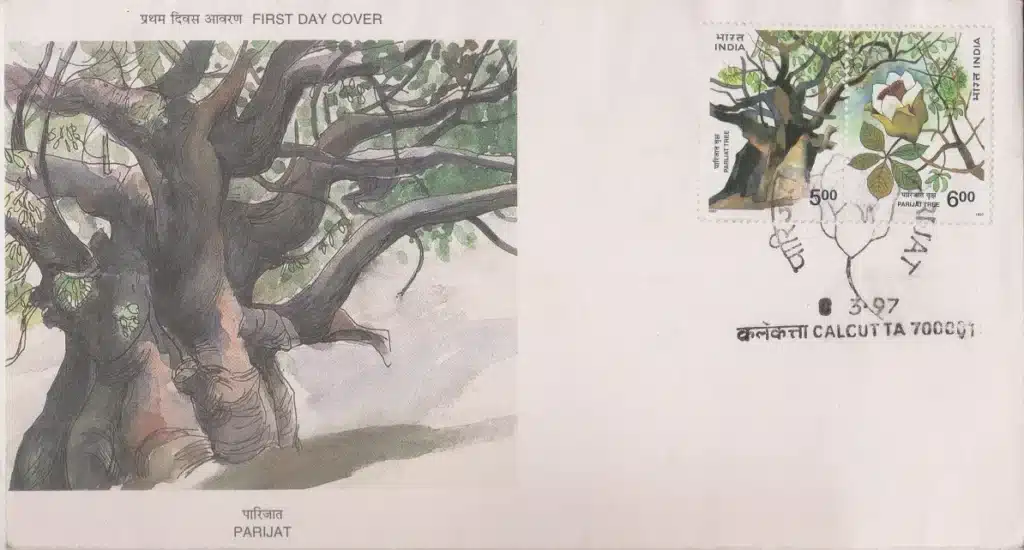
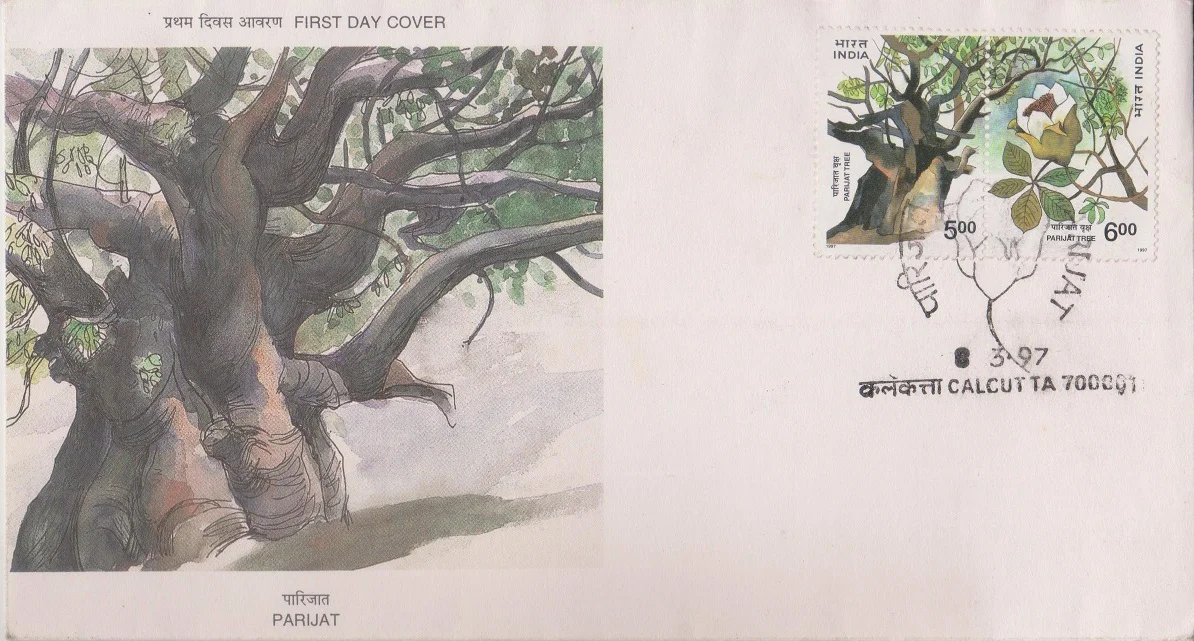
About this stamp
Introduction
Parijat is considered a sacred and divine tree in Indian culture. It is admired for its fragrant flowers, ornamental beauty, and medicinal importance. The tree holds a special place in literature and tradition, and its flowers have been mentioned in the poems of Rabindranath Tagore.
Names of the Tree
Parijat is known by several popular names, including:
- Har Singar
- Sephali
- Sephalika
- Night Jasmine
Characteristics
The Parijat tree is known for its attractive and fragrant flowers.
- The flowers bloom during the evening hours.
- They fall to the ground by the next morning.
- The flower stem is saffron-orange in colour.
- The petals are white and delicate.
- The branches of the tree are rectangular in shape.
- Flowering season is from August to October.
Distribution
Parijat grows widely in India, especially in the outer Himalayan regions up to a height of 1400 metres. It is found in:
- Jammu and Kashmir
- Nepal
- Assam
- West Bengal
- Tripura
- Central India up to the Godavari region
It is also found in Thailand, Indonesia, and Pakistan.
Medicinal Uses
Parijat has many medicinal properties.
- Leaf juice is used in the treatment of fever.
- Bark medicine helps relieve swelling of the lungs.
- Bark oil is useful for eye pain and hair tonics.
- Leaf juice mixed with honey is used for chronic fever.
- Leaf decoction helps in sciatica pain.
- Seeds are used for skin diseases and piles.
- Flowers act as an appetiser and soothe the stomach.
Importance
Apart from beautifying gardens with its fragrant flowers, the Parijat tree is highly valued in traditional medicine and cultural heritage.
Conclusion
The Parijat tree is a symbol of beauty, healing, and spirituality. Its divine status, pleasant fragrance, and medicinal usefulness make it one of the most cherished trees in Indian tradition.