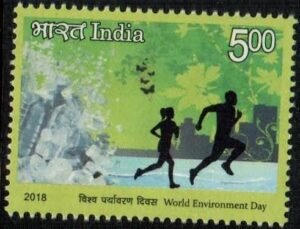
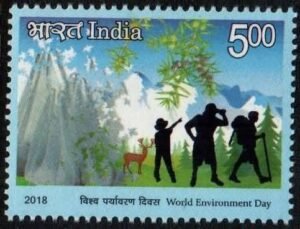
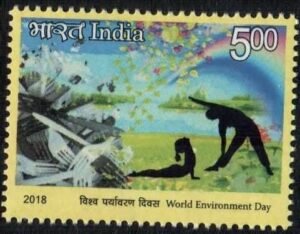
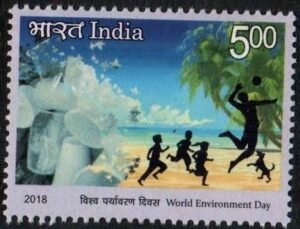
About this stamp
A Global Call to Action
World Environment Day (WED), celebrated annually on 5th June, is the United Nations’ flagship platform to promote awareness and action for the environment. Since its inception in 1974, WED has grown into a global movement, observed in over 150 countries, and has become a crucial forum for advancing the environmental dimensions of the Sustainable Development Goals (SDGs).
History and Significance
The first World Environment Day activities began in 1974, and by 1987, the celebration started rotating among host countries, with Kenya being the first official host. India has been an active participant and hosted WED in 2011, under the theme “Forest: Nature at Your Service.” In 2018, India was honored as the global host, with the theme “Plastic Pollution”, highlighting one of the most pressing environmental challenges of our time.
Plastic Pollution – A Global Threat
Plastic is durable, versatile, and inexpensive, yet it poses a serious environmental hazard due to its slow degradation. Plastic pollution occurs when plastic products accumulate in land, waterways, and oceans, adversely affecting wildlife, human health, and ecosystems.
The impacts of plastic waste include:
- Clogged drainage systems leading to unhygienic conditions in urban areas.
- Harm to animals, which may ingest plastic along with food, causing illness or death.
- Reduced groundwater recharge, as plastic in soil impedes natural water absorption.
- Contamination of landfill sites, where leaching of chemicals affects soil and water quality.
- Microplastics, formed by fragmentation, entering the food chain via microorganisms.
- Marine debris, which threatens coastal safety and tourism.
The consequences are far-reaching, making urgent collective action essential.
India’s Commitment to Tackling Plastic Pollution
India has actively engaged in combating plastic pollution through both legislation and community action. The Plastic Waste Management (PWM) Rules, 2016, implemented by the Ministry of Environment, Forest and Climate Change, include measures such as:
- Increasing minimum thickness of plastic carry bags from 40 to 50 microns.
- Mandatory registration of plastic manufacturers with State Pollution Control Boards.
- Responsibility of waste segregation for households, offices, industries, and event organizers.
- Implementation of Extended Producer Responsibility, ensuring producers manage take-back systems for plastic waste.
- Payment of user fees as per local regulations.
Towards a Sustainable Lifestyle
Beyond legislation, reducing plastic pollution requires public awareness, innovative solutions, and community participation:
- Education and awareness – Empowering youth and children as agents of change to create transformational impact.
- Innovative reuse – Converting non-recyclable plastics into secondary raw materials or refuse-derived fuel (RDF) for use in industries like cement production.
- Reducing consumption – Limiting single-use plastics and promoting responsible alternatives to protect human health and biodiversity.
A Collective Responsibility
Protecting the environment is a shared responsibility. By reducing plastic consumption, segregating waste, and adopting sustainable practices, we can collectively curb plastic pollution and preserve the environment for future generations. World Environment Day reminds us that the time to act is now — together, we can reduce our plastic footprint and safeguard the planet.
For More Information
Read more here: