
Woven on Stamps: India's Handloom Traditions
 An exhibit plan by Jaspreet Kaur
updated 24 November 2026
About this exhibit
Almost every region of India has a cloth of its own: a silk, a weave, a way of dyeing yarn or a style of embroidery, often made by the same families for generations. Many of these traditions are now protected as Geographical Indications, so that only cloth made in the home region may carry the name.
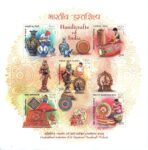
India Post has put this cloth on stamps many times, from the spinning wheel of 1950 to a set for National Handloom Day in 2026. This exhibit follows the thread from spinning to weaving, through silks, ikat, shawls and embroidery, in 27 stamps from the catalogue.
The spinning wheel and hand-spun cloth
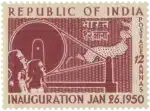
On 26 January 1950 India became a republic, and India Post marked the day with four stamps. The highest value, 12 annas, meant for foreign air mail, shows a charkha with hand-spun, hand-woven cloth behind it, a symbol of the cottage industry and of the self-reliance Mahatma Gandhi had preached through hand-spinning.
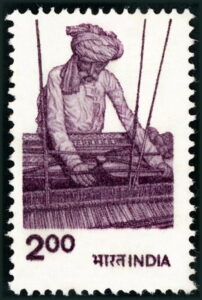
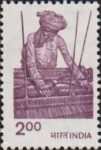
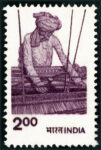
Weaving by hand remained one of India's largest sources of work in the villages. In the early 1980s a ₹2 definitive in the series on rural India showed a weaver in a turban at his loom, printed in violet. India Post's 2026 folder puts the handloom sector among the country's largest sources of livelihood after farming, with more than 35 lakh weavers and allied workers.
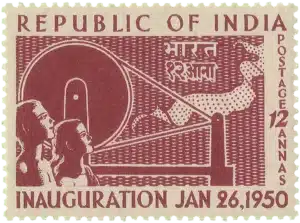
26 January 1950
Inauguration of the Republic – Spinning Wheel and Cloth
- Commemorative
- Special Occasions
- Textile
Silks and brocades
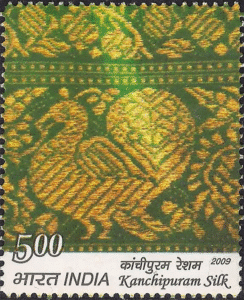
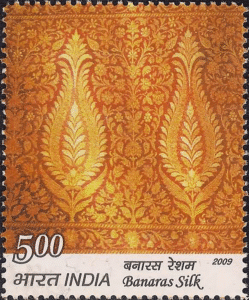
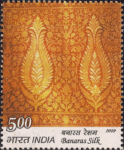
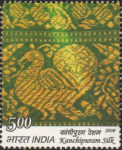
Kanchipuram, a temple town in Tamil Nadu, weaves heavy silk saris from twisted three-ply yarn, with borders in strong contrast to the body. The body and border are woven separately and interlocked, a join made to hold even if the sari tears. Varanasi, also called Banaras or Kashi, is known for brocades: extra weft threads of coloured silk or zari, metallic thread, are woven in to raise patterns of flowers, creepers and birds. Both appeared on a set of four ₹5 stamps on Indian textiles issued on 10 December 2009.
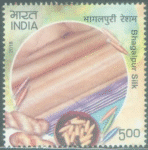
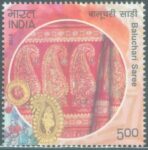
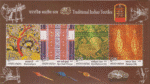
The set of 7 August 2018 showed five handloom products registered as Geographical Indications. Two are silks of the east. The Baluchari sari takes its name from Baluchar in Murshidabad district of West Bengal; its pallu carries woven scenes, often from the epics, and today it is woven mainly in Bishnupur. Bhagalpur, on the southern bank of the Ganga in Bihar, is called the Silk City and is known especially for tasar silk.
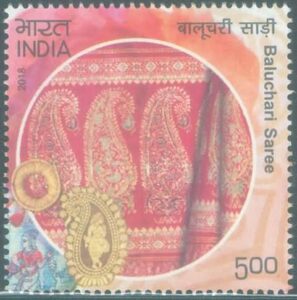
7 August 2018
Geographical Indication (GI) Registered Handloom Products
Baluchari Saree
- Commemorative
- Textile
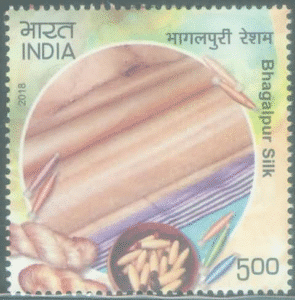
7 August 2018
Geographical Indication (GI) Registered Handloom Products
Bhagalpur Silk
- Commemorative
- Textile
Ikat: the pattern dyed into the yarn
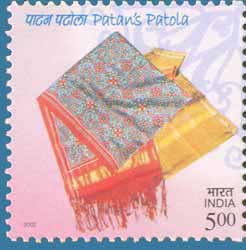
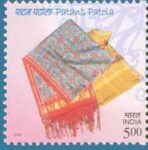
In ikat the yarn is tied in places and dyed before it goes on the loom, so the pattern appears only as the threads are woven together. In double ikat both the warp and the weft are tied and dyed, and they must meet exactly. Patan in Gujarat is famous for double ikat silk patola, still woven by a few families of the Salvi community. Patan Patola was registered as a Geographical Indication in 2013, and a ₹5 stamp in a set on handicrafts was issued on 15 November 2002.
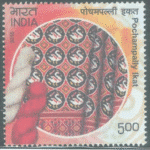
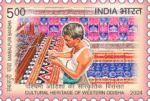
Pochampally Ikat comes from Bhoodan Pochampally in Telangana, a village renamed after Vinoba Bhave's land-gift movement began there in 1951; in 2004 it became one of the first textiles in India to be registered as a Geographical Indication. Odisha's own ikat is bandha. India Post's brochure for the ₹5 Sambalpuri Bandha stamp of 20 February 2024 tells of the Bhulia weavers, believed to have brought the craft to western Odisha in the twelfth century.
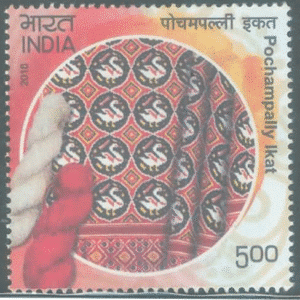
7 August 2018
Geographical Indication (GI) Registered Handloom Products
Pochampally Ikat
- Commemorative
- Textile
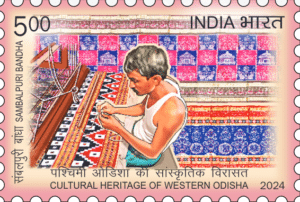
20 February 2024
Cultural Heritage of Western Odisha
Sambalpuri Bandha Silk Textile
- Commemorative
- Textile
- Textile Industry
Dots, stripes and pen-work
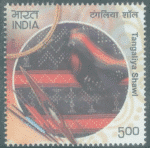
Some cloth is known for a single technique. In Tangaliya weaving, done by the Dangasia community of Surendranagar and nearby districts of Gujarat, the weaver twists a thread of another colour around the warp to raise tiny bead-like dots, called dana, and builds patterns from them. The Tangaliya Shawl was one of the 2018 stamps.
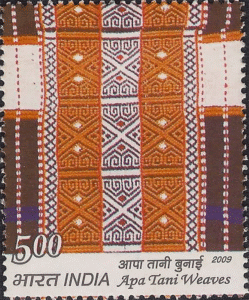
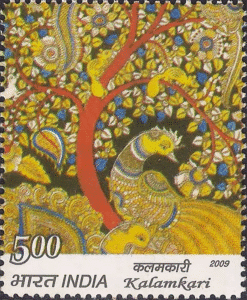
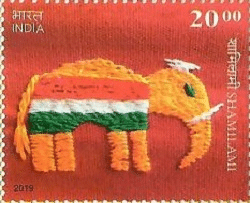
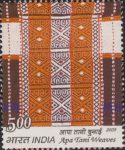
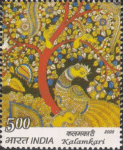
Among the Apa Tani of Arunachal Pradesh nearly every home has a loom, and weaving passes from mother to daughter. The women weave on a portable loin loom, adding bold stripes and geometric patterns in the extra weft. Kalamkari, "pen work", is painted rather than woven: in Andhra Pradesh, Srikalahasti artists still draw scenes from the epics by hand with the kalam, while Machilipatnam adopted carved wooden blocks. Both were on the 2009 set. Shamilami of Manipur, worn by Meitei women on the phanek, combines weaving with embroidery; it appeared in the 2019 set on embroideries.
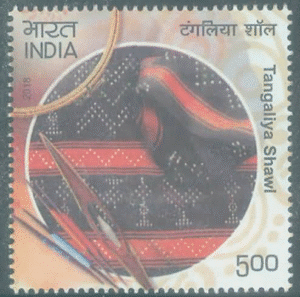
7 August 2018
Geographical Indication (GI) Registered Handloom Products
Tangaliya Shawl
- Commemorative
- Textile
Shawls of Kashmir
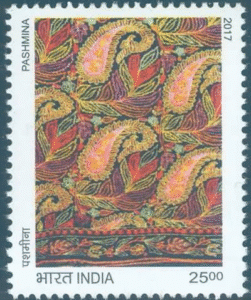
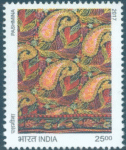
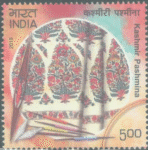
Pashmina is the fine undercoat of the Changthangi goat, raised by herders on the high, cold plateau of Ladakh. In Kashmir the wool is cleaned, spun by hand and woven into shawls so light they are said to pass through a ring. Some are then embroidered. A ₹25 stamp in India Post's New Year sheetlet of 1 January 2017 showed a Pashmina shawl, and Kashmir Pashmina, registered as a Geographical Indication, was among the 2018 handloom stamps.
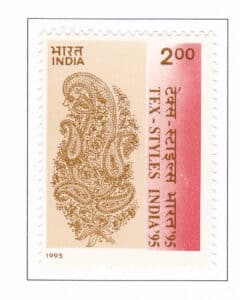
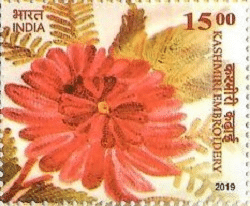
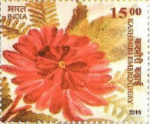
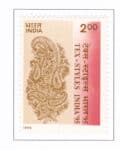
The curving paisley motif, known in Kashmir as the buta, travelled to Europe on Kashmir shawls. A ₹2 stamp for Tex-Styles India '95, a textile fair held in Bombay from 18 to 21 January 1995, shows a paisley of flowers and leaves in brown and gold. Kashmiri embroidery, or kashida, draws on the valley itself, with chinar leaves, lotuses, creepers and birds worked in chain, satin and stem stitch on wool, silk or cotton.
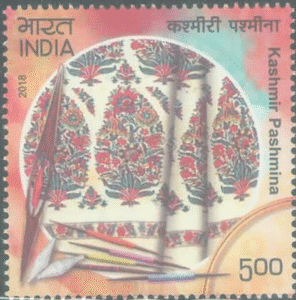
7 August 2018
Geographical Indication (GI) Registered Handloom Products
Kashmir Pashmina
- Commemorative
- Textile
Embroidery of the north
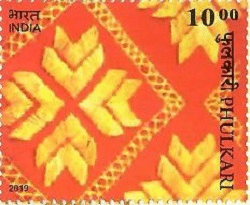
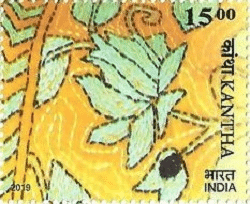
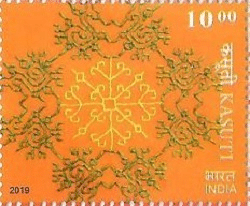
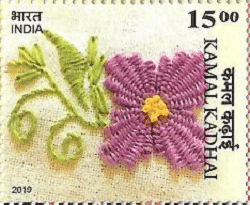
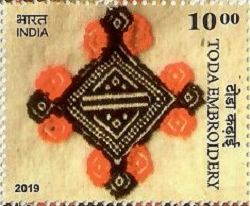
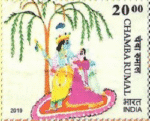
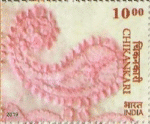
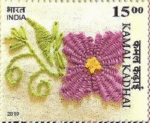
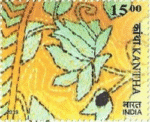
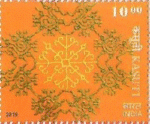
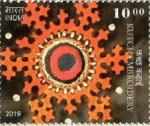
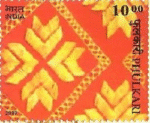
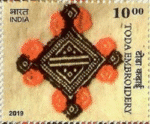
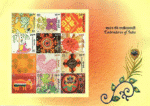
On 19 December 2019 India Post issued twelve stamps on the embroideries of India, in values of ₹10, ₹15 and ₹20. Phulkari, "flower work", is Punjab's embroidery: floss silk worked in darning stitch from the back of hand-spun cotton khaddar, so that the pattern appears on the front. A bagh covers the whole cloth.
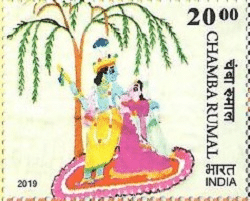
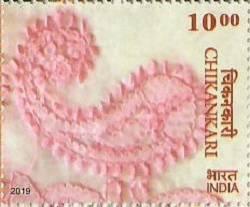
The Chamba Rumal of Himachal Pradesh is worked in double satin stitch, so that the picture, often from Pahari painting and mythology, is the same on both sides. It flourished under the rulers of Chamba; the earliest known example is said to be one made by Bebe Nanaki, sister of Guru Nanak, kept at a gurdwara in Hoshiarpur. Chikankari of Lucknow is white thread on fine white muslin or cotton, with shadow work, jali and knots; tradition credits the Empress Noor Jahan with bringing it to the Mughal court.
Embroidery of the east
Kantha, among the oldest embroideries of the subcontinent, comes from West Bengal, Tripura, Odisha and Bangladesh. Women layered old saris and dhotis and stitched them together with running stitch, making quilts called lep kantha and covers for books and precious things.
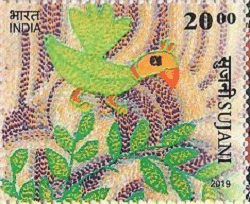
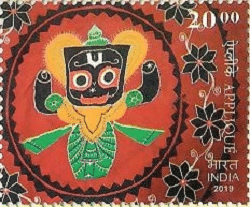
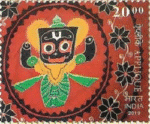
Sujani, from Bhusura village in Muzaffarpur district of Bihar, was first made as cloth to welcome a newborn. The motifs are outlined in black or brown and filled with bright colours, telling stories from myth and village life. Appliqué sews cut pieces of cloth onto a base; India Post's brochure notes its use in Rajasthan and Odisha. At Pipili in Odisha it grew from the canopies and chariot covers made for the Rath Yatra of Lord Jagannath at Puri.
Embroidery of the west and south
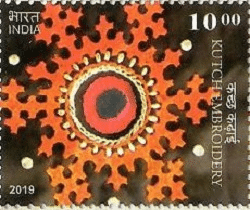
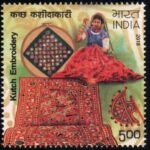
Kutch embroidery of Gujarat works coloured threads with small mirrors, called abhla, in chain, buttonhole, satin and darning stitches; each community of the region has its own colours and motifs. Kasuti of Karnataka, traced back to the Chalukya period, is counted stitching done without knots, so that both sides look alike; its motifs, temple towers, chariots, palanquins and lamps, are traditionally stitched on Ilkal saris.
Kamal Kadhai of Andhra Pradesh uses needle weaving to raise lotus and other flowers whose petals appear to stand in steps. In the Nilgiri hills of Tamil Nadu, Toda women embroider the putkuli, the shawl of their community, with red and black wool on white cotton, in motifs that include buffalo horns, the sun and the moon. Kutch Embroidery and Toda Embroidery are both registered Geographical Indications.
Handlooms of India, 2026
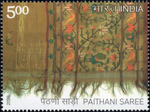
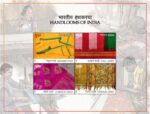
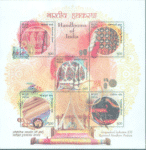
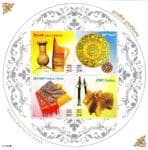
National Handloom Day has been kept on 7 August since 2015, the date chosen because the Swadeshi Movement was launched in Calcutta on 7 August 1905. On the twelfth Handloom Day, 7 August 2026, India Post issued a souvenir sheet of four ₹5 stamps.
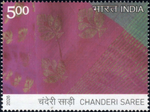
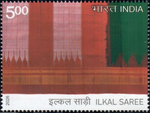
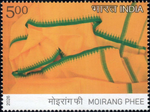
They show the Paithani sari of Maharashtra, named after Paithan and woven today mainly at Yeola, silk with gold and silver zari and peacocks on the pallu; the sheer Chanderi sari of Madhya Pradesh, woven from silk and cotton; the Ilkal sari of northern Karnataka, whose pallu and body are joined by the kondi technique; and Moirang Phee, the cotton cloth of the Meitei of Manipur, with its border of pointed triangles said to be the teeth of the serpent deity Pakhangba.
Sources
India Post's stamp brochures; the Geographical Indications Registry; Wikipedia; the Press Information Bureau; istampgallery.com.
Stamps in this plan
Comments 0
No comments yet. Be the first to say something kind or useful.
Sign in to join in.
Comments show straight away. Keep them kind and about the exhibit; anyone can report one that isn't. House rules
