
Bhor’s Portrait Label of 1901: Postage or Not?
The half anna portrait of Shankar Rao reported to have replaced the handstamps on 6 June 1901: its sheet of 21, the separate receipt stamp, the Poona supplier, covers of 1903 and why its postal status is still disputed.
Updated October 9, 2026
In this article
In 1901 a printed half anna with the portrait of the Pant Sachiv, Shankar Rao Chimnaji, appeared. Catalogues list it; officials of the Imperial post said Bhor stamps had no place in paying postage; the State dak was still carrying stamped petitions in 1912. Its status is still argued.
What the reports of 1901 and 1902 say
The Stanley Gibbons Monthly Journal of January 1902 is far more specific than later catalogue shorthand. An unnamed Indian correspondent passed on information from Bhor’s principal medical officer: the earlier designs had been superseded on 6 June 1901. That is a reported date, not an issue order or a first day cover.[28]
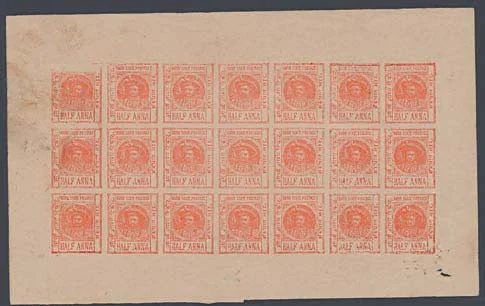
The same account describes the half anna portrait in a circle inside a rectangular frame, with the State’s name above, the value below and native characters at the sides, in sheets of twenty-one, three rows of seven, on toned wove paper, imperforate. The September 1901 report had read the top inscription as BHOR STATE POSTAGE; the January account gives only BHOR STATE. The two readings are kept as they are.[28]
The January account also separates a larger one anna portrait design reading BHOR STATE RECEIPT STAMP at the right. That is a receipt stamp, not another portrait postage value, and not one of the earlier square fiscal labels.[28]
In December 1901 the Journal reported that Whitfield King had supplied a small quantity of the portrait despite a postmaster’s reported restriction on sales to dealers. That is a dealer’s account, not the sales rule itself.[28]
Sheets and printing
The Park catalogue describes a 21-subject portrait sheet with the first position only partly printed, a different object from the hand-struck sheets of the oval. Philately Life calls the portrait typographed and Mintage World calls it lithographed; the sheet of 21 helps identify it but leaves the process open. Neither report of 1901–02 names an artist, engraver or printer.[14][21][22][28]
A State press and a Poona supplier
The Bombay Presidency register of 1898–99 lists a State Printing Press at Bhor, owned by the State, and the State’s annual reports carry Bhor press imprints. In the 1909 debate an unnamed Poona tradesman, accused of engineering the issue for speculation, was said after enquiry to have been only the contractor who supplied presses and materials. The register records an institution and the debate a supplier; neither names the printer, the designer, the source of the portrait or the die maker, and the accusation of speculation should not be repeated as fact.[4][15][24][25]
| Person or institution | Documented role | Limit |
|---|---|---|
| Shankar Rao Chimnaji, Pant Sachiv | Ruler and subject of the portrait[32][28] | Not known as designer, engraver, printer or commissioner |
| Unnamed Poona tradesman | Reported contractor supplying presses and material[4] | No name, firm, contract or design credit; the speculation charge is contested |
| Unnamed principal medical officer of Bhor | Informant on the replacement date, the stamps’ functions and State use[28] | Not a postal officer or maker |
| Unnamed Indian correspondent | Passed the medical officer’s information to the Monthly Journal[28] | Not a witness to manufacture |
| Assistant Director-General of Posts, unnamed | Answered the enquiry about the stamps on 22 April 1902[4][35] | No abolition date |
| Crofton | Disputant against Evans in 1909; the writer reports service as political agent of Bhor[4] | Full name not verified |
| E. B. Evans | Author, interpreter and disputant[1][6][4] | His positions changed; some readings uncertain |
| Robert Bateman | Later author[5] | Not a witness to manufacture |
| Whitfield King & Co. | Dealers who supplied specimens and relayed a postmaster’s remarks[28] | Not printers or designers |
| Unnamed Bhor postmaster | Source of the reported restriction on dealers[28] | Known only through the dealer |
| Wetherell | Credited in 1909 with publishing an official description of 1906[4][34] | Not thereby its author or a postal official |
| Hereditary runners, unnamed | Carriers, paid in land according to Bateman; daily runners in 1912[5][23] | No individuals known |
| A. B. Kay | Showed the journal the imitations of 1903[16] | Not the forger |
| Bhor State Printing Press | Press owned by the State in the 1898–99 register[15] | No stamp-printing job documented |
Covers with the portrait
David Feldman’s listing of spring 2025 describes the portrait half anna on Queen Victoria stationery sent from Bhor on 12 April 1903, with a Malabar Hill delivery mark of 13 April. It leaves open whether the Bhor stamp paid a separate State charge, where the letter passed into the Imperial post, and who carried it before.[17]
Spink lists a locally addressed cover with the same design and cites a British Philatelic Association certificate of 2019. Until the certificate has been read and the objects compared, their relationship, what the certificate covers, and the local service they used remain open.[18]
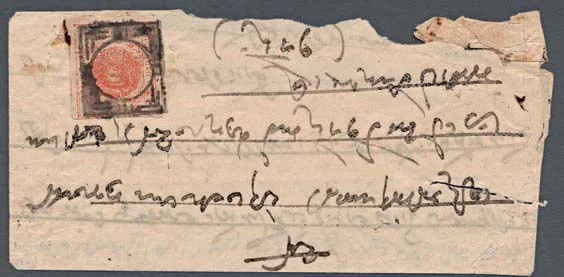
Klaseboer says the genuinely used cancellations on the portrait avoid the ruler’s head, and the Park catalogue describes a special cancellation doing just that on a damaged native cover. A photograph alone cannot settle the dispute.[32][14]
Why the dispute is not settled
StampWorld lists the portrait as an issue. The Imperial letter of 1902 denied it any scope as postage, and the account of 1912 describes a limited runners’ service for petitions. These may concern different layers of the service, or different understandings of it; the sources do not reconcile them, and no authenticated portrait cover tied to a dated petition has been found. The portrait stays a disputed label in the checklist.[4][35][23]
Identification traps
The receipt stamp, the printed portrait and the handstruck stamps are different categories. A sheet of 21 does not settle typography against lithography, and the man who supplied the presses was not necessarily the printer. The survival of the State dak, the availability of stamps to collectors, the validity of a stamp and the genuine postal use of one object are four different questions.[28][4]
Evidence still needed
An order book, press accounts, invoices or a signed design would name the printer, designer, engraver and paper supplier. A print order or the examination of a complete sheet would settle the process. The certificate and both sides of the Spink cover, compared with the Gärtner and Feldman covers, might show how the portrait was used. Casey’s notice of May 1879, the correspondence of 1902, the political agent’s list of offices and the State’s administration reports would date the beginning and end of the post. H. D. S. Haverbeck’s three-page study of Bhor (1958) is a further lead.[33][37]
Sources
- [1] E. B. Evans, “The Stamps of Some of the Native States of India: Bhor”, Stanley Gibbons Monthly Journal, 30 November 1899, p. 104.
- [4] “Bhor and Orcha”, The Postage Stamp, vol. 3, 9 January 1909, pp. 175–176, reprinting the Philatelic Journal of India account with the Imperial letter of 22 April 1902, and E. B. Evans’s reply.
- [5] Robert Bateman, “My Favourite Stamp”, The Stamp Lover, vol. 62, p. 141, continued p. 150.
- [6] E. B. Evans, Bhor (continued), Stanley Gibbons Monthly Journal, 30 November 1899, p. 105.
- [14] Christoph Gärtner, Park Collection, 7 March 2011, p. 112, Bhor lots 677–681.
- [15] Report on the Administration of the Bombay Presidency, 1898–99, register of printing presses (British Library IOR/V/10/310).
- [16] Stanley Gibbons Monthly Journal, 30 September 1903, vol. 14, p. 45, Bhor.
- [17] David Feldman, spring 2025, lot 80256, Bhor uprated stationery.
- [18] Spink, Philatelic Collector’s Series, sale 25118, lot 4514.
- [21] Mintage World, Bhor half-anna portrait, item 6701.
- [22] Philately Life, “The Feudatory State of Bhor”.
- [23] “The Bhor State Stamps”, Philatelic Journal of Great Britain, 20 February 1912, p. 42. Additional bounded reading: Entire extract printed p.42; PDF p.50.
- [24] Asiatic Society of Mumbai, Bhor State administration reports through 1895–96, GP_00134775.
- [25] Asiatic Society of Mumbai, Bhor State administration reports, 1896–97 to 1906–07, GP_00134776.
- [28] Stanley Gibbons Monthly Journal, vol. 12: 30 September 1901, p. 40; 31 December 1901, p. 108; 31 January 1902, p. 141.
- [32] Evert Klaseboer, Catalogue Indian States: Bhor, 1879; 1901; Fiscal stamps sections.
- [33] Anglo-Indian Affairs bibliography, Bhor titles (including H. D. S. Haverbeck’s study of 1958).
- [34] “Notes on the Postal Arrangements in Some of the Native States”, The Philatelic Journal of India, vol. X, no. 10, October 1906, pp. 218–227 (Bhor, p. 226).
- [35] The Philatelic Journal of Great Britain, 25 June 1902, p. 91: letter dated 22 April 1902.
- [37] British Library, Crawford Library catalogue: Stamp Journal (Joseph J. Casey), Crawford 2185.
- StampWorld, Bhor, entries 1–3.
Notes 0
Add what you know: a cover or stamp in your collection, a date or source, a correction or a question.
No notes yet.
Sign in to add a note.
Notes show straight away. Keep them kind and about the article; anyone can report one that isn't. House rules
