
Bhor’s State Dak: Hereditary Runners Beside the Imperial Post
Runners paid in land, eight village offices or six, the belief that the post closed in 1895, the Imperial letter of 1902, and the State dak still working in 1906 and 1912.
Updated October 3, 2026
In this article
When did Bhor’s own post end? Collectors have given 1895 and 1902, but the State dak was still carrying petitions in 1912. The sources disagree because they describe different parts of the service.
Hereditary carriers and village offices
The Bhor post grew out of a service of hereditary runners paid by grants of land. Robert Bateman describes eight village offices and traffic that was mostly official, with a smaller number of private letters needing the half anna and one anna stamps in 1879. That is a different model from a post staffed by salaried clerks.[5][6]
1895 and 1902: conflicting accounts
E. B. Evans wrote in 1899 that he believed Bhor’s State offices had closed in 1895; it was a belief, not an order he had seen. Bateman later distinguished outside mail, handled by the Indian Government post from about 1895, from internal letters, which went on using the State’s stamps. He placed a portrait issue in June 1901 and reported the Indian Post Office’s claim in 1902 to have taken over the internal mail completely.[6][5][9]
The Smithsonian’s summary also gives 1902 for the replacement of Bhor stamps by Indian stamps. So 1895 cannot stand as the end of all Bhor postal activity, and the later portrait label has to be judged within this conflicting evidence, not dismissed by repeating the early report that no State post remained.[6][5][9]
The Imperial letter of 22 April 1902
An Assistant Director-General of Posts wrote on 22 April 1902, in answer to an enquiry of 10 October 1901, that his department managed Bhor’s postal arrangements and that there was no scope for Bhor stamps to pay postage. It answered a question about the stamps; it did not announce a date of abolition, and it does not name the official.[4][35]
By 1909 a writer in the Philatelic Journal of India, reprinted in The Postage Stamp, was challenging that conclusion from his own experience as political agent, from a published list of working offices, and from an account of 1906 of the chief’s unwillingness to give up his dak. The editors framed it as “Crofton v. Evans”. The dispute was about how the State and Imperial services related, as much as about the stamps.[4]
The State dak in 1906
The Imperial offices did not mean Bhor’s own service had gone. An account published in October 1906 named Bhor and Junagad as the two Bombay Presidency states that kept postal arrangements of their own: their chiefs accepted Imperial offices and lines but resisted abolishing their State daks and stamps. The office lists and rates that follow in that article are Junagad’s, not Bhor’s.[34]
The Imperial Gazetteer of 1908 likewise leaves Bhor and Junagarh, “which had their own postal arrangements”, out of its description of the Bombay postal circle. It gives no tariff, offices, staff or closing date for Bhor, and its Presidency totals are not Bhor figures.[38]
Six offices and stamped petitions, 1912
The Philatelic Journal of India of January 1912, reprinted in Britain in February, described six offices, one at Bhor itself and one at each subdivision headquarters, linked daily by runners. Official letters travelled without stamps; members of the public had to use State stamps to send letters by the runners. In practice, the report found, these were stamped petitions to the Chief or to State officials, while ordinary letters went by the Imperial post. The report itself wondered how far this counted as postal use. It does not name the six offices or give a tariff.[39][23]
Bateman’s eight village offices and the six offices of 1912 are dated descriptions from different sources. Neither is preferred, and no programme of closures should be invented to explain the difference.[5][23]
A British journal of January 1913 described Bhor as having issued only three labels in 33 years, said the State was unwilling to sell them except for postal use, and openly asked whether they were postage stamps at all. That is collectors’ commentary, not an official record.
What the surviving dak does and does not prove
Evidence that the State dak survived does not prove that any particular portrait stamp or cancellation was used on a genuine petition. Evans saw this in his reply of 1909: he accepted that the 1901 stamp might have worked quietly, but was troubled that used copies never reached collectors in the ordinary way. A dated, intact petition with legible postal markings would settle more than any unused sheet or catalogue listing.[4]
Politically, the State lasted until 1948; the Marathi Vishwakosh dates its merger into Bombay State to 8 March 1948. The first notice of 1879, the original correspondence of 1902, the political agent’s list of offices and the State’s own administration reports, held by the Asiatic Society of Mumbai, are where the dates of the post’s beginning and end should be looked for. A search of the 1930 history of the State found no postal references.[24][25][36][37]
Sources
- [4] “Bhor and Orcha”, The Postage Stamp, vol. 3, 9 January 1909, pp. 175–176, reprinting the Philatelic Journal of India account with the Imperial letter of 22 April 1902, and E. B. Evans’s reply.
- [5] Robert Bateman, “My Favourite Stamp”, The Stamp Lover, vol. 62, p. 141, continued p. 150.
- [6] E. B. Evans, Bhor (continued), Stanley Gibbons Monthly Journal, 30 November 1899, p. 105.
- [9] Smithsonian National Postal Museum, “Feudatory States: A–D”, Bhor: Indian issues replaced state stamps in 1902.
- [23] “The Bhor State Stamps”, Philatelic Journal of Great Britain, 20 February 1912, p. 42. Additional bounded reading: Entire extract printed p.42; PDF p.50.
- [24] Asiatic Society of Mumbai, Bhor State administration reports through 1895–96, GP_00134775.
- [25] Asiatic Society of Mumbai, Bhor State administration reports, 1896–97 to 1906–07, GP_00134776.
- [34] “Notes on the Postal Arrangements in Some of the Native States”, The Philatelic Journal of India, vol. X, no. 10, October 1906, pp. 218–227 (Bhor, p. 226).
- [35] The Philatelic Journal of Great Britain, 25 June 1902, p. 91: letter dated 22 April 1902.
- [36] Ranade and Joshi, A Short History of the Bhor State, Poona, 1930.
- [37] British Library, Crawford Library catalogue: Stamp Journal (Joseph J. Casey), Crawford 2185.
- [38] The Imperial Gazetteer of India, vol. VIII, 1908, p. 333.
- [39] “The Bhor State Stamps”, The Philatelic Journal of India, vol. XVI, no. 1, January 1912, p. 2.
- The Philatelic Journal of Great Britain, vol. 23, 20 January 1913, p. 4.
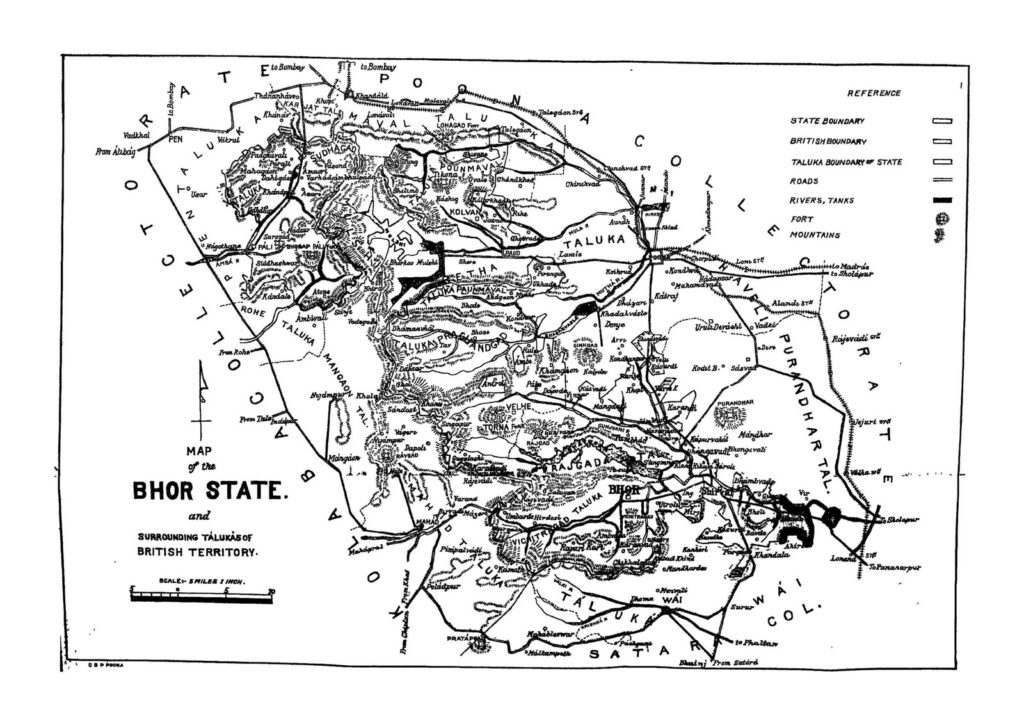
- Ranade and Joshi, A Short History of the Bhor State (1930), map of Bhor State, via Wikimedia Commons.
Notes 0
Add what you know: a cover or stamp in your collection, a date or source, a correction or a question.
No notes yet.
Sign in to add a note.
Notes show straight away. Keep them kind and about the article; anyone can report one that isn't. House rules
