
How Bijawar’s Stamps Were Printed: Units, Sheets, Varieties and Specimens
Six-subject units and larger press sheets, Stoney’s measurements, the disputed printing method of the 1937 high values, imperforate-between pairs and SPECIMEN markings.
Updated July 23, 2026
In this article
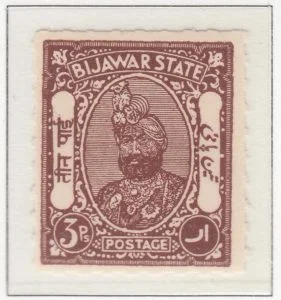
One portrait runs through all three Bijawar issues, but each was made differently. Compare the separation, format, gum and sheet arrangement before naming a stamp. A photograph shows the edges and the value; it cannot show the gum or the paper.[1][12][14]
| Issue | Printing and sheet | Separation | Gum |
|---|---|---|---|
| 1935 low values | Typography; unit of six, three across and two down | Perforation 11 | Paper gummed before printing |
| 1936 low values | The same clichés in changed colours | Roulette 7 | Look at the paper and the back |
| 1937 high values | Unit of six; typography in the 1937 notice, uncertain in Stoney, lithography in Haverbeck | Perforation 9 | Gummed after printing, according to Haverbeck |
The printing method of the high values
The low values are always described as typographed. The 1937 high values need a more careful label. The May–June 1937 chronicle calls them typographed. Stoney repeated in 1942 that they were said to be typographed, but admitted he could not explain why they looked different. Haverbeck later described lithography with a halftone portrait, while Holman called all Bijawar stamps letterpress.[12][14][1][4]
These are competing interpretations, not a known fact about the workshop. A halftone image does not name a printing process, an engraver or a press. Only a printer’s specification or a technical examination of the stamps can settle it.[12][14][1][4]
| Source | Issue date | Printing | What it shows |
|---|---|---|---|
| Philatelic Journal of India, May–June 1937, p. 37 | All five values already chronicled | Typographed | A contemporary report, not an issue order or a printer’s specification |
| Stoney, October 1942, p. 137 | Catalogue listings kept apart from issue dates | Said to be typographed; he could not explain their appearance | Open uncertainty, not proof either way |
| Haverbeck, 1959, pp. 288–289, 293 | July 1937 | Lithography, with a 60-line halftone portrait screen | A later interpretation; no printer named |
| Holman, November 2008, p. 33 | May 1937 | All Bijawar stamps letterpress | A later survey, no printing contract |
| Brunström, February 2019, pp. 80–81 | May 1937 | The Lakshmi attribution is for the 1935 set | Not to be extended to the high values |
Six subjects, but not a six-stamp sheet
Stoney’s study of 1942 is an early check on the six-subject unit. He described a three pies block made of two vertical pairs, 19 mm apart, one pair upside down to the other, and concluded that more than one unit had been printed on the same piece of paper. Haverbeck later illustrated a double unit and explained it by work-and-turn printing.[14][1]
So the unit is three across and two down, but the uncut paper could carry repeated units, and the size of the unit is not the size of the press sheet. Stoney also listed small positional differences in the low values, marking some as uncertain. His idea that one original type was used with altered values is a reconstruction from the stamps, not a record of how the dies were made. The extra S on the rupee is more firmly placed, at subject 2, top middle.[14][1]
Stoney’s opposed three pies pairs are positions 3 and 6. His lists of positional details are leads for comparing stamps, not a finished plating: he himself doubted the dot he gave to position 6 of the two annas, and not every weak detail is constant.[14]
Stoney’s measurements
Stoney’s dimensions and spacings describe the stamps he examined; they have not been measured again from pictures. He notes that the Hindi and Urdu inscriptions change sides between the two designs. Record the scale, the paper and where you measure from before applying his figures to a stamp.[14]
| Design | Size of stamp | Spacing | Paper and separation | Inscriptions |
|---|---|---|---|---|
| Low values | 23¾ × 27½ mm | 3 mm | Thin white wove; perforation 11 for the first family (the rouletted family is separate) | Hindi left, Urdu right |
| High values | 25 × 29½ mm | 6½ mm | Thicker white wove; perforation 9; process disputed | Urdu left, Hindi right |
Imperforate between: keep the pair
Haverbeck’s checklist records the four annas imperforate between horizontally and the six annas imperforate between vertically. Both describe the join between two stamps: a single trimmed close on one side cannot show either. The one rupee also has an imperforate listing, which is a different claim from one missed line of perforation in a normally perforated sheet.[1]
The May–June 1937 notice describes the six annas instead as imperforate between horizontally, and Stoney later mentions, without having seen it, a vertical pair imperforate between. Both descriptions stand until an intact pair settles which way it runs.[12][14]
Haverbeck’s rarity ratings describe the unused and used stamps known to him. They are not today’s prices or a census of what survives, and a variety needs an intact multiple or other direct evidence, not a rarity symbol.[1]
SPECIMEN markings are not proofs
Stoney recorded low values in his collection with SPECIMEN on the back in black, apparently put on before gumming, and high values marked on the face in violet. So such material existed at the time. It does not show who applied the marks, whether they were official, whether the stamps went out through the UPU, or that they were printer’s proofs.[14][1]
No essay or proof with a documented history from the printer is known. SPECIMEN stamps, missing perforations, tête-bêche multiples and issued stamps are separate categories, and none of them adds a new value.[14][1]
Sources
- [1] H. D. S. Haverbeck, “Bijawar”, The Collectors Club Philatelist, vol. 38, no. 6 (November 1959), pp. 287–293, with checklist.
- [4] John Holman, “New Collector: Indian Feudatory States”, Gibbons Stamp Monthly, November 2008, p. 33 (Bijawar).
- [12] “New Issues for Chronicle”, The Philatelic Journal of India, XLI, nos. 5–6 (May–June 1937), pp. 36–37, Bijawar p. 37.
- [14] R. F. Stoney, “The Stamps of Bijawar”, The Philatelic Journal of India, XLVI, no. 10 (October 1942), pp. 133–137.
- [15] Christer Brunström, “Bijawar: Seven Years in the Philatelic Limelight”, Gibbons Stamp Monthly, February 2019, pp. 80–81.
Notes 0
Add what you know: a cover or stamp in your collection, a date or source, a correction or a question.
No notes yet.
Sign in to add a note.
Notes show straight away. Keep them kind and about the article; anyone can report one that isn't. House rules
