
Bijawar’s Stamps: the Sawant Singh Portraits of 1935, 1936 and 1937
Five low values perforated in 1935, the same clichés rouletted in 1936, five larger high values in 1937, the 1 R and 1 Rs rupees, and the supplier and printers named for them.
Updated July 7, 2026
In this article
For so small a service Bijawar issued ambitious stamps: fifteen values in three years, all with the portrait of Maharaja Sawant Singh.
1935: the first five values
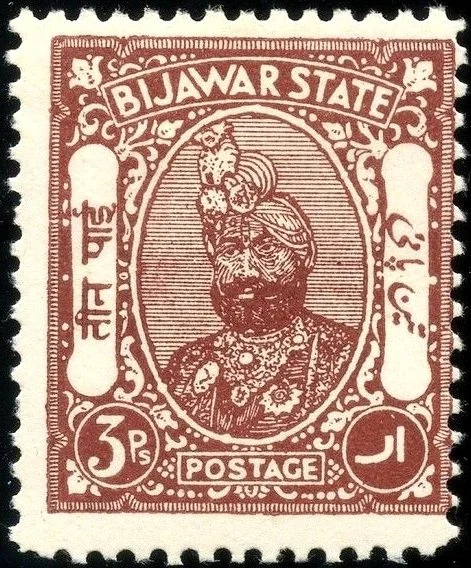
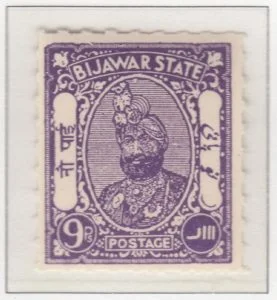
Haverbeck dates Bijawar’s first stamps to 1 July 1935; no contemporary sale notice has been found. The five values, three, six and nine pies, one anna and two annas, show Maharaja Sawant Singh. Haverbeck names Beerindra Kumar & Co. of Saharanpur as the supplier, though a later article names a different printer (see below). The stamps were typographed in units of six, three across and two down.[1]
The paper was unwatermarked white wove, gummed before printing. The first separation was perforation 11. In 1936 the same clichés appeared in new colours with roulette 7, so a full description has to give the separation as well as the colour.[1]
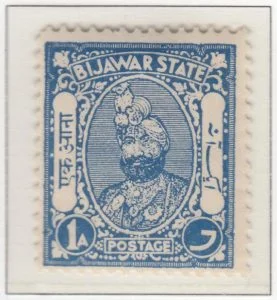
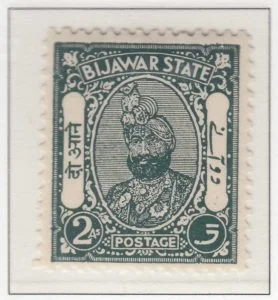
1936: the same clichés, rouletted
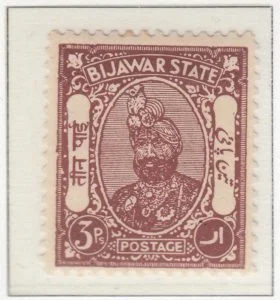
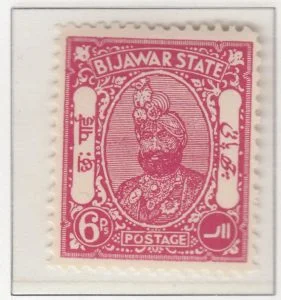
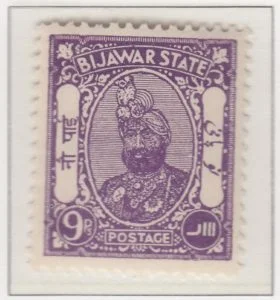
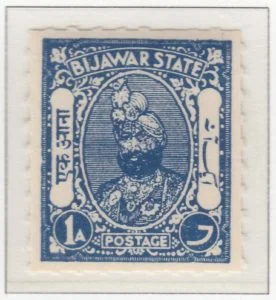
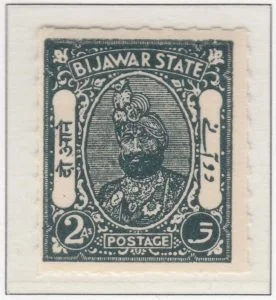
The rouletted set of 1936 has its own colours: three pies dark brown, six pies brown-red, nine pies violet, one anna indigo and two annas dark green. These belong to the roulette 7 family and are not just more of the 1935 perforated set. A three pies printed on the gummed side is recorded separately.[1]
The nominal gauge is roulette 7. A. M. Benders measured 6¾, with stretches resembling 13½, which he explained by the pointed pieces of the rouletting wheel; that is not another issue.[16]
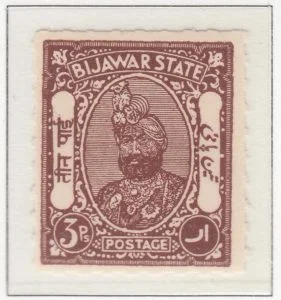
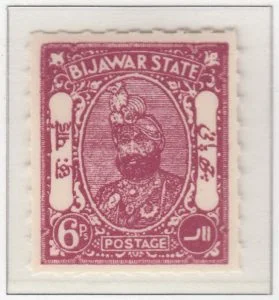
What the issue notices establish
The Philatelic Journal of India for September 1936 reports the brown three pies, rouletted, on unwatermarked white wove paper. Its chronicle for January–February 1937 adds the other four low values with roulette 7. Collectors therefore knew the rouletted family at the time; the order of the reports does not show that the values reached the counters on different days.[10][11][12][1][4][15]
The issue for May–June 1937 already describes all five high values, from four annas to one rupee, in units of six with perforation 9. Haverbeck later gave July 1937, and later surveys say May. The year 1937 is secure, the month is not: the label on a journal issue proves neither when that issue was distributed nor when the stamps went on sale. The 1 July 1935 date for the first set likewise rests on the specialist chronology, not on a sale notice.[10][11][12][1][4][15]
1937: the larger high values
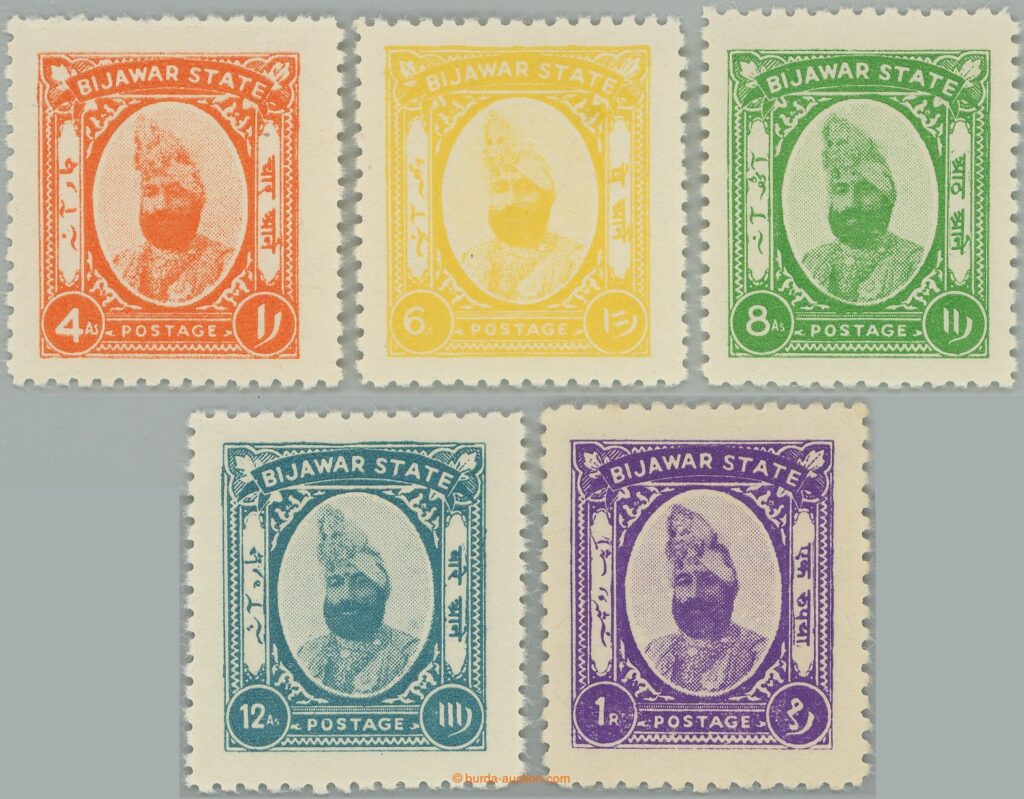
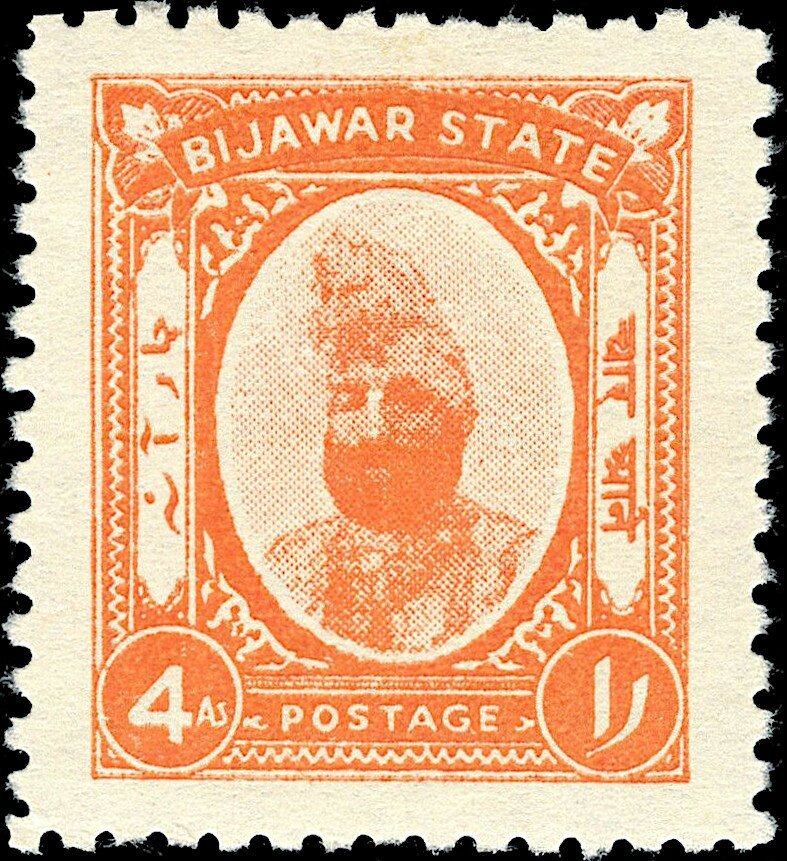
In 1937 the State added four, six, eight and twelve annas and one rupee in a larger format: four annas orange, six annas lemon-yellow, eight annas emerald-green, twelve annas blue and one rupee violet. Haverbeck describes lithography, soft white wove paper, gum put on after printing and perforation 9. The May–June 1937 notice says typography instead, and R. F. Stoney in 1942 admitted he was unsure of the process. Haverbeck did not identify the printer, and the supplier of 1935 should not be assumed to have made them.[1][12][14]
1 R and 1 Rs
The one rupee sheet has a useful positional difference: the second subject, top middle, reads “1 Rs” where the others read “1 R”. It is catalogued separately (StampWorld 10A, Michel 10II, Yvert 15a) but it is a variety, not another value. Read the value lettering and the format before naming a stamp from its colour.[1][12][14]
Missing perforations and tête-bêche arrangements need care. Haverbeck explains some inverted pairs by a work-and-turn method of printing; an unusual multiple is no proof of ordinary postal demand.[1]
Printer names need reconciling
Haverbeck names Beerindra Kumar & Co. of Saharanpur as the firm that supplied the first stamps, and names no printer for the 1937 high values. John Holman’s account of 2008 says Bijawar’s stamps were typographed by the Lakshmi Art Printing Works in Bombay, and Christer Brunström gives that attribution for the 1935 set in particular. The two firms may have had different roles, but no source explains how they were related, and the 1937 printer remains unconfirmed.[1][4][15]
No source names a designer, engraver, die cutter or block maker. Sawant Singh is the subject of the portrait, not its artist. C. T. Sturton lent Haverbeck the rupee sheet he illustrated, which is a collector’s credit, not a part in making the stamps.[1][4][15]
| Person or firm | Documented role | Limit |
|---|---|---|
| Beerindra Kumar & Co., Saharanpur | Supplier of the first stamps, according to Haverbeck[1] | Supplying does not make them the printer, designer or engraver |
| Lakshmi Art Printing Works, Bombay | Printer according to Holman, and for the 1935 set according to Brunström[4][15] | No contract seen; the high-value printer is unproved |
| Maharaja Sawant Singh | Ruler and portrait subject[1] | No part in the design |
| Chief Minister (Dewan) of Bijawar | Unnamed informant of the 1937 report and of Haverbeck[13] | Name and letter not recovered |
| H. D. S. Haverbeck | Collector and author of the 1959 study[1] | Researcher, not maker |
| C. T. Sturton | Lent the illustrated rupee sheet[1] | Collector credit only |
| A. M. Benders | Reported the roulette measurements[16] | Not a maker of the machine or the stamps |
| John Holman; Christer Brunström | Later authors[4][15] | Not witnesses to the printing |
| R. F. Stoney | Described his own material and the catalogue reports in 1942[14] | His plate ancestry is inference; some varieties he had not seen |
| C. E. Luard | Compiler of the 1907 gazetteer[18] | The Newul Kishore Press printed the book, not the stamps |
Revenue stamps are not postage
Brunström’s review of 2019 also describes Bijawar court-fee and revenue stamps, including a portrait one anna revenue stamp reported in use around 1930–40. These fiscal stamps are not in the postage checklist.[15]
Sources
- [1] H. D. S. Haverbeck, “Bijawar”, The Collectors Club Philatelist, vol. 38, no. 6 (November 1959), pp. 287–293, with checklist.
- [4] John Holman, “New Collector: Indian Feudatory States”, Gibbons Stamp Monthly, November 2008, p. 33 (Bijawar).
- [6] Wikimedia Commons, Bijawar 1935 three pies, Maharaja Sawant Singh Bahadur; scan credited to the Post of Bijawar.
- [7] Wikimedia Commons, Bijawar 1937 four annas, Maharaja Sawant Singh Bahadur; scan credited to the Post of Bijawar.
- [8] Indian Feudatory States Stamps, “Bijawar”, online exhibition.
- [9] Burda Auction, Public Auction 74, object 247356, Bijawar 1937 high-value set, SG 11–15 as attributed by the auction.
- [10] “New Issues for Chronicle”, The Philatelic Journal of India, XL, no. 9 (September 1936), p. 114.
- [11] Editor, “New Issues for Chronicle”, The Philatelic Journal of India, XLI, nos. 1–2 (January–February 1937), p. 9.
- [12] “New Issues for Chronicle”, The Philatelic Journal of India, XLI, nos. 5–6 (May–June 1937), pp. 36–37, Bijawar p. 37.
- [13] “Bijawar” (reprinted from Gibbons’ Stamp Monthly), The Philatelic Journal of India, XLI, nos. 11–12 (November–December 1937), pp. 87–88.
- [14] R. F. Stoney, “The Stamps of Bijawar”, The Philatelic Journal of India, XLVI, no. 10 (October 1942), pp. 133–137.
- [15] Christer Brunström, “Bijawar: Seven Years in the Philatelic Limelight”, Gibbons Stamp Monthly, February 2019, pp. 80–81.
- [16] A. M. Benders, “Some Notes on Perforations of Native States Stamps”, pp. 36–41.
- [18] C. E. Luard, The Central India State Gazetteer Series, Eastern States (Bundelkhand) Gazetteer, Volume VI-A: Text (Lucknow: Newul Kishore Press, 1907).
- Wikimedia Commons, Bijawar 1937 one rupee “1 Rs” variety (Michel 10II, Yvert 15a).
- Christoph Gärtner, Indian States catalogue, lot 703: Bijawar 1937 one rupee pair with the “Rs” for “R” variety.
- StampWorld, Bijawar, 1935–1937.
Notes 0
Add what you know: a cover or stamp in your collection, a date or source, a correction or a question.
No notes yet.
Sign in to add a note.
Notes show straight away. Keep them kind and about the article; anyone can report one that isn't. House rules
