
The Jhalawar Raj Post: Seventeen Offices, Seals, Covers and Postal Unity in 1900
Irwin’s 114,934 letters, the 1896 presentation of seventeen office seals by Jwala Prasad, seals and date cancellers, combination covers, and the long road to Imperial postal unity in 1900.
Updated August 13, 2026
In this article
A bigger post than two stamps suggest
In his report of 9 April 1894 the Political Agent, G. R. Irwin, recorded 114,934 letters through the Raj Post in Samvat 1949, about a thousand more than the year before. Receipts had risen, but expenditure had risen more; the department ran at a loss, and he proposed examining whether its offices could be redistributed to reduce it. These are traffic figures, not rates.[12]
Seventeen offices in 1896
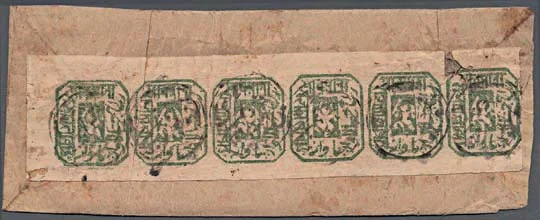
A presentation sheet dated 5 August 1896 gives the fullest picture of the network. Jwala Prasad, Munsarim Superintendent of Raj Post Offices at Jhalrapatan, presented it to Lieutenant Colonel J. H. Sadler, Political Superintendent of Kota and Jhalawar. Seventeen strips of five quarter-anna stamps bore office seals, with the office names and postal lines written in the margins. The offices included the head office, Patan, Suket, Chechat, Bakani, Ikhara, Pachpahar, Awar, Dag, Gangadhar, Shahabad and Manoharthana, grouped into the Shahabad, Suket-Chechat and Chomehl lines. It is a prepared presentation, not proof that each stamp carried mail, and neither man is known to have designed or printed stamps.[3][1][4]
Other names belong to the study of the stamps rather than their making: W. Dorning-Beckton, whose album held the presentation and the questioned proof; L. E. Dawson, who described them; H. D. S. Haverbeck; C. A. Howes; and Maharani Shiv Kumari, whose interview Chopra reports as published in 2011. Nobody who drew the stamps, cut the die or printed the strips has been named.[3][1][10][11]
Seals and date cancellers
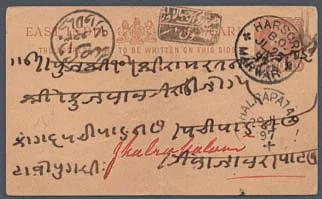
The first two cancellation types are office seals. Their inscriptions include years, which Dawson took to be the dates the seals were made, perhaps when the offices opened; such a year is not the date of a letter. The third type is an office-and-date canceller: one reads Dak Manoharthana 1 Dsm 98 Jhalawar, 1 December 1898, and others show the head office, Dag and Pachpahar. The stamps’ inscriptions are Hindustani in Persian and Devanagari characters; the cancellations are in Urdu.[3]
Two services on one envelope
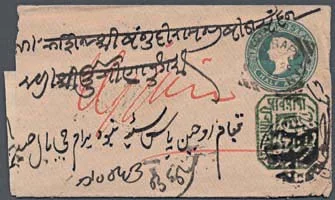
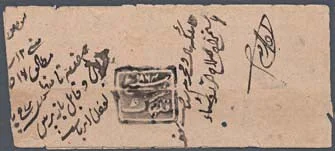
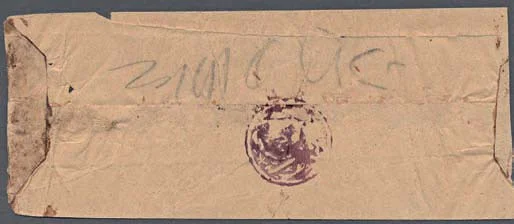
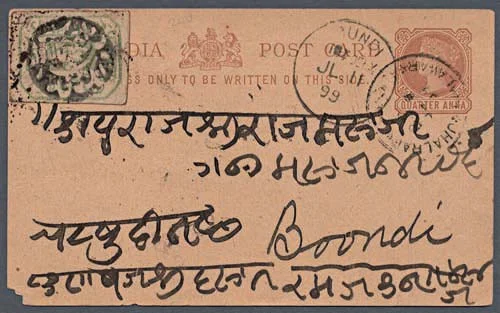
Dawson describes an Indian half-anna embossed envelope with a Jhalawar quarter anna added. The Imperial Jhalrapatan mark is dated 9 December 1897 and the Bombay delivery mark 12 December, while state marks on the back record the local part of the journey. The two stamps paid two services. Another letter, to Kota, carried only the state quarter anna and received a one-anna postage-due mark: the state stamp paid the local service but not the Imperial charge.[3]
Postal unity took years
Zalim Singh, chief from 1875 and ruler during both stamp designs, was deposed in 1896; British administration followed until Bhawani Singh was restored to a reduced state in 1899. The Deputy Postmaster-General’s review for 1896–97, reported on 14 May 1897, records a detailed scheme for postal unity agreed with the Political Superintendent and the Diwan, but shelved while the Government decided the State’s future. The review for 1897–98, of 17 May 1898, still treated unity as a future step, to follow final orders on the new state’s constitution.[2][13][14]
The territorial transfer that created the reduced state took effect on 1 January 1899, but the post did not change with it. The report for 1899–1900, dated 10 May 1900 and signed by G. Barton Groves, Deputy Postmaster-General for Rajputana, says famine had held up the schemes for Jhalawar and several other states. The State’s administration report of 1907 and the Imperial Gazetteer confirm that the State’s post offices were abolished when it joined the Imperial system in 1900. Evans’s account of 1903 gives the day, 1 November 1900; the official sources confirm the year.[17][14][16][4]
Imperial offices before and after
Imperial offices already worked beside the Raj Post. In 1899–1900 growing business raised Jhalrapatan City from a branch to a sub-office, and a permanent telegraph was added there. After unity the network grew. The State report for the year ending 30 September 1907, by Rai Bahadur Pandit Parmanand Chaturvedi, counts seven offices: four branches, one sub-office, and combined post and telegraph offices at Chhaoni Jhalrapatan and Patan Town. A branch at Jhalrapatan Road Station, opened the year before for employees of the Nagda–Muttra Railway, was confirmed. The report also records an annual free grant of Imperial service stamps worth Rs 800, which is not a native official issue.[14][16]
| Record | Count | What it is |
|---|---|---|
| Presentation of 5 August 1896 | 17 office-seal strips | Raj Post offices and lines, on a prepared presentation |
| Imperial Gazetteer, vol. XIV | 6 post offices | The Imperial network after unity |
| Year ending 30 September 1907 | 7 offices | Four branches, one sub-office and two combined post and telegraph offices |
What is still to be found
Still unknown: the designer, engraver and printer of both stamps; the intended subject of the first design; the order that opened the Raj Post, its exact sale dates, its full office list, runner routes, exchange terms and tariff; the order fixing 1 November 1900; and a full record of its postmarks.
Sources
- [1] H. D. S. Haverbeck, “Jhalawar”, The Collectors Club Philatelist, vol. XXXVI, no. IV (July 1957), pp.193–195.
- [2] Encyclopædia Britannica, 11th edition (1911), “Jhalawar”.
- [3] L. E. Dawson, “Jhalawar: Some Further Notes”, The Collectors Club Philatelist, vol.37, no.3 (1958), pp.131–132.
- [4] “The Stamps of some of the Native States of India: Jhalawar,” by “The Editor” (E. B. Evans attribution in library metadata), Stanley Gibbons Monthly Journal, 31 October 1903, pp. 81–82.
- [10] C. A. Howes, “Some Stamp Designs”, Jhalawar subsection, American Journal of Philately, 1906 continuation, printed p.3.
- [11] Vivek S. Chopra, “Deities and Myths of India’s Stamps: Demystifying Mythological Images on Stamps from Princely States”, American Philatelist (August 2025), pp.42–46; Jhalawar section pp.43–45, figs.3–10.
- [12] G. R. Irwin, Political Agent, “Jhallawar Agency Administration Report”, No. 111 G., Jhalrapatan, 9 April 1894, in Report on the Political Administration of the Rajputana States for 1893–94, pp. 109–111, especially “Raj Post Office”, pp. 110–111.
- [13] Deputy Postmaster-General, Rajputana, review of the Imperial Post Office in the Rajputana Postal Circle for 1896–97, No. 418-C., Camp Abu, 14 May 1897, in Report on the Political Administration of the Rajputana States for 1896–97, pp. 134–135, paragraph 6.
- [14] Deputy Postmaster-General, Rajputana, review of the Imperial Post Office in the Rajputana Postal Circle for 1897–98, No. 381 C., Camp Abu, 17 May 1898, in Report on the Political Administration of the Rajputana States for 1897–98, p. 142, paragraph 5.
- [16] Rai Bahadur Pandit Parmanand Chaturvedi, Report on the Administration of the Jhalawar State for the Year Ending 30th September, 1907 (Bombay: Times Press, 1907), pp. 9–10, paragraph 28, “Post Offices”.
- [17] The Imperial Gazetteer of India, new edition, vol. XIV, Jaisalmer to Kara (Oxford: Clarendon Press), “Jhalawar State”, pp. 117 and 119.
Notes 0
Add what you know: a cover or stamp in your collection, a date or source, a correction or a question.
No notes yet.
Sign in to add a note.
Notes show straight away. Keep them kind and about the article; anyone can report one that isn't. House rules
