
How Jhalawar’s Stamps Were Printed: Strips of Twelve, Screw Marks, Paper and Plate Flaws
Both designs were typographed in horizontal strips of twelve from a screwed-down cast or electrotype, on laid paper of several kinds, with position flaws at 3 and 10, a questioned proof and forgeries.
Updated September 28, 2026
In this article
A strip, not a sheet
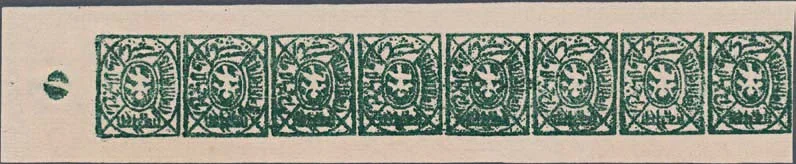
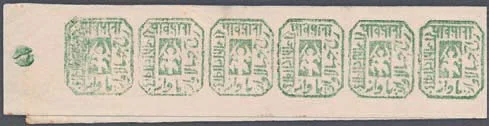
Both designs were printed in long horizontal strips of twelve. They were typographed in green on laid paper, white or toned, and issued imperforate; yellow-green and blue-green shades occur. Traces of screw heads at the ends of a strip show how the printing surface was mounted. They are marks in the margin, not cancellations or controls. Ageing can make the paper look buff, which is not a separate buff-paper issue.[1]
What the screw marks show
Evans argued in 1903 that the screw heads meant the printing unit was fixed as one block to a support. It could have been made by engraving each design on one metal strip, or by combining casts of an original die into one cast or electrotyped unit; he preferred the second, because the designs were too alike for twelve separate hand engravings. The report of August 1890 also spoke of “casts or electrotypes”, and Haverbeck later favoured electrotypes. That is a reconstruction from the stamps, not a recovered plate. Haverbeck’s illustrations divide the twelve subjects into two rows of six only to fit his page.[4][9][1]
Twelve impressions, not twelve engravings
In December 1890 the Philatelic Record reported coarse greyish paper as well as smooth white laid paper, and concluded from comparing strips that all twelve positions were different types. Evans was more cautious: he put the stable differences down to defects or touching-up of the casts or electrotypes, and many other apparent varieties to poor printing and clogged ink.[9][4]
Plate flaws that repeat
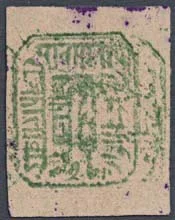
On the first design Evans recognised the third position by a dent where the oval band meets the upper frame, after comparing complete strips and a single in another shade. On the second design a missing dot in the Perso-Arabic inscription at the right marks the third stamp from the right, position 10 of twelve, so the direction of counting must be stated. Weak inking elsewhere can hide a dot too; one missing detail is not a variety, or a test of genuineness, on its own.[4][1]
A wove-paper listing that nobody had seen
Evans examined a strip of the second design in August 1890 and found laid paper. He suggested that an early report of merely “white paper” lay behind a catalogue entry for wove, and kept the wove entry in his own list with a question mark, saying he had never seen it. A wove claim needs transmitted light, the whole stamp and a specialist opinion; discolouration or a face scan is not enough.[4]
Paper
Haverbeck describes both horizontal and vertical laid lines on the first design, and usually vertical, less often horizontal, on the second. He says the paper was English foolscap sold in the local bazaars, which names no papermaker. L. E. Dawson adds white laid batonné, a stout cream laid paper like card, and a white laid example with the curved letters AWOO, a fragment, not a papermaker’s name. The cream wove paper on which the 1896 presentation strips are mounted is no evidence of wove stamp paper.[1][3][11]
| Design | Paper | Colours |
|---|---|---|
| 1887 oval, one pice (quarter anna) | White or toned laid, lines either way; white laid batonné; stout cream laid; a partial AWOO watermark | Yellowish green and later blue-green (Haverbeck); pale sage-green and dull yellow-green (Dawson) |
| 1890 octagonal, quarter anna | Laid, usually vertical lines, also horizontal; a wove listing queried by Evans | Blue-green and yellow-green |
A questioned proof and the essays
Dawson describes a grey-green quarter anna on white laid paper in the Dorning-Beckton album, annotated “Proof?”. Its frame, lettering and scratched shading differed from the issued stamps, and he thought it an impression from the original die; that is his opinion, not a proof order. It is distinct from the modern black objects on thin wove paper presented as essays, and from the known imitations.[3][1][11]
Forgeries
Crude lithographic imitations are known, and Haverbeck illustrates misleading concentric-circle and barred-oval cancellations used on them, so a used look settles nothing. No official overprint is known. Evans said in October 1903 that he had heard no rumours of reprinting; that was his knowledge then, not proof that no reprint was ever made.[1][4]
Sources
- [1] H. D. S. Haverbeck, “Jhalawar”, The Collectors Club Philatelist, vol. XXXVI, no. IV (July 1957), pp.193–195.
- [3] L. E. Dawson, “Jhalawar: Some Further Notes”, The Collectors Club Philatelist, vol.37, no.3 (1958), pp.131–132.
- [4] “The Stamps of some of the Native States of India: Jhalawar,” by “The Editor” (E. B. Evans attribution in library metadata), Stanley Gibbons Monthly Journal, 31 October 1903, pp. 81–82.
- [9] “Jhalawar,” The Philatelic Record, vol. XII, no. 140 (August 1890), p. 140; no. 141 (September 1890), p. 158; no. 144 (December 1890), p. 209.
- [11] Vivek S. Chopra, “Deities and Myths of India’s Stamps: Demystifying Mythological Images on Stamps from Princely States”, American Philatelist (August 2025), pp.42–46; Jhalawar section pp.43–45, figs.3–10.
Notes 0
Add what you know: a cover or stamp in your collection, a date or source, a correction or a question.
No notes yet.
Sign in to add a note.
Notes show straight away. Keep them kind and about the article; anyone can report one that isn't. House rules
