
M.B.D.: the Nandgaon Initials, the State Obliterator and the Stamps Sold after 1895
What the violet M.B.D. oval meant, the corner-cancelled blocks, the state obliterator of RAJNANDGAON, the Sub-Postmaster’s sales of 1896 and the stamps made as curiosities after 1897.
Updated October 12, 2026
In this article
What M.B.D. tells us
The original report of July 1893 explains M.B.D. through an unnamed correspondent and the Diwan, without yet giving it an official-only function. In September the Diwan is reported as saying that the marked stamps were for State-service covers, and by August 1894 the journal had received marked small stamps and classed them as service issues.[11][12][1]
Evans’s later evidence complicates this. The overprinted stamps dominated later supplies to collectors, and many cancelled marked stamps seemed to have been struck in blocks. The initials identify the ruler, Mahant Balram Dass, without proving that every marked stamp served the same purpose; official use, later control, remainders and actual postal use are separate questions. Evans expressly did not take the corner-cancelled blocks as proof that no M.B.D. stamp ever carried mail. A complete dated cover is stronger evidence than an overprint or a corner strike.[11][12][1]
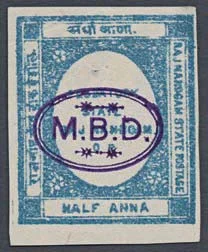
M.B.D. on the elliptical design
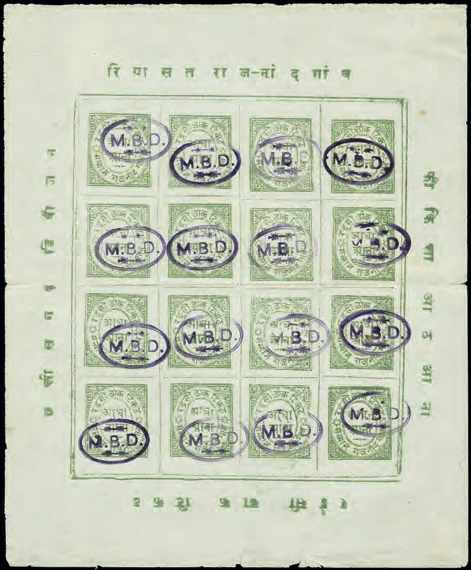
The oval M.B.D. also occurs on the closer-setting elliptical half anna. Köhler lot 10964 is a complete sheet of sixteen yellow-green half annas with sixteen separate violet M.B.D. impressions and the margins, catalogued as SG O4. The auction classes it as an official form; an unused sheet cannot show whether the marks controlled postal issue, served another administrative purpose or were made for collectors.[7]
The state obliterator
Evans described the state obliterator in 1909 as a circular device about 28 mm across. In its centre were the letters C P on crossed lines forming a rough diamond pattern, with STATE POST above and RAJNANDGAON below, separated by a large dot at each side, the lettering white against the struck ground. He recorded complete strikes on the early half anna blue and two annas rose and on the later half anna green and one anna red on wove paper. On other stamps with M.B.D. only one corner was struck, and matching edges and sheet positions showed that a single strike had been applied to the centre of a block of four. Such a strike can come from the state device without proving that the stamp paid for a letter.[1]
Sales after the post had closed
The letter of 1 January 1896 reproduced by Evans is signed Mohammed Shumsooddeen, Sub-Postmaster at Raj Nandgaon. It offers half, one and two annas marked M.B.D. and expands the initials. The reply of February prints the signature as Md. Shumsoodin and records unsuccessful requests to the Raja and the Diwan for stamps without the overprint. He was a postal official selling to a collector after the State post had ended, not the designer, the printer or the head of the earlier service; the registration and postage on his invoice paid for delivering the stamps, not the native-post tariff.[1]
Correspondence of 1897–98 explains why later supplies need care. The postal authorities accepted that after the Imperial post came in, the state could go on making and selling stamps as curiosities; a Nagpur letter of 4 February 1898 says so plainly. On 26 January 1898 Superintendent Bhagwant Rai called three submitted examples genuine. Genuine state manufacture, issue for postal service, use at the time, and later manufacture for collectors are four different things.[1]
A strike reading RAJNANDGAON 23 DE 98 is later than any of the proposed closing dates; it cannot show ordinary state-post use without an explanation of the service and mark involved. Old stamps survive with later or favour cancellations.[1]
Reading the complete original
The Philatelic Journal of India’s reprint of 1944 is abridged and leaves out Evans’s remarks on remainders and possible reprints, which are needed for the correspondence of 1896–98; the original publication of 1909 is the one to use. The records behind this account are many, but they are not all independent witnesses.[1][16]
What to record
Record the state design, the M.B.D. mark and the cancellation separately. Keep the sixty-four-subject sheets of the large lithographs apart from the sixteen-subject formes of the small typographed stamps. Treat the later settings as a provisional reconstruction. Permission to sell curiosities after closure does not date any particular stamp, and dealers’ postage charges are not the State tariff.[1][10]
What is still to be found
A final count of the printings, a settled meaning for M.B.D., the native tariff, the exact date of the transfer of the post, and the names of the Poona printer and of any designer or engraver are still unknown.
Sources
- [1] E. B. Evans, “The Stamps of some of the Native States of India: Raj Nandgaon”, Gibbons Stamp Weekly X: 24 July 1909, pp. 87–90; 14 August 1909, pp. 159–161; 11 September 1909, pp. 249–251.
- [2] Encyclopædia Britannica, 11th edition (1911), “Nandgaon”.
- [3] Evert Klaseboer, online catalogue, “Indian States, Nandgaon”, design values, MBD and reprint notes.
- [5] Christoph Gärtner, 17th auction, 7 March 2011, India and Indian States, Nandgaon lots 1415–1424, plates pp. 80–82.
- [7] Heinrich Köhler, 377th auction, Gems of Indian States, lot 10964, description p.175 and original photograph p.171; catalogue attribution SG O4.
- [8] Bhagwant Rai, Diwan of Raj Nandgaon, “The Stamps of Raj Nandgaon”, The Philatelic Journal of India II(6), June 1898, pp. 122–123.
- [9] The Philatelic Journal of India I(1), January 1897, “Notes and Extracts”, p. 15; reproducing Deputy Director-General of the Post Office letter to the Philatelic World, 8 December 1894.
- [10] Stanley Gibbons Monthly Journal I, 31 March 1891, “New Issues and Discoveries: Nandgaon”, pp. 212–213.
- [11] Stanley Gibbons Monthly Journal IV, 31 July 1893, “New Issues and Discoveries: Nandgaon”, pp. 5–6.
- [12] Stanley Gibbons Monthly Journal V, 31 August 1894, “New Issues and Discoveries: Nandgaon”, pp. 20.
- [13] Stanley Gibbons Monthly Journal III, 31 December 1892, “New Issues and Discoveries”, pp. 100.
- [14] Stanley Gibbons Monthly Journal VI, 30 April 1896, “New Issues and Discoveries”, pp. 171–172.
- [15] Peter Röver and H. Garratt-Adams, private correspondence and accompanying working notes on Nandgaon, 1985, India Study Circle accession 573.
- [16] E. B. Evans, “The Stamps of Raj Nandgaon”, The Philatelic Journal of India, March–June 1944, mastheads printing vol. XLIX, nos.3–6; an abridged reprint of Gibbons’ Stamp Weekly vol. X (1909).
- [17] E. A. de Brett, I.C.S., Political Agent, Central Provinces Gazetteers: Chhattisgarh Feudatory States (Bombay: Times Press, 1909).
- [18] J. Woodburn, Chief Commissioner, Report on the Administration of the Central Provinces for the Year 1894–95 (Nagpur: Secretariat Press, 1895).
Notes 0
Add what you know: a cover or stamp in your collection, a date or source, a correction or a question.
No notes yet.
Sign in to add a note.
Notes show straight away. Keep them kind and about the article; anyone can report one that isn't. House rules
