
Raj Nandgaon’s State Post: a Proposal of 1879, Runners in the 1890s and a Disputed End
Bhagwant Rai’s account of labels prepared in 1879, the runner service to Dongargaon, Mohagaon and Pandadeh, and three different dates for the end of the state post.
Updated August 10, 2026
In this article
Raj Nandgaon was a feudatory state of the Central Provinces, made up of separated areas, whose chiefs bore the religious title Mahant. Its separate post was brief, and even its dates are disputed.[2]
A proposed label before a working post
The stamps cannot be understood from their designs alone. Bhagwant Rai’s account, published in 1898, says labels were prepared in 1879 under Mahant Ghasi Das for a postal proposal that was abandoned, and that the material was afterwards sold to collectors. Evans questioned the year. From the stamps’ resemblance to Indore’s issue of 1886, and the absence of earlier reports, he proposed about 1889 or 1890. Neither account proves that a paid public post was running in 1879.[8][1]
The government gazetteer records Ghasi Das’s death in 1883, before Evans’s date. The two accounts cannot be joined into a simple story of an 1889 issue under Ghasi Das; the dates of the reign expose the conflict without resolving it.[17][8][1]
Mahant Balram Das
The gazetteer of 1909 records the succession of Ghasi Das’s minor son Balram Das in 1883. Balram received the personal title Raja in 1887, was installed in 1891 with a Diwan appointed by the Government, and was made Raja Bahadur in 1893. He died in 1897 and was succeeded by his adopted son Rajendra Das. Succession, installation and titles are separate events. The Sub-Postmaster’s letter of 1 January 1896 expands the initials M.B.D. on the stamps as Mahant Balram Dass.[17][8][1]
Runners to Dongargaon, Mohagaon and Pandadeh
Rai places the State-run post between January 1894 and July 1895. He describes three routes, from Raj Nandgaon to Dongargaon, Mohagaon and Pandadeh, with ten runners, a head office and three terminal branches, at a cost of Rs 91 a month. He also reports that Rs 600 worth of labels were used for postal purposes; that is not a print run, a revenue figure or a tariff.[8]
When did the state post end?
The contemporary record does not agree on the end. In April 1896 the Monthly Journal quoted the Indian Post Office’s annual report for 1894–95 as saying that the whole management of Nandgaon’s post had been taken over during that year. An official letter of 8 December 1894 lists Rajnandgaon among services taken over, or to be taken over, from 1 January 1895, and in June 1896 the journal’s editor only supposed that 1 January was the Nandgaon date.[14][9]
Peter Röver later proposed a public post from January 1893 to July 1894, followed by official carriage to the end of 1894; his letter of 1985 cites further notices and a statement in an administrative report about completed postal unity. July 1895, July 1894 and 1 January 1895 therefore all have their sources, and none of them is settled.[15]
Covers
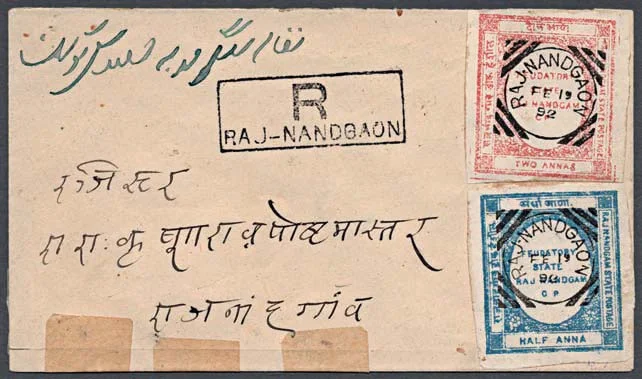
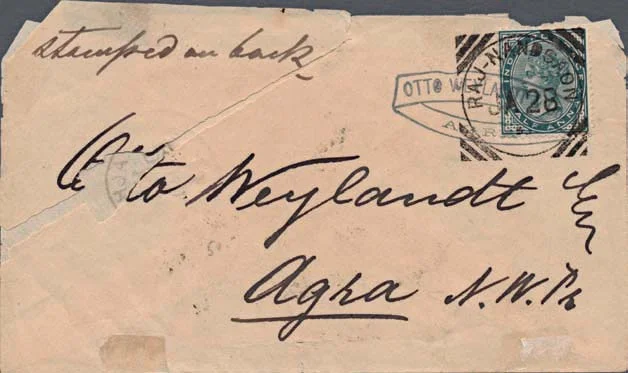
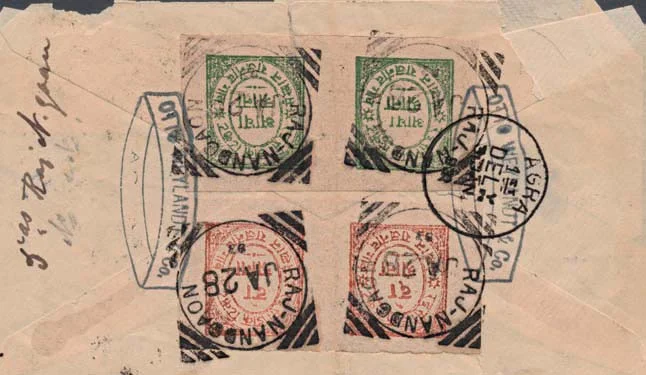
Two covers in Gärtner’s 17th auction show the stamps in use. The first is a registered cover dated 19 February 1892, earlier than any of the proposed operating dates; the second, to Agra in January 1893, carries a British Indian stamp on its face and four state stamps on its back. Neither tells us the local charge, or the status of every similar object.[5]
Sources
- [1] E. B. Evans, “The Stamps of some of the Native States of India: Raj Nandgaon”, Gibbons Stamp Weekly X: 24 July 1909, pp. 87–90; 14 August 1909, pp. 159–161; 11 September 1909, pp. 249–251.
- [2] Encyclopædia Britannica, 11th edition (1911), “Nandgaon”.
- [3] Evert Klaseboer, online catalogue, “Indian States, Nandgaon”, design values, MBD and reprint notes.
- [5] Christoph Gärtner, 17th auction, 7 March 2011, India and Indian States, Nandgaon lots 1415–1424, plates pp. 80–82.
- [7] Heinrich Köhler, 377th auction, Gems of Indian States, lot 10964, description p.175 and original photograph p.171; catalogue attribution SG O4.
- [8] Bhagwant Rai, Diwan of Raj Nandgaon, “The Stamps of Raj Nandgaon”, The Philatelic Journal of India II(6), June 1898, pp. 122–123.
- [9] The Philatelic Journal of India I(1), January 1897, “Notes and Extracts”, p. 15; reproducing Deputy Director-General of the Post Office letter to the Philatelic World, 8 December 1894.
- [10] Stanley Gibbons Monthly Journal I, 31 March 1891, “New Issues and Discoveries: Nandgaon”, pp. 212–213.
- [11] Stanley Gibbons Monthly Journal IV, 31 July 1893, “New Issues and Discoveries: Nandgaon”, pp. 5–6.
- [12] Stanley Gibbons Monthly Journal V, 31 August 1894, “New Issues and Discoveries: Nandgaon”, pp. 20.
- [13] Stanley Gibbons Monthly Journal III, 31 December 1892, “New Issues and Discoveries”, pp. 100.
- [14] Stanley Gibbons Monthly Journal VI, 30 April 1896, “New Issues and Discoveries”, pp. 171–172.
- [15] Peter Röver and H. Garratt-Adams, private correspondence and accompanying working notes on Nandgaon, 1985, India Study Circle accession 573.
- [16] E. B. Evans, “The Stamps of Raj Nandgaon”, The Philatelic Journal of India, March–June 1944, mastheads printing vol. XLIX, nos.3–6; an abridged reprint of Gibbons’ Stamp Weekly vol. X (1909).
- [17] E. A. de Brett, I.C.S., Political Agent, Central Provinces Gazetteers: Chhattisgarh Feudatory States (Bombay: Times Press, 1909).
- [18] J. Woodburn, Chief Commissioner, Report on the Administration of the Central Provinces for the Year 1894–95 (Nagpur: Secretariat Press, 1895).
Notes 0
Add what you know: a cover or stamp in your collection, a date or source, a correction or a question.
No notes yet.
Sign in to add a note.
Notes show straight away. Keep them kind and about the article; anyone can report one that isn't. House rules
