
1 April 1950: the Rajasthan Post Offices Join the Indian Posts and Telegraphs
The notices of March 1950 that closed the inherited State posts, the officials who signed them, savings banks, staff and accounts, the new Indian tariff, and what taxed covers of early April show.
Updated September 7, 2026
In this article
The order for 1 April 1950
The inherited State systems were ordered to close on 1 April 1950 and become part of the Indian Posts and Telegraphs. A first notice said Jaipur stamps and stationery would no longer be accepted and arranged for unused stocks to be exchanged. The surviving covers show that the change was neither instant nor uniform.[1]
A letter of 2 April with a ¾-anna Rajasthan-overprinted stamp was charged 2½ annas postage due. The study reads that as credit for the stamp against the 2-anna letter rate, leaving 1¼ annas short, charged double. A taxed cover has to be worked out arithmetically, not just labelled “invalid stamp”.[1]
Local rates still mattered
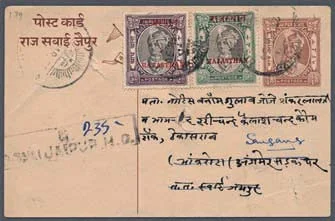
In the former Jaipur region the postcard rate had been ¼ anna and the basic letter ¾ anna since 1 January 1947. A card of 31 March 1950 franked with a Rajasthan-overprinted ¼ anna is recorded in the study; that rate belonged to that administration and date, not to all Rajasthan.[1]
The Indian schedule brought in at integration required ¾ anna for a postcard and 2 annas for a basic letter up to 1 tola. Whether an old stamp was still accepted and how much postage was needed are separate questions: a letter could carry an accepted stamp and still be underpaid because the rate had changed.[1]
The officials behind the postal notices
The reproduced Jaipur notices separate the date an order was signed, the date it was published and the date it took effect. Notice I was dated 16 March 1950; Notice II, signed by Superintendent Abdul Wahhab, was dated 17 March. Both were printed in the Rajasthan Gazette of 8 April, though the transfer was to take effect from 1 April.[1]
A later revalidation notice, on Gazette page 70, is signed by Girdharilal Narula, Superintendent of State Post Offices. It supersedes Notice I, accepts former Jaipur stamps until the end of April at Indian Guide rates, and extends exchanges to 31 July; its own date is not known. A separate notification for Bundi and Kishangarh, signed by B. S. Ranawat, Secretary in the Transport and Communication Department, closes their State offices and requires Indian stamps. Jaipur’s temporary acceptance does not apply to them.[1]
| Notice | Signed / published | Signatory | What it said |
|---|---|---|---|
| Notice I | 16 March / 8 April 1950 | Not assigned | Jaipur stamps, postcards and envelopes invalid from 1 April 1950; unused stocks exchangeable for Indian stamps until the end of April. Rajasthan Gazette vol. 2, no. 2, p. 41 |
| Notice II | 17 March / 8 April 1950 | Abdul Wahhab, Superintendent | Jaipur and other former State post offices transferred to the Indian Posts and Telegraphs from 1 April, under Indian rules; savings-bank accounts brought under Indian rules. Gazette vol. 2, no. 2, p. 41 |
| Revalidation notice | Date not known | Girdharilal Narula, Superintendent, State Post Offices | Supersedes Notice I; ex-Jaipur stamps accepted until the end of April at Indian Guide rates; exchange until 31 July 1950. Gazette p. 70 |
| Bundi and Kishangarh notification | Date not known | B. S. Ranawat, Secretary, Transport and Communication Department | Bundi and Kishangarh postal systems taken over from 1 April 1950; State offices closed; Indian stamps and posting boxes required. Gazette p. 279 |
The same Gazette page as the Bundi and Kishangarh notification carries a general notice on integration, on supplementary Indian postage for stationery and on exchange until 31 July; the specifically named notification is read on its own. The 4 April date sometimes given for revalidation is inferred by the specialists from postal use; it is not on the reproduced notice.[1]
Savings and staff
Notice II was about more than stamps. It brought savings-bank accounts at Rajasthan post offices under Indian rules and interest from 1 April. It gives 2 per cent a year for the qualifying category, subject to balance conditions including a Rs 200 minimum, and 1½ per cent for other accounts, with reference to rule 29 of the Indian Posts and Telegraphs Guide; not every account earned 2 per cent.[1][33]
The White Paper of 1950 sets out the general policy for staff on federal work: permanent staff were to be taken over in suitable grades on terms no less favourable, and temporary staff absorbed as far as possible. No Rajasthan postal staff list or headcount has been found. A parliamentary question of 4 July 1952 on the integration of post offices in Rajasthan is a further lead.[33][40]
Postal balances outlasted the transfer
Rajasthan’s Finance Accounts for 1951–52 and Audit Report of 1952 record a debit of Rs 5,07,345 for pre-integration postal drawings at the Jodhpur Treasury. Of this, Rs 3,96,895 had been refunded in 1950–51 but posted under the wrong head; the correction in the 1952–53 accounts left Rs 1,10,450. A separate entry records Rs 2,61,589 of unmatched remittance credits.[31]
These are balances between governments, not the post’s revenue, profit or traffic. The Accountant General’s office began on 1 October 1949, and its first consolidated account covered October 1949 to March 1950, including postal transactions. Financial consolidation and the postal takeover belong on different lines of the chronology.[31][32]
| Entry | Rupees | Meaning |
|---|---|---|
| Pre-integration postal drawings debit | 5,07,345 | Jodhpur Treasury and the D.A.G., P and T, Nagpur account |
| Refund in 1950–51 | 3,96,895 | Posted under the wrong head, later corrected |
| Balance after correction | 1,10,450 | Outstanding after the 1952–53 accounts |
| Unmatched credits | 2,61,589 | Treasury remittance reconciliation |
Read the postal geography, not just the place name
The Jaipur district of 1951 was not the old Jaipur State: its census handbook says the new district took in Kishangarh State, with the Kishangarh, Arain, Roopnagar and Sarwar tehsils. The new boundary cannot define the old Jaipur local-rate concession. The Imperial Gazetteer also records a Shahpura town inside Jaipur State, distinct from Shahpura State, and Kishangarh Renwal is not necessarily in the former Kishangarh State. A claim about a route or a concession needs the full address, the cancellation and the jurisdiction of the time.[36][37][1]
| Object | What it supports | What it does not prove |
|---|---|---|
| Quarter-anna Rajasthan card, Gangapur 31 March 1950 to Sri Madhopur 2 April | Posted before integration, delivered after | A new April tariff |
| Jhunjhunu 2 April to Niwai via Jaipur Raj RMS 4 April; quarter-anna stamp disregarded, 1½ annas due | A full double deficiency on the ¾-anna national postcard rate here | Uniform treatment by every office |
| Khetri 2 April to Kotputli 4/5 April; ¾-anna Rajasthan postage, 2½ annas due | Postage credited: twice the 1¼-anna shortfall from 2 annas | A policy matching the Jhunjhunu card |
| Jaipur 3 April to Kishangarh Renwal; half-anna card, pavanna note and nine pies Indian postage | The full national postcard rate added, no credit for the old stamp | Mail to the former Kishangarh State |
| Barwara 4 April to Ringas 5 April via Jaipur Raj RMS; quarter-anna card and two Indian three-pies stamps | The old stamp credited, making ¾ anna | The date of a revalidation order |
| Jaipur 5 April to Sawai Madhopur; Indian half-anna card, three pies and Jaipur Raj RMS IN/OUT marks | The ¾-anna national rate and sorting in transit | A full railway route or timetable |
Jaipur’s revalidation was a limited exception
Later notices allowed former Jaipur stamps until the end of April 1950 at Indian rates and extended the exchange of eligible stocks to 31 July. The study takes this to include stationery and uses covers to trace it in practice from about 4 April. A further notice expressly left out Bundi and Kishangarh. Integration, validity, the change of rate and the exchange deadline are four different dates or rules.[1]
Mixed franking after revalidation
A Barwara–Ringas postcard of 4 April shows the credit restored to Jaipur stationery: its quarter-anna stamp and two Indian 3-pies stamps make the ¾-anna national rate. The same total could be paid with an Indian half-anna card and a 3-pies stamp, as on a Jaipur–Sawai Madhopur card of 5 April. Another quarter-anna Jaipur card posted on 8 April was charged only half an anna due instead of the expected double deficiency, an odd charge that does not make a new rate; fully paid cards of 9–11 April still support the national rate.[1]
A manuscript charge can be an addition
A card of 9 April has enough postage for the national rate but also a red manuscript note of half an anna to pay. The study wonders whether it was added later, since there is no official postage-due mark. A believable handwritten charge must fit the stamps, the rate of the day and the processing marks.[1]
Sources
- [1] A. V. Kemmenoe, R. C. Batia and G. Porwal, “Local Delivery Rates in the Region of the Former Jaipur State (Part 1)”, India Post 203, vol. 51, April–June 2017, pp. 42–48.
- [31] Government of Rajasthan, Finance Accounts 1951–52 and the Audit Report 1952 (Jaipur: Government Press, 1953), p. 101 §73 and p. 107 §96.
- [32] Comptroller and Auditor General of India, History of the Office of the Principal Accountant General (A&E), Rajasthan, institutional history page.
- [33] Government of India, White Paper on Indian States (1950), Part IX, §§194, 197–199.
- [36] Pt. Yamuna Lal Dashora, Census of India 1951, Rajasthan and Ajmer, District Census Handbook, Jaipur, Part I, General Description and Census Tables (Bikaner: Government Press, 1954), p. viii, sections IV(h) and V.
- [37] Imperial Gazetteer of India, vol. XXII, Samadhiala to Singhana (Oxford: Clarendon Press, 1908), p. 227, Shahpura Town (2).
- [40] QUALIFIED DISCOVERY LEAD. Lok Sabha, 4 July 1952, starred question 1495, Integration of Post Offices in Rajasthan, Shri Balwant Sinha Mehta; reply by Deputy Minister of Communications Shri Raj Bahadur.
Notes 0
Add what you know: a cover or stamp in your collection, a date or source, a correction or a question.
No notes yet.
Sign in to add a note.
Notes show straight away. Keep them kind and about the article; anyone can report one that isn't. House rules
