
Rajasthan on Jaipur, Kishangarh and Shahpura: Old Stocks under a New Name
Jaipur stamps overprinted RAJASTHAN from 26 January 1950, Kishangarh arms and portraits handstamped in red and blue, the Shahpura postal-fiscal, the makers of the base stamps and the limits of each attribution.
Updated May 17, 2026
In this article
Jaipur: dated covers and the first-day problem
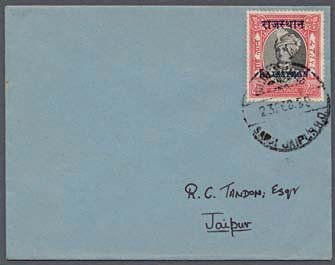
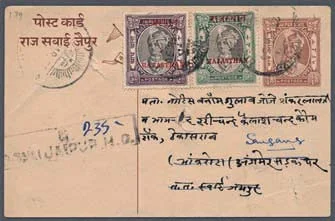
Jaipur’s Rajasthan-overprinted stamps were introduced on 26 January 1950, the date given in the specialist chronology citing Stanley Gibbons; no issue order has been seen. Unoverprinted Jaipur stamps and stationery still carried much of the former State’s internal mail, so seeing both together is to be expected, not a late-use oddity.[1]
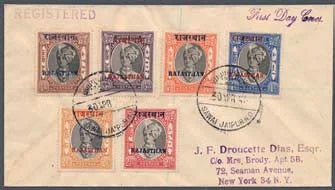
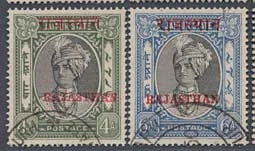
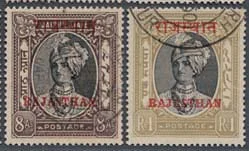
The six low values on an illustrated registered cover are cancelled 30 April 1950. The auction calls it a first-day cover, but the documented introduction was 26 January, so it is treated as a dated philatelic cover. The red Rajasthan inscriptions on the four, six and eight annas and one rupee can be compared with the low values. A used stamp shows a cancellation on that object, not commercial use or a rule for the whole union.[5]
Feldman describes the Jaipur overprint as bilingual and mostly red, blue on the quarter anna and blue-black or pale blue on the three-quarter anna. He traces the half-anna base to 1931 and the three late high values to 1946: dates of the base stock. Who printed the base and who applied the Rajasthan inscription are separate questions.[13]
Eleven Jaipur values in a notice of May 1950
The Philatelic Journal of India of May 1950 lists eleven Jaipur values with the Rajasthan addition: a quarter, half, three-quarter, one, two, two and a half, three, four, six and eight annas, and one rupee. It describes the old JAIPUR STATE inscription as covered by a row of vernacular characters. That confirms the range of values, not a day of issue.[23]
Base printing and overprint are two layers
An error in the base stamp is not an error in the union addition. Gärtner’s Jaipur two and a half annas and six annas with double frame printing should not be called double Rajasthan overprints, and a marginal block of ten is not a complete sheet of ten.[5]
Kishangarh: identify the stock beneath the handstamp
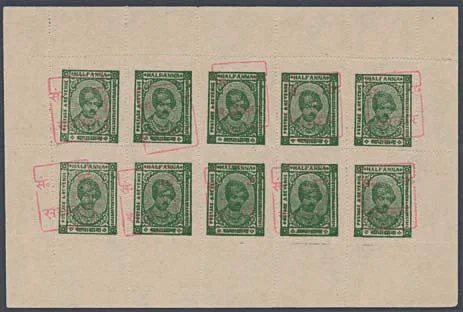
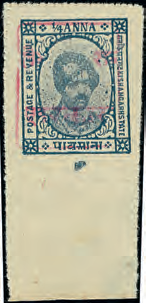
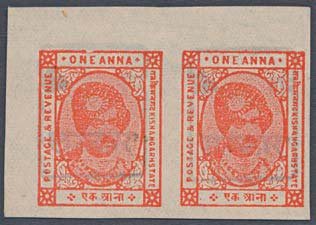
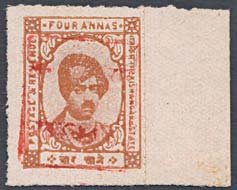
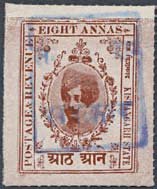
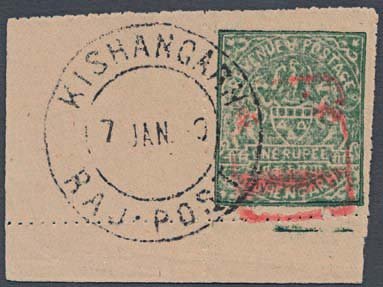
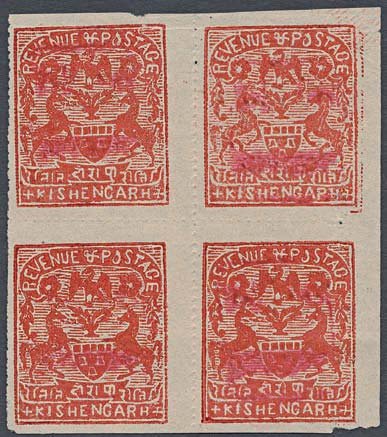
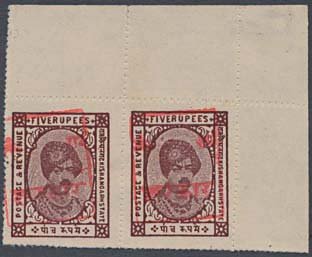
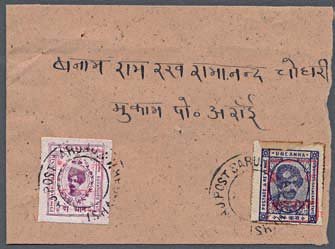
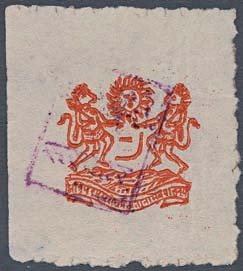
Rajasthan handstamps occur on several generations of Kishangarh designs and papers, so the arms and the later portraits have to be identified first. The one-rupee arms stamp on piece and the five-rupees portrait pair are different base families; sharing the Rajasthan name does not make them one printing. The blue handstamps on the one-anna pair and the eight annas, the red on other values and the sheet margins give material for comparison; the catalogue’s statements about smooth or soft paper, pin-perforation and shades remain its own until checked on the stamp.
Kishangarh descriptions distinguish pin-perforated and imperforate stamps, toned wove, thick smooth-surfaced and thick soft unsurfaced papers. These stay with the base and object they describe. The catalogue records an older two-annas purple portrait sheet of twenty and sheets of ten for some later paper groups; the Rajasthan mark did not turn these inherited stocks into a common union paper.[5]
The StampWorld crosswalk
StampWorld lists 22 ordinary Kishangarh-base combinations. Its 1950 headings are catalogue groupings, and its 1912–13, 1913–16 and 1945–47 dates identify the underlying designs; Feldman describes a wider span of base stocks, including an issue of 1899–1901.[14][13]
| Underlying design | Values | StampWorld nos. |
|---|---|---|
| Arms, 1899–1904 catalogue base | ½, 1 and 8 annas | 19–21 |
| Madan Singh, 1912–13 | 2 annas | 22 |
| Madan Singh, 1913–16 | ¼, ½, 1, 2, 4 and 8 annas, 1, 2 and 5 rupees | 23–31 |
| Jagjanarajan Singh, 1945–47 | ¼, ½, 1, 2, 4 and 8 annas, 1, 2 and 5 rupees | 32–40 |
Why nine values do not mean nine Kishangarh stamps
The research checklist summarises Kishangarh in nine value lines; it is not a count of stamps. StampWorld alone separates twenty-two combinations across the arms and two portrait generations, and specialist descriptions add earlier arms stocks and paper and separation varieties. A pictured one-rupee arms stamp cannot stand for both later one-rupee portraits. Catalogue references belong to the named source and edition or sale: a stamp unlisted in 2011 may not be unlisted today.[14][5][26]
Two catalogue-column problems are left unresolved: lot 1510 describes a quarter-anna and two-annas combination but prints references 16 and 19, and lot 1544 describes one anna but prints 62. Neither is used to make a new assignment.[5][25][19][16]
| Object | Base and value | Reference as printed | Note |
|---|---|---|---|
| Gärtner 1519 | Arms, 1899–1901; brown-lilac pin-perforated; 1 anna | SG 29b var | Red inverted handstamp, block of four |
| Gärtner 1520 | Arms, 1899–1901; brown pin-perforated; 4 annas | SG 30 | Used, red handstamp |
| Gärtner 1522 | Arms, 1899–1901; chestnut pin-perforated; 4 annas | SG 30 var | Shade called unlisted in 2011 |
| Gärtner 1523 | Arms, 1899–1901; brown-red pin-perforated; 2 rupees | SG 31a | Red block of four |
| Gärtner 1525 | Arms, 1901; dull-green toned wove pin-perforated; 1 rupee | SG 31 var (2011) | Later SG listing uses SG 32a for this base |
| Gärtner 1526 | Arms, 1904–10; blue; 1 anna | SG 33a | Red handstamp on piece |
| Gärtner 1527 | Arms, 1904–10; slate pin-perforated; 8 annas | SG 35 | Red pair |
| Gärtner 1529 | Portrait, 1915; purple; 2 annas | SG 43 | Complete sheet of twenty |
| Gärtner 1531 | Portrait, 1913–16; brown; 8 annas | SG 45 | Blue handstamp, unlisted in 2011 |
| Gärtner 1533 | Portrait, 1928–36; thick smooth yellow-green; ½ anna | SG 49 | |
| Gärtner 1534 | Portrait, 1928–36; magenta, thick smooth, pin-perforated; 2 annas | SG 49a | Not the 1915 two annas |
| Gärtner 1535 | Portrait, 1928–36; chestnut, thick smooth, pin-perforated; 4 annas | SG 50 | |
| Gärtner 1536 | Portrait, 1928–36; violet, thick smooth, pin-perforated; 8 annas | SG 51 | Complete sheet of ten |
| Gärtner 1537 | Portrait, 1928–36; lemon-yellow, thick smooth, pin-perforated; 2 rupees | SG 53 | Part sheet of eight |
| Gärtner 1538 | Portrait, 1943–47; deep green, thick soft; ½ anna | SG 57 | Complete sheet of ten |
| Gärtner 1539 | Portrait, 1943–47; yellow-green; ½ anna | SG 57b | A colour and paper variant |
| Gärtner 1540 | Portrait, 1943–47; yellow-green; ½ anna | SG 57bb | Blue handstamp |
| Gärtner 1541 | Portrait, 1943–47; carmine-red; 1 anna | SG 58 | On piece, Arain cancellation |
| Gärtner 1542 | Portrait, 1943–47; orange-red imperforate; 1 anna | SG 58ba | Blue handstamp pair |
| Gärtner 1543 | Portrait, 1943–47; brown; 4 annas | SG 61 | Complete sheet of ten |
| Gärtner 1545 | Portrait, 1943–47; green; 1 rupee | SG 63 | Complete sheet of ten |
| Gärtner 1546 | Portrait, 1943–47; claret; 5 rupees | SG 65 | Corner pair |
| Gärtner 1547 | Portrait, 1943–47; deep violet-blue, thick soft unsurfaced, pin-perforated; 1 anna | Note after SG 65 (2011) | Red handstamp |
Old stocks, uncertain trials and cut-outs
The Kishangarh overprints used much more than one current portrait set: Stoney and Congreve were already listing older arms and portrait stamps in 1949. Stoney described a half anna on diagonally laid paper that he thought had been cut from a postal envelope, a suspicion about that stamp, not every half anna. The catalogue later describes six half-anna envelope cut-outs handstamped Rajasthan and used as stamps on a local cover, which is different from a new Rajasthan stationery stamp or a whole envelope.[21][22][5]
Stoney also saw a pair in a colour belonging to another old catalogue number and suggested a colour trial from cleared Treasury stock, without establishing a new colour error. Both writers warned about conspicuous inverted, doubled and sideways additions; their warnings show concern about varieties made for collectors, without condemning every surviving stamp. Record the base stamp, the handstamp, the ink, separation, paper and postal evidence.[21][22][5]
Postal-fiscals and revenue-only material
The Shahpura one-anna arms stamp with a violet Rajasthan handstamp is a postal-fiscal, kept apart from the portrait issues of the other States; its design differs from the typographed RAJ SHAHPURA stamps, and its postal use needs evidence on the object. A Rajasthan overprint on a revenue stamp does not prove postal use: the same auction has a Dungarpur fiscal sheet with punch cancellations, which is not a postage issue.[3][5]
The makers beneath the overprint
A contemporary account by A. MacAlpine-Blair names H. W. Barr as designer of Jaipur’s investiture set of 14 March 1931, twelve stamps, and the Government of India Security Press at Nasik as its printer, on unwatermarked paper. That belongs to the 1931 set. It does not make Barr the designer of every later portrait, or show that Nasik added RAJASTHAN to the old stocks.[27]
Kishangarh offers a different kind of evidence: a photographed quarter-anna portrait sheet carries the imprint DIAMOND SOAP WORKS, K. S. G. Gärtner catalogued it as the first printing of the 1913–16 group, twenty stamps in two panes of ten, and Köhler’s catalogue of 2021 describes a printer’s sample card. The imprint names an establishment on an inherited base sheet; neither object shows who cut or applied the Rajasthan device.[5][8]
Gärtner’s lot 1347 shows enlarged Kishangarh portrait composites, some frames with empty centres and a photographic portrait in a two-annas design, catalogued as material for photographic reduction. They belong to the base design, as does the sample card; neither is a union proof. No artist’s essay or die proof for the Rajasthan overprint has been found.[5][8][22]
| Person or institution | Role | Not established |
|---|---|---|
| H. W. Barr | Designer of Jaipur’s 1931 investiture set | No Rajasthan overprint credit; not all 1932–1946 portraits |
| Government of India Security Press, Nasik | Printer of the 1931 investiture set | Not the printer of the Rajasthan inscription |
| Diamond Soap Works, K. S. G. | Named in the imprint of an early Kishangarh quarter-anna portrait sheet | Not a Rajasthan handstamp maker; not every Kishangarh base |
| Times of India Press, Bombay | Printer of the Bundi 1947 base set (later study) | Not a named Rajasthan overprinter |
| Unidentified makers | Designing and cutting the devices, setting the formes, applying the handstamps | Not to be filled from base makers, rulers or officials |
| P. Congreve | Investigated the Bundi black sheets and Kishangarh handstamps, December 1949 | Not a maker |
| R. F. Stoney | Described the handstamps in 1949 | Not a maker |
| A. N. Atal | Reported Finance Member of the Jaipur Council; correspondence on the 1931 stamps | A lead from a handwritten card only |
| Bhupal Singh and Sawai Man Singh II | Constitutional heads; Man Singh is on the Jaipur portraits | No design or commissioning role |
| B. S. Ranawat | Signed the Bundi and Kishangarh closing notice | Not a printer |
| Abdul Wahhab | Superintendent; signed Notice II, 17 March 1950 | Not a designer or printer |
| Girdharilal Narula | Superintendent, State Post Offices; signed the revalidation notice | No maker role |
Sources
- [1] A. V. Kemmenoe, R. C. Batia and G. Porwal, “Local Delivery Rates in the Region of the Former Jaipur State (Part 1)”, India Post 203, vol. 51, April–June 2017, pp. 42–48.
- [3] Sandeep Jaiswal, “Shahpura—A newly discovered stamp issuing Indian Princely State”, exhibit, Shahpura postal-fiscal Rajasthan handstamp listing.
- [5] Christoph Gärtner, 17th auction, 7 March 2011, Rajasthan lots 1486–1551.
- [8] Heinrich Köhler, Gems of Indian States 1864–1950, 377th auction, 21 September 2021, lot 11093.
- [11] Government of India, White Paper on Indian States (1950), §§134–138.
- [13] David Feldman, Indian Princely States (2017).
- [14] StampWorld, Rajasthan ordinary listing, entries 1–40.
- [16] Universal Philatelic Auctions, sale 56. Lots 20509–20510.
- [19] Universal Philatelic Auctions, sale 84.
- [20] R. F. Stoney, “Rajasthan Overprints”, The Philatelic Journal of India LIII, July–August 1949, p. 62.
- [21] R. F. Stoney, “Rajasthan Overprints”, The Philatelic Journal of India LIII, November 1949, p. 101.
- [22] R. F. Stoney, “The Rajasthan Overprints”, The Philatelic Journal of India LIII, December 1949, p. 111.
- [23] “New Issues”, The Philatelic Journal of India LIV no. 5, May 1950, p. 75.
- [25] Universal Philatelic Auctions, sale67, lot 12288.
- [26] Stanley Gibbons, stock P234003002, Rajasthan SG 32a, Kishangarh 1r on toned wove.
- [27] A. MacAlpine-Blair, “The Maharajah of Jaipur”, The Stamp Lover, vol. XXIV, January 1932, pp. 222–223.
- [29] Bundi production study, citing Gibbons Stamp Monthly, November 2008.
- [39] Handwritten excerpt card, “Jaipur investiture stamps”, citing the Philatelic Journal of India, May 1931, p. 54.
Notes 0
Add what you know: a cover or stamp in your collection, a date or source, a correction or a question.
No notes yet.
Sign in to add a note.
Notes show straight away. Keep them kind and about the article; anyone can report one that isn't. House rules
