
Portuguese India 1938: Airmail, Navigators and Colonial Issues
Separate the airmail stamps, the navigator pictorials and the colonial commemorations before reading a route or a franking.
Updated October 19, 2026
In this article
1938 holds several subjects
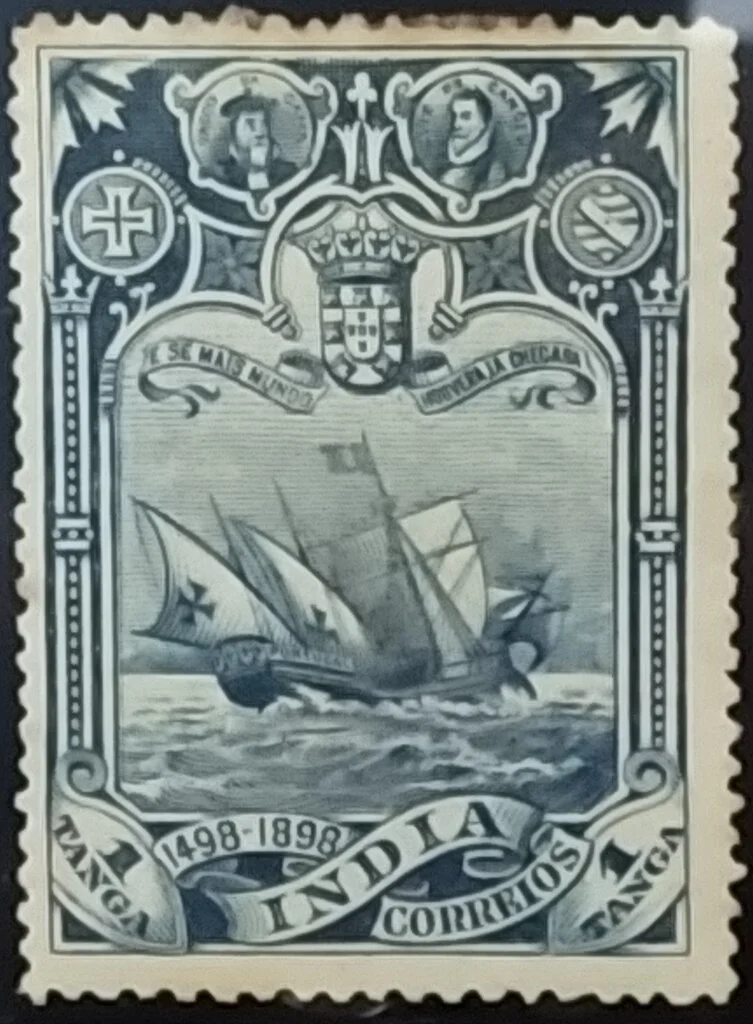
The programme of the late 1930s is not one uniform set. It includes historical and navigator pictures, a colonial commemoration and a separate airmail family. A catalogue page may put them side by side because of their date, while their postal jobs and designs differ.[1][2][3]
Start with the actual inscription, value and design. A ship or an explorer points to the historical pictorials; airmail wording points to the airmail family. A stamp’s place on a modern album page helps arrangement, but does not decide what service a cover received.[1][2][3]
Historical figures in a colonial programme
Towler describes the larger pictorial programme that followed the definitive of 1933 and names Mousinho de Albuquerque among the historical figures shown. Such subjects are part of the administration’s presentation of history, not necessarily scenes from Portuguese India.[1][2]
A colonial omnibus can use related designs in several territories. The territorial wording and local value identify the Portuguese India stamp, so do not take a catalogue number from another colony because the person pictured is the same; record both the shared subject and the local details.[1][2]
An airmail design is not proof of flight
An airmail stamp shows that it was made for the airmail programme. That a letter actually flew needs its endorsement, date, office of posting and evidence of route; a loose used airmail stamp has lost most of what would identify a flight.[3][2]
On a flown cover, separate the ordinary postage from the air fee where the rules are known. Do not work back from an attractive value to an assumed route: an aeroplane design and an airmail label are worth noting, but neither proves the whole journey or the exact fee.[3][2]
The outside network mattered
Portuguese Indian letters could depend on connections outside the territory. A study of airmail has to separate local acceptance from the outside airline or postal service that carried it on. A cover may record several administrations without bearing a stamp of every one that handled the bags.[4][5]
Transit and arrival marks can support a reading, but a missing mark does not prove a route impossible. A detailed table of connections would need dated schedules or postal notices; no invented timetable is offered in their place.[4][5]
Describing an airmail cover
Record the whole front and back, all stamps, written directions, air labels and any registration or due marks. Copy office names as struck, and tell a routing instruction from proof that it was followed. Keep any contents that give the sender’s date and purpose.[6][4]
Then compare the posting with a dated service rule and an identified route. A special-event envelope, a first-flight souvenir and an ordinary business airmail letter can all be genuine while answering different questions; say which each is, rather than ranking them by unexplained rarity.[6][4]
What the issue list can show
The catalogue and album families show that the different programmes of 1938 should be kept apart, and give a starting point for designs and values. They are not a catalogue of flight dates, air fees, interrupted services or transit marks.[2][3]
Attach each new find to the question it answers: a photographed stamp illustrates a design, a cover proves a dated use, a regulation proves an authorised charge. Keeping those kinds of evidence apart lets this section grow without turning a partial history of the service into a falsely complete one.[2][3]
Sources
- [1] Bernard Towler, “Forgotten Countries: Portuguese India”, originally The Stamp Lover, reprinted in IND DAK, July–August 2001, pp. 103–104.
- [2] StampWorld, Portuguese India, postage 1930–1939.
- [3] William E. Steiner, Portuguese India album pages (46-page PDF).
- [4] M. A. Nayeem, “Portuguese India, British India and Hyderabad Combination Cover”, The Philatelist, August 1964, pp. 263–264.
- [5] Royal Philatelic Society London, publisher’s description of Luís and Eduardo Barreiros, Portuguese India: Postal History and the First Issues—From the “natives” to 1900 (2022), ISBN 978-1-913015-18-3.
- [6] “Cancellations of British & Portuguese India”, undated collection mounts nos. 1, 8 and 9.
Notes 0
Add what you know: a cover or stamp in your collection, a date or source, a correction or a question.
No notes yet.
Sign in to add a note.
Notes show straight away. Keep them kind and about the article; anyone can report one that isn't. House rules
