
Portuguese India in the 1940s and 1950s: Portraits, Forts and Maps
Later issues showed historical people, religion, philately and territorial claims, while older picture stocks went on receiving new values.
Updated September 8, 2026
In this article
The postwar portraits
The programmes of 1946 and 1948 brought historical personalities into the stamp sequence; Towler names St Francis Xavier among the recurring subjects. These commemorations belong to the postwar supply, even though the people pictured lived centuries earlier.[1][2]
A biographical caption and a postal caption answer different questions. The design shows the subject the administration chose; a dated letter shows when and where a stamp was used. Do not let a familiar saint or navigator date a loose stamp without checking its inscriptions, value and design family.[1][2]
Religious issues with similar names
The early 1950s include more than one Holy Year programme and further religious commemorations. The tercentenary of José Vaz’s birth and the anniversary of Francis Xavier’s death are separate subjects, and a short album label such as “religion” can hide which event, issue and values you are collecting.[3][1]
Use the full name of the commemoration in the record and keep it apart from the date of a cancellation. A reused picture or a related subject does not make two sets one issue. The catalogue’s broad chronology helps find the groups; a first-day date needs the individual entry or an announcement of the time.[3][1]
Philately on stamps
The first stamp exhibition of 1952 made collecting itself a subject. A first-day cover from such an event can be a genuine postal item and a deliberate philatelic product at once; say so, rather than either dismissing it or assuming ordinary business use.[1][2]
Keep the stamp issue, the exhibition marking and the printed envelope apart. A cachet printed by a collector or dealer is not an official marking, and a cancellation proves the item was handled without proving every printed statement on the envelope.[1][2]
A map stamp can record a claim
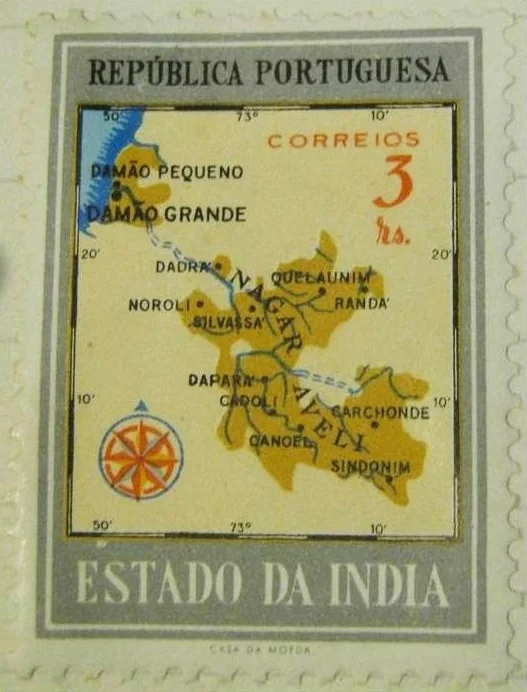
The map stamp of 1957 shown here names Daman, Dadra and Nagar Haveli. Coming after the political change in the inland enclaves in 1954, it is revealing: it records how the issuer presented its territory, not that Portugal was running all the places shown when the stamp was on sale.[4][1]
Read the map as a dated image. Its place-names are useful, but compare them with the territory’s political chronology before turning them into a map of post offices. A design can express a claim, a commemoration or a view of history rather than a neutral survey of who controlled what.[4][1]
New values on earlier pictures
The 1940s and 1950s did not replace every old definitive at once. The sequence includes new values on earlier picture stocks, among them the families of 1933 and 1938, so a later surcharge needs both the printed design and the new value identified.[2][5]
Separate an overprint that changes authority from one that changes value or function. A surcharged pictorial is not a new commemorative because it appears in a later year; it may simply be old stock being used up. A dated counter report or an official notice is needed before giving each operation a reason.[2][5]
The last regular issues and what came after
The coin set of 1959 and the 3-escudo Henry the Navigator stamp of 25 June 1960 close the regular sequence in Towler’s survey. The coin designs are in the new currency while picturing older money; the Henry stamp marks five hundred years since his death, a different event from the earlier da Gama anniversaries.[1][6]
These stamps had a later life. The reported INDIA 15 nP proposals used the coin and Henry stamps as their base but, according to the report of 1990, were never issued. They belong with the transfer, marked as unissued, not among the regular stamps of Portuguese India because genuine old designs lie underneath.[1][6]
Sources
- [1] Bernard Towler, “Forgotten Countries: Portuguese India”, originally The Stamp Lover, reprinted in IND DAK, July–August 2001, pp. 103–104.
- [2] William E. Steiner, Portuguese India album pages (46-page PDF).
- [3] StampWorld, Portuguese India, postage 1950–1959.
- [4] Administration of Dadra and Nagar Haveli and Daman and Diu, “About UT Administration”, historical section.
- [5] “Portuguese India”, journal report of 3 April 1959, p. 235, from Dr W. Alexander-Katz of Lisbon.
- [6] “Indian Discovery”, Gibbons Stamp Monthly, February 1990: report of Pradip Jain’s study of the unissued INDIA 15 nP surcharges.
- [7] Portuguese India 3-réis territorial-map stamp, 1957. Via Wikimedia Commons; public domain.
Notes 0
Add what you know: a cover or stamp in your collection, a date or source, a correction or a question.
No notes yet.
Sign in to add a note.
Notes show straight away. Keep them kind and about the article; anyone can report one that isn't. House rules
