
Portuguese India 1959: Decimal Currency, Local Surcharges and the Coin Series
The decree of 1958, the change at the counter in 1959 and the stamps actually reported on sale are three different things.
Updated August 21, 2026
In this article
Two dates, two acts
A reform of 1958 and a stamp of 1959 can belong to the same monetary change. The history of the Banco Nacional Ultramarino names decree 41.680 of 16 June 1958, while a philatelic report of the time gives the new currency in use from 1 January 1959. Making the law and putting it into effect at a post office counter are different events.[1][2]
This matters when dating a surcharge. A catalogue may group stamps by the year they appeared without mentioning the earlier reform, and the date of a decree does not mean every new-value stamp was on sale that day. Keep the act, the supply and the recorded postal use in separate fields.[1][2]
Old and new units
The old system had twelve réis to a tanga and sixteen tangas to a rupia. The conversion reported in 1959 was six escudos to one rupia, with a hundred centavos to the escudo. The same figure can therefore mean very different amounts on related designs.[2]
Name the unit at every step of a calculation. One old rupia is 192 réis, and its value after the reform is six escudos, not one decimal unit with a similar name. When writing down a cover, keep the printed and added wording before converting the total for comparison.[2]
| Relationship | Equivalent |
|---|---|
| 12 réis | 1 tanga |
| 16 tangas | 1 rupia |
| 1 rupia | 6 escudos |
| 100 centavos | 1 escudo |
A sales report with a defined scope
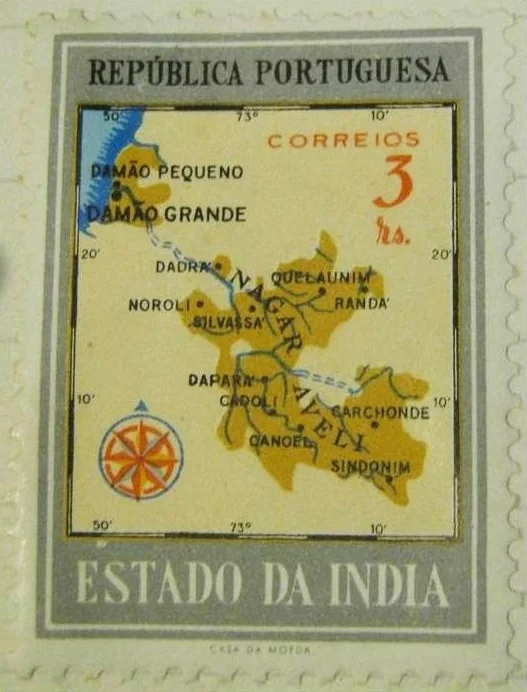
Information from Dr W. Alexander-Katz, published on 3 April 1959, reported local decimal surcharges on the earlier settlements, arms and map designs. The report says plainly that official information was hard to obtain, so its list of values at Nova Goa is a valuable observation of the time, not a complete list of what was authorised.[2]
That can explain why a later catalogue has entries the report lacks: a stamp may have been supplied elsewhere, later or in quantities the correspondent did not see. Absence from one counter list does not prove a stamp was not issued, and the date of the report is not the first day of a listed value.[2]
Read decimal figures as money
Figures such as 0.05, 0.80 and 1.50 on the new-value stamps are escudos and centavos, not old réis printed with decorative points. Record the original stamp and the added amount together, and say which value the altered stamp carried.[2][3]
Compare the values the stamps actually had, not the original printed figures. Two different old stamps can end up with the same decimal value, while similar-looking surcharges can differ a great deal in money. Colour and design identify the base; the full figure and unit give the intended new value.[2][3]
Twenty values picturing older money
The coin series of 1959 has twenty values. Its historical coins and its face values belong to different monetary histories: an old coin in the picture does not make the stamp payable in that coin’s units. Read the value tablet on its own, apart from the picture.[3][4]
The list of values is useful for an inventory; it does not establish the paper, shade or cancellation of a particular stamp.[3][4]
| Unit | Values |
|---|---|
| Centavos | 5, 10, 15, 30, 40, 50, 60, 80 |
| Escudos | 1, 1.50, 2, 2.50, 3, 4, 4.40, 5, 10, 20, 30, 50 |
What a cover of the reform period can prove
On a dated cover of 1959, tell old stamps used at their old value from stamps with authorised decimal surcharges. Adding them up needs the conversion and the postal rule in force; an old design on a cover does not tell you how it was then counted.[2][3]
Keep the whole charge, including any due or tax. A counter report, a catalogue and an actual cover each give different evidence; carefully combined they explain supply and use, but none of them replaces the validity notice or the full tariff, which are still to be found.[2][3]
Sources
- [1] Mónica Ferreirinha, history of the Banco Nacional Ultramarino, December 2009, section 9.2.2, p. 113: decree-law 41.680 of 16 June 1958.
- [2] “Portuguese India”, journal report of 3 April 1959, p. 235, from Dr W. Alexander-Katz of Lisbon.
- [3] William E. Steiner, Portuguese India album pages (46-page PDF).
- [4] Bernard Towler, “Forgotten Countries: Portuguese India”, originally The Stamp Lover, reprinted in IND DAK, July–August 2001, pp. 103–104.
Notes 0
Add what you know: a cover or stamp in your collection, a date or source, a correction or a question.
No notes yet.
Sign in to add a note.
Notes show straight away. Keep them kind and about the article; anyone can report one that isn't. House rules
