
Portuguese India 1961–1975: Transfer, Postal Succession and the Unissued INDIA Stamps
The political transfer, the old postal material that survived it and the proposals that were never issued each need their own chronology.
Updated May 4, 2026
In this article
The inland enclaves changed first
Dadra and Nagar Haveli changed hands in 1954, before Portuguese rule ended in Goa, Daman and Diu in December 1961. A collection arranged under one final year can hide that difference, so where a letter actually came from is essential to its political and postal setting.[1][2]
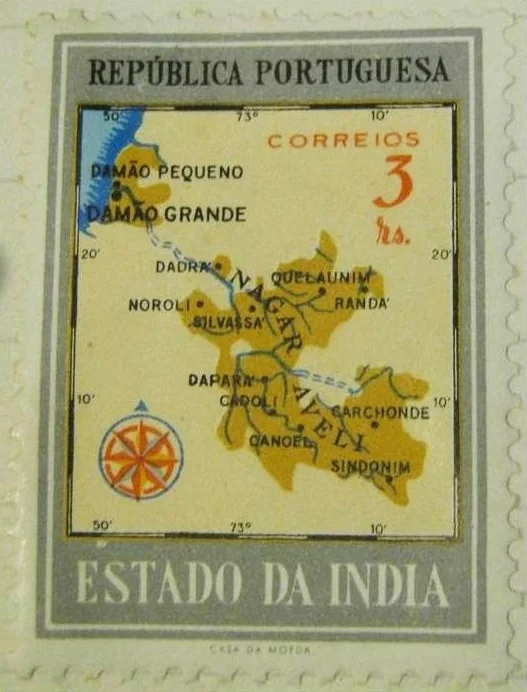
The map stamp of 1957 is a clear warning: it shows places whose government had already changed. A printed map is evidence of how the issuer presented its territory, not proof of continuing control. Compare map, cancellation and political chronology instead of letting one answer the others’ questions.[1][2]
The coastal transfer and the post
December 1961 brought the remaining coastal territories under Indian administration. Towler reports that Portuguese Indian stamps had stopped being used by January 1962. An exact last day of validity, though, needs the postal notice or other primary evidence; the political event alone does not fix it.[2][3]
Unused stock, stationery and old cancelling devices could outlast a change of government. Their later presence does not prove that every old value stayed valid. A sound study of the transition shows what was reused, with what postage and on what date, instead of treating every surviving Portuguese item as continuing Portuguese postal authority.[2][3]
A card that separates paper from postage
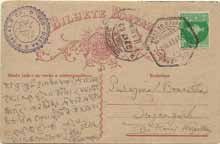
The Lusíadas card shown here is catalogued with an Indian 15-naye-paise stamp, sent from Vasco da Gama on 25 February 1962. It uses the old stationery as paper while paying with a stamp of the new administration, which says more than assuming the old and new printed amounts were added together.[3]
The caption follows the auction description; the other side is not shown. The card’s value is the dated combination it records. It does not show that the old Portuguese impression was still valid, or that every surviving colonial card could be used in the same way.[3]
INDIA 15 nP: a report of unissued stamps
Gibbons Stamp Monthly of February 1990 describes Pradip Jain’s examination of a folder bearing the Asokan Capital, with a title naming ex-Portuguese stamps overprinted INDIA and an Indian value of fifteen naye paise. It describes the twenty-value coin set of 1959 and the 3-escudo Henry stamp treated in this way.[4]
The report says outright that the stamps were never issued. Its account of stock being sent to Nasik is qualified in the original and is not treated here as a government production order. A genuine old stamp underneath and an official-looking folder do not settle the status of the added printing.[4]
Keep the reported versions apart
The coin proposals are described with a black 15 nP overprint; the Henry stamp in black, red and purple. These distinctions come from the report; they are not extra issued values or evidence of use in any town. The value itself belongs to the Indian currency after the transfer.[4]
An album can show this material in a clearly marked unissued section and explain the attempt to reuse old stock. It should not invent a first day, a quantity or a release story. A commercial cancellation added later, or a sale description, would not prove that a proposal ever entered the authorised postal supply.[4]
The treaty came much later
Portugal and India signed the recognition treaty on 31 December 1974, and it came into force on 3 June 1975. These diplomatic dates are separate from the transfer of 1961 and the changes in postage that followed; the treaty concerns sovereignty and related matters, not stamps.[5][6]
A clear chronology keeps several tracks: the change of territory, recorded postal use, surviving equipment and stationery, the unissued adaptations and diplomatic recognition. They can be read together without forcing everything to end on one date, or letting later recognition alter the evidence preserved on a card of 1962.[5][6]
Sources
- [1] Administration of Dadra and Nagar Haveli and Daman and Diu, “About UT Administration”, historical section.
- [2] Bernard Towler, “Forgotten Countries: Portuguese India”, originally The Stamp Lover, reprinted in IND DAK, July–August 2001, pp. 103–104.
- [3] Clube Filatélico de Portugal, auction catalogue 31, p. 32, lots 461–472.
- [4] “Indian Discovery”, Gibbons Stamp Monthly, February 1990: report of Pradip Jain’s study of the unissued INDIA 15 nP surcharges.
- [5] United Nations Treaty Series, vol. 982, No. 14321: treaty of 31 December 1974 recognising Indian sovereignty over Goa, Daman, Diu, Dadra and Nagar Haveli, p. 159; in force 3 June 1975.
- [6] Ministry of External Affairs, Government of India, Portugal—Bilateral Brief, 23 November 2022.
- [7] Portuguese India 3-réis territorial-map stamp, 1957. Via Wikimedia Commons; public domain.
Notes 0
Add what you know: a cover or stamp in your collection, a date or source, a correction or a question.
No notes yet.
Sign in to add a note.
Notes show straight away. Keep them kind and about the article; anyone can report one that isn't. House rules
