
About this stamp
The Jewel of the Solar System
Saturn, the sixth planet from the Sun, stands out as one of the most captivating celestial bodies in our Solar System. Known as the “Ringed Planet”, Saturn’s spectacular ring system makes it one of the most easily recognizable and visually stunning planets in the night sky. Second in size only to Jupiter, Saturn is a gas giant with an enormous yet graceful presence, embodying both strength and beauty in the cosmos.
Composition and Structure
Saturn is composed primarily of hydrogen and helium, with traces of methane, ammonia, and water vapor. Beneath its outer gaseous layers lies a core of iron-nickel and rocky materials, surrounded by a deep layer of metallic hydrogen and liquid helium. Despite its massive size—over 95 times the mass of Earth—Saturn has a remarkably low density, even less than that of water. This means that, if there were a vast ocean large enough, Saturn would float!
The planet’s average density and unique composition make it one of the most studied bodies in the Solar System, offering key insights into planetary formation and gas giant dynamics.
Orbit and Rotation
Saturn completes one revolution around the Sun in about 29.5 Earth years, taking 10,759 Earth days to complete its orbit. Despite this long journey, it rotates very rapidly, spinning once on its axis every 10.7 hours. This rapid rotation contributes to Saturn’s slightly flattened shape at the poles and bulging at the equator.
Rings and Moons
What makes Saturn truly enchanting is its magnificent ring system — a series of ice and rock particles that encircle the planet in a dazzling display. These rings vary in thickness and composition, and the Cassini Division — a dark gap between the rings — is one of its most striking features.
Saturn also has a large family of moons, with Titan being the largest and most intriguing. Titan’s thick atmosphere and liquid hydrocarbon lakes make it one of the most Earth-like worlds in the Solar System and a prime target for scientific exploration.
Philatelic Tribute to Saturn
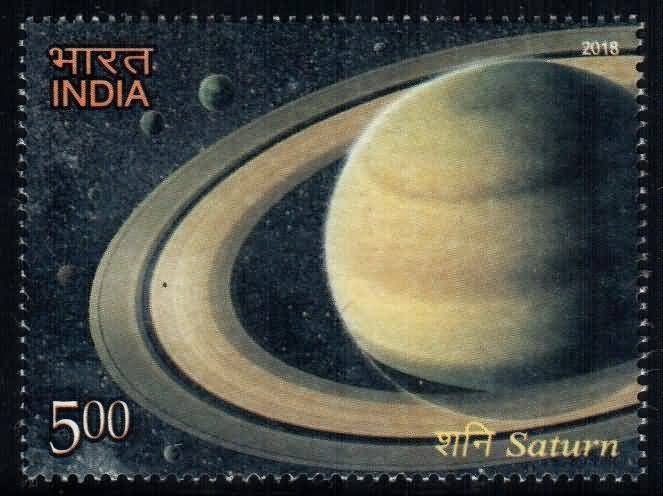
In honor of the planet’s awe-inspiring grandeur, the Department of Posts issued a commemorative postage stamp on Saturn as part of its Solar System series. The stamp artistically captures the planet’s golden hue and iconic rings, celebrating Saturn as a symbol of cosmic beauty, mystery, and scientific curiosity.
This philatelic issue pays tribute to humanity’s unending fascination with the stars — a reminder of our place in the vast universe and the timeless allure of the ringed giant, Saturn.


